
A toll-free number is not automatically better than a local number for business texting: choose toll-free for a single, non-geographic business identity and local for a geographic presence or an established customer-facing number. Neither option guarantees message delivery, and both require the appropriate business messaging setup. Before changing numbers, confirm texting eligibility, registration requirements, and who will answer incoming replies.
- Is a toll free number better than a local number for texting? No—choose based on customer recognition and coverage.
- Local numbers suit businesses serving a defined area, especially when customers already know the number.
- Toll-free numbers suit businesses that want one non-geographic contact number across locations.
- VirtualPBX business texting suits small teams seeking SMS and webchat in a shared inbox through VirtualText.
- Registration, customer consent, and reply handling matter more than the number prefix alone.
Is a toll-free number better than a local number for texting?
Toll-free wins for a centralized, non-geographic identity; local wins for continuity and geographic identity. Neither is the universal winner for customer service, appointment reminders, or lead follow-up in 2026.
If customers already call your business number, first investigate whether one phone number can handle both calls and texts. Adding texting to a suitable existing number avoids asking customers to remember a separate contact.
| Decision factor | Local number | Toll-free number |
|---|---|---|
| Best for | A defined service area or an established local contact | A centralized contact across regions or locations |
| Geographic identity | Uses a geographic area code | Uses a toll-free prefix rather than a local area code |
| Main advantage | Keeps a familiar local number when eligible | Provides a non-geographic business contact |
| Main limitation | A single area code does not represent every market | Does not communicate a specific local service area |
| Business messaging setup | U.S. application-to-person messaging uses the applicable local-number registration process | Uses toll-free messaging verification |
| Delivery guarantee | None from the number type alone | None from the number type alone |
| Customer replies | Require a text-enabled number and an inbox | Require a text-enabled number and an inbox |
Why this matters
Your customers need a recognizable way to reach you. Your team needs a reliable place to receive the reply.
Choosing a prefix does not solve either task by itself. A familiar number with an unattended inbox still leaves a customer waiting, while a new number needs a clear introduction so recipients know who is contacting them.
Separate the decision into identity, messaging approval, and response ownership. That keeps a number change from becoming a substitute for fixing the actual service problem.
Local numbers: best for geographic identity and continuity
Choose a local number when your service area is part of your business identity. A plumbing company serving a defined region, for example, has a practical reason to keep its established local contact number.
A U.S. local number has a 3-digit area code followed by a 7-digit subscriber number. The area code identifies a numbering region; it does not prove that the business currently operates there.
The strongest reason to keep a local number is continuity, not an unsupported promise that customers will answer more often. If the number already appears on invoices, appointment cards, vehicles, and customer contact lists, replacing it creates changes you must manage.
Keep your established local number when it supports your service identity and qualifies for the texting setup you need. Ask the provider to confirm eligibility before announcing that customers can text it.
The trade-off is geographic emphasis. A business expanding into several regions must decide whether its original area code still fits the contact experience it wants to present.
Toll-free numbers: best for a centralized business identity
Choose a toll-free number when you want customers in different regions to use the same non-geographic contact. It suits a centralized service desk or a business that does not want its main contact tied to one local area code.
A toll-free number such as one beginning with 800 is also a 10-digit number in the North American numbering system. Its prefix distinguishes the numbering category; it does not certify the sender or guarantee that a text will reach its destination.
The practical advantage is consistency. You can publish one contact number across your customer materials rather than selecting a local area code to represent the whole business.
The limitation is the loss of a local geographic cue. A toll-free prefix alone does not tell a customer which branch serves them, so your opening message should identify the business and, where relevant, the location.
Choose toll-free for a centralized identity, not as a shortcut around verification, consent, or message filtering. Those responsibilities remain part of business texting in 2026.
Why the better texting number varies
Your existing contact habits and service model determine the better choice. Use these factors rather than treating either prefix as a performance claim:
- Customer recognition: Keep a familiar number when it remains suitable. Introduce any new texting number through channels customers already use.
- Geographic coverage: A local area code supports a regional identity. A toll-free number avoids choosing one region to represent a broader business.
- Existing number eligibility: Confirm that the number can support the required messaging service. Voice service alone does not establish texting capability.
- Registration route: Local application-to-person messaging and toll-free messaging use different approval processes. Ask which requirements apply before launch.
- Team ownership: Decide who receives replies, handles requests, and covers absences. The number prefix does not assign the work.
- Published contact details: Review your website, forms, invoices, and customer records before switching. A new number creates updates beyond the messaging platform.
These factors also expose when no number change is necessary. If customers recognize your contact number but messages sit unanswered, fix inbox ownership before replacing the number.
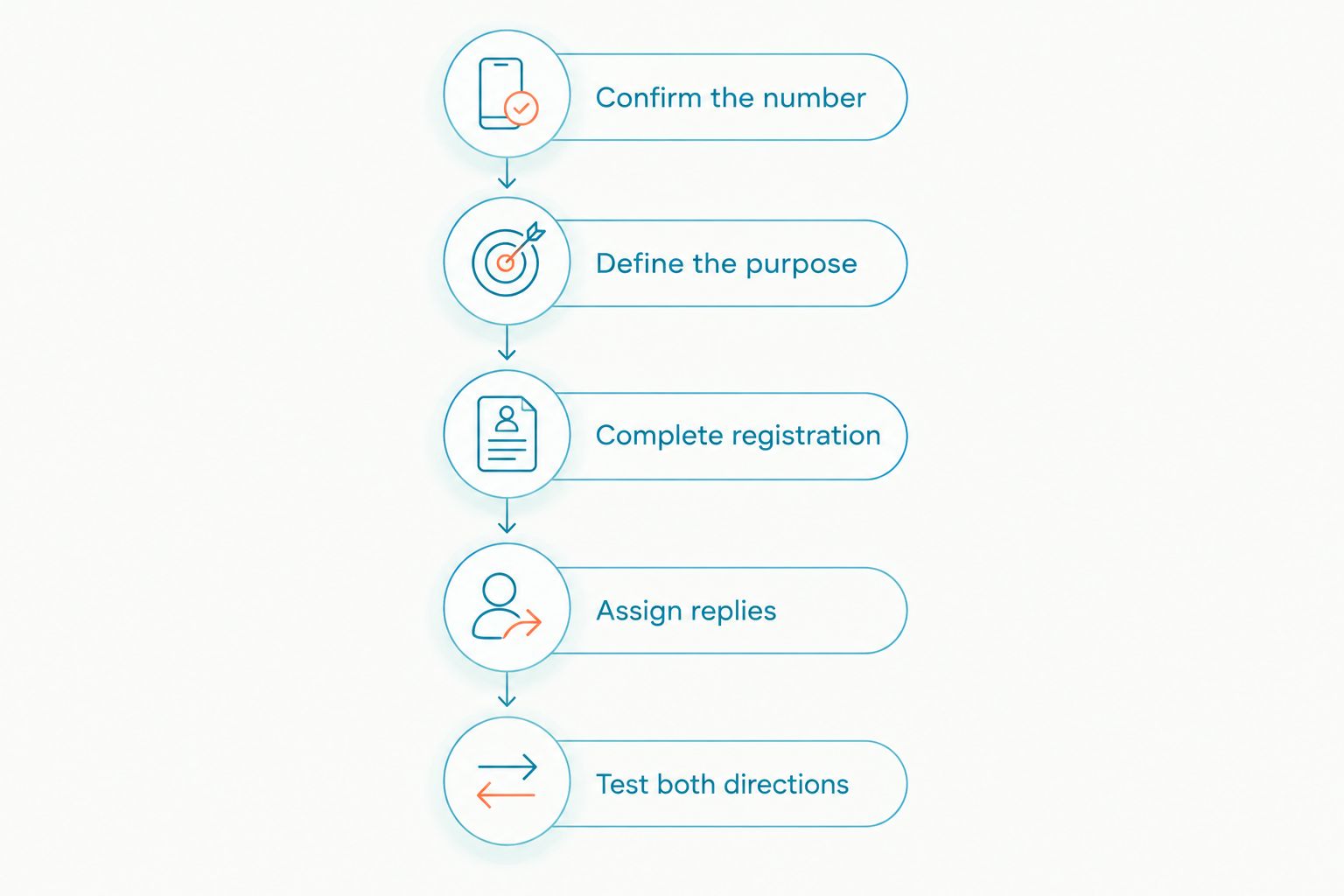
How to choose and set up your texting number
Use this sequence for a 2026 rollout. Confirm the number and messaging requirements before changing public contact details.
Confirm the number
List the number customers currently use and where it appears. Ask your prospective messaging provider whether it can support business texting and whether enabling messaging changes any part of the existing voice arrangement.
Do not cancel the current service or publish a replacement based on an assumption. Number eligibility, voice routing, and messaging configuration need separate confirmation.
Define the purpose
Write down what you intend to send: appointment reminders, service updates, customer support replies, or promotional messages. Distinguish those purposes rather than describing everything as general communication.
This gives your provider a clearer basis for explaining registration requirements. It also helps your team write messages that match what customers agreed to receive.
Complete registration
Ask which registration or verification process applies to your chosen number. For U.S. business messaging, local long-code registration and toll-free verification are distinct processes.
Prepare accurate business information, sample messages, and an explanation of how customers give permission. Confirm the current requirements directly with the provider rather than relying on an assumed approval timeline.
Assign replies
Choose an owner for incoming messages and a backup for absences. Define what happens when a conversation arrives after hours or needs a different team member.
A shared inbox gives staff a common place to work, but your operating rules still need to say who acts next. Do not treat access to the inbox as proof that somebody owns every conversation.
Test both directions
Send a permitted test message, reply from a receiving phone, and confirm that the reply reaches the intended inbox. Test opt-out handling and any after-hours response you have configured.
Finally, call the number if it also supports voice service. The launch check should cover the contact experience customers will actually use, not just a successful outbound text.
Does a toll-free number deliver texts better than a local number?
Neither number type guarantees better delivery. Registration status, message content, recipient permission, and carrier filtering all matter.
For a 2026 provider evaluation, ask how the service reports rejected or undelivered messages. A clear failure status is more useful operationally than a broad claim that a particular prefix always performs better.
Also distinguish delivery from response. A delivered message does not establish that the customer recognized the sender, read the text, or wanted the follow-up.
Do not replace a local number solely to fix a delivery problem without first identifying the cause. Review the relevant failure information and messaging setup with your provider.
Can I keep my existing business number for texting?
An existing business number can support texting when the number and provider arrangement are eligible. Confirm the specific number rather than assuming that every landline, mobile, or cloud phone number works the same way.
Ask whether voice service stays with the current provider, whether a transfer is necessary, and what changes during activation. Get the answers before changing your published contact information.
If keeping the number is possible, explain the new texting option clearly. Customers who know they can call you do not automatically know that the same number now accepts messages.
What should a small team look for beyond the number?
VirtualPBX business texting is best for small service teams that want SMS and webchat in a shared inbox through VirtualText. The useful fit is the shared conversation workspace, not a claim that one number prefix produces better results.
VirtualPBX is the parent brand. For this decision, evaluate the texting workflow separately from the choice of local or toll-free identity.
The advantage of bringing messages into a shared inbox is a common place for staff to handle customer conversations. The trade-off is operational: you still need ownership rules, suitable permissions, and a clear handoff when automated handling reaches its limit.
Ask VirtualPBX to confirm support for your intended number, the applicable messaging approval process, current pricing, and the setup path. Do not assume that every feature or number arrangement is included merely because a platform supports business SMS.
What should you change before announcing the number?
Prepare the customer-facing details before launch. Your website should clearly distinguish whether a number accepts calls, texts, or both, and your messages should identify the sender without making customers guess.
Use a short launch checklist:
- Name the business in the opening message.
- Describe the kinds of messages customers are agreeing to receive.
- Provide the required opt-out instructions for the messaging program.
- Set an honest expectation for when your team handles replies.
- Give staff a procedure for wrong numbers and requests to stop messaging.
Keep these details consistent across forms and customer materials. Your 2026 launch is ready when customers understand the channel and staff know how to handle it—not merely when the number becomes text-enabled.
FAQ
Is a toll free number better than a local number for texting customers?
A toll-free number is better for a non-geographic, centralized identity; a local number is better for a geographic identity or continuity with an established contact. Neither guarantees better message delivery.
Can customers reply to a toll-free business text?
Customers can reply when the toll-free number is enabled for two-way messaging. Confirm that replies reach a monitored inbox rather than assuming outbound messaging includes the response workflow you need.
Do local business texting numbers need registration?
U.S. application-to-person messaging over local long-code numbers uses the applicable business messaging registration process. Ask your provider which requirements apply to your business, use case, and number.
Does a toll-free number need texting verification?
Toll-free business messaging uses a verification process distinct from local-number registration. Confirm the current requirements and approval status with your provider before launching customer messages.
Will a local area code make more customers answer my texts?
A local area code does not guarantee more replies. Customer recognition, permission, message relevance, and a clear sender identity are separate considerations.
Should I change my existing number when adding business texting?
Keep your existing number when it is eligible and still fits your customer contact strategy. Confirm messaging support and any effect on voice service before deciding to replace it.
Is a toll-free texting number automatically compliant?
A toll-free prefix does not make a messaging program compliant. Verification, appropriate consent, opt-out handling, and the content of your messages still require attention.
One last thing
Choose the number customers should remember, then build the reply process around it. Before replacing an established number, ask whether enabling texting on that number solves the problem with less customer confusion.
Then name the person responsible for the next incoming reply. That decision does more to define your service workflow than choosing an area code.