
Measure lead capture software ROI by subtracting its total cost from the additional contribution profit it produces, dividing the result by that cost, and multiplying by 100%. Include setup, follow-up labor, and fulfillment costs; more captured contacts do not prove that your business earned more money.
- How do you measure ROI on lead capture software? Compare additional contribution profit against the full cost of capture and follow-up.
- VirtualPBX’s VirtualText fits small service teams that need SMS, webchat, and a shared inbox; measure results against completed sales.
- Count unique prospects, qualified leads, completed jobs, and collected revenue—not messages or chatbot conversations.
- Separate attribution from incrementality: a tracked sale is not necessarily a sale the software created.
How do you measure ROI on lead capture software?
Use additional contribution profit, not total sales revenue, as the return in your calculation. Contribution profit is revenue minus the variable costs of delivering that work. Subtract the lead capture program’s costs separately so you do not count them twice.
Follow this sequence for your 2026 evaluation:
- Define the outcome. Choose completed, paid work rather than contacts collected or appointments requested.
- Set the baseline. Record the results of your existing process before changing capture or follow-up.
- Connect records. Match each unique lead to its source, conversation, sales outcome, and payment.
- Estimate the additional return. Separate sales the new process created from sales your existing process would have produced.
- Calculate the full cost. Include the subscription, setup, staff time, and other costs required to run the process.
- Calculate ROI. Divide net additional profit by total program cost and express the result as a percentage.
For the operational handoff between a conversation and a sale, use the guide to converting website visitors into booked jobs with chat. The financial measurement must continue beyond the booking.
Why this matters
A lead capture report and a profit report answer different questions. The first shows whether people entered your pipeline; the second shows whether serving those people justified the expense.
For a small service business, an unanswered inquiry, an unqualified request, and a completed job are different outcomes. Keep those outcomes separate. Otherwise, a busy inbox can look like a successful investment while your team spends more time handling requests that never become work.
Use the right ROI formula
For a sales-focused evaluation, use:
ROI (%) = [(additional contribution profit − total lead capture program cost) ÷ total lead capture program cost] × 100%
Additional contribution profit is the contribution profit attributable to the change beyond your baseline. Total program cost covers the capture and follow-up process being evaluated. Use the same accounting period for both.
A result above 0% ROI means measured additional contribution profit exceeds program cost. A result at 0% ROI means the program breaks even under your assumptions. A negative result means measured returns have not covered the expense.
Keep cost savings separate from sales returns until you can document them. Reduced overtime or a canceled software subscription is a financial saving; spare staff capacity is not automatically cash saved.
Keep revenue, contribution profit, and cash distinct
Revenue measures sales value. Contribution profit subtracts the variable cost of delivering those sales. Cash collection records whether the customer actually paid.
Choose a consistent basis for your report. If you use collected revenue, compare cohorts after they have had time to pay; if you use accounting revenue, reconcile refunds and cancellations before finalizing the result.
Do not compare a new lead cohort’s unpaid bookings with an older cohort’s completed, paid jobs. That comparison measures different stages of the sales cycle, not software performance.
Build a lead record that survives the handoff
Your 2026 lead log should connect the initial inquiry to the final business outcome. A spreadsheet is enough to begin if your team keeps it current and uses consistent definitions.
| Record field | What you record | Why it belongs in the calculation |
|---|---|---|
| Lead identifier | A unique prospect or opportunity reference | Prevents duplicate counting across channels |
| Capture details | Source, channel, and initial inquiry timestamp | Connects the lead to its entry point |
| Business-hours status | Whether the inquiry arrived during staffed hours | Separates after-hours performance |
| Qualification | Service fit, location fit, and purchasing intent | Distinguishes usable leads from raw contacts |
| Ownership | Responsible employee and next action | Makes follow-up accountable |
| Response timestamps | Initial reply and meaningful response | Separates acknowledgment from actual help |
| Sales outcome | Qualified, booked, completed, lost, or canceled | Shows where prospects leave the process |
| Financial outcome | Revenue, variable delivery costs, and payment status | Connects activity to contribution profit |
Define duplicate handling before reviewing results. A prospect who starts a chat and later sends a text should not become separate acquired customers simply because the channel changed.
Record lost reasons in plain language. “Outside service area” calls for a different fix than “no appointment available.” Neither problem is solved merely by collecting more contact details.
Choose an attribution method without overstating its proof
Attribution assigns credit to a touchpoint. Incrementality asks what changed because the new process existed. Your ROI report needs that distinction even when your records cannot establish causation precisely.
| Measurement approach | Best for | Strength | Limitation |
|---|---|---|---|
| First-touch attribution | Understanding where prospects enter | Preserves the original acquisition source | Does not establish which later interaction changed the outcome |
| Last-touch attribution | Reviewing the final interaction before a sale | Makes closing-stage activity visible | Can overcredit the final channel |
| Matched before-and-after comparison | Small teams without a separate test group | Uses existing operating records | Other changes can explain the difference |
| Concurrent controlled comparison | Teams able to maintain comparable groups | Helps isolate the effect of the new process | Requires careful assignment and consistent handling |
Choose the strongest comparison your operation can maintain accurately. Do not describe a simple before-and-after change as proof that software caused every additional sale.
For a before-and-after comparison, keep service mix, staffing, advertising, and operating hours as consistent as possible. Record changes you cannot avoid. If your sales team expands during the evaluation, disclose that change alongside the result.
A controlled comparison also needs discipline. Keep groups comparable and prevent staff from applying the new workflow to the comparison group. Otherwise, the test stops measuring the difference you intended to evaluate.
Measure the whole path, not just the first reply
A useful funnel follows the customer from Captured to Qualified, Booked, Completed, and Paid. Each stage answers a separate operational question, and each transition needs its own denominator.
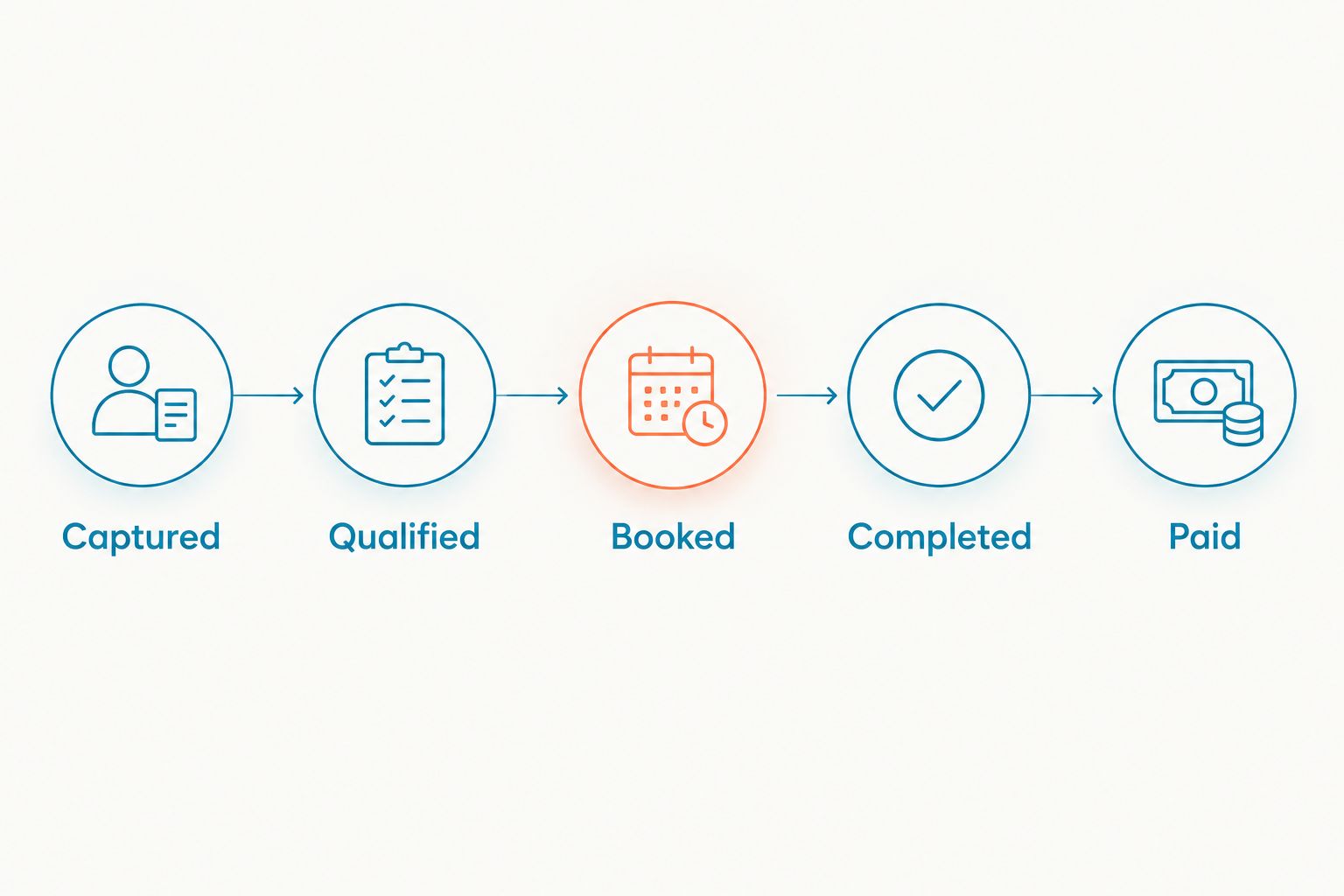
Use these calculations consistently:
- Qualification rate: qualified leads divided by unique captured leads.
- Booking rate: booked opportunities divided by qualified leads.
- Completion rate: completed jobs divided by booked jobs.
- Paid conversion rate: paying customers divided by unique captured leads.
- Program cost per acquired customer: total program cost divided by additional acquired customers.
- Contribution per acquired customer: contribution profit divided by acquired customers.
These measures diagnose the result; they do not replace ROI. A lower cost per captured contact is not an improvement if qualification deteriorates or follow-up work increases.
Record response time in minutes or hours, but define what counts as a response. An automated acknowledgment confirms receipt. A meaningful response answers the request, asks a relevant intake question, or gives the customer a usable next step.
Why lead capture software ROI varies
Your 2026 ROI calculation changes with the work your team captures and its ability to complete that work. Review these drivers before assigning the result entirely to software:
- Lead quality: requests outside your service area or scope consume attention without creating suitable opportunities.
- After-hours coverage: inquiries captured outside staffed hours still need qualification and an accountable handoff.
- Follow-up ownership: a shared conversation needs a named person responsible for its next step.
- Job economics: different services produce different contribution profit, even when their revenue looks similar.
- Available capacity: additional bookings do not become completed work when your schedule cannot accommodate them.
- Sales and payment timing: long decision cycles or delayed collections push financial outcomes beyond the initial capture period.
Break results into meaningful groups rather than reporting only a blended average. Compare staffed-hours and after-hours inquiries, then review channel and service type where the lead volume supports it.
Do not split the report so finely that isolated outcomes drive the conclusion. Keep small groups visible, but distinguish observations from repeatable patterns.
Where a shared inbox fits the measurement
VirtualText by VirtualPBX is best for small service teams that need SMS, webchat, and a shared team inbox. Its supplied offer also includes an AI agent for website and after-hours lead handling. The stated platform price is $89 per month; use your actual invoice and operating costs in the ROI calculation.
The practical fit is a combined place for customer conversations. The limitation is financial visibility: a conversation record alone does not establish whether a job was completed, paid, or profitable. Connect those outcomes in your lead log rather than treating captured conversations as earned revenue.
Start by defining the intake questions, assigning follow-up ownership, and deciding where sales outcomes will be recorded. Then test the path from a new inquiry through to a closed record. Keep VirtualPBX as the parent-brand reference when evaluating the offer.
How long should you measure before judging ROI?
Measure long enough for a lead cohort to complete its normal sales, delivery, and payment cycle. There is no universal waiting period that makes unfinished opportunities equivalent to completed sales.
Review operational indicators while that cycle runs. Missing ownership, duplicate records, and unanswered qualified requests need correction immediately; final financial conclusions need mature outcomes.
For a 2026 rollout, label cohorts by their capture period and keep updating their downstream results. Do not restart the clock every time a prospect moves from chat to text or from an estimate to a booking.
Can time savings count toward ROI?
Time savings count as financial returns when they produce a documented economic benefit. Reduced paid overtime is different from an employee having more unused time between tasks.
Track the task, the time spent, and what changed afterward. If saved follow-up time enables additional completed work, count the resulting contribution profit once rather than adding both its sales value and a second estimate of the same capacity benefit.
What should you change when ROI is negative?
Fix the stage that loses qualified opportunities before buying more traffic. If inquiries are suitable but remain unassigned, repair ownership; if bookings fail to complete, review scheduling and confirmation.
Separate a weak process from a weak acquisition source. More leads will not repair unavailable appointments, unclear service coverage, or records that never reach a final outcome.
FAQ
What's the simplest way to calculate lead capture software ROI?
Subtract total program cost from additional contribution profit, divide by total program cost, and multiply by 100%. Include setup and follow-up costs, not just the subscription.
Should I use revenue or profit to measure lead capture ROI?
Use contribution profit rather than revenue to evaluate the financial return. Subtract variable delivery costs from sales revenue, then account for capture and follow-up costs separately.
Does every sale from webchat count as additional revenue?
No. A webchat sale is attributed to that channel, but the customer might have purchased through another route without it. Use a baseline or controlled comparison to estimate additional results.
How do I measure ROI on after-hours leads?
Tag after-hours inquiries and follow them through qualification, booking, completion, and payment. Compare their additional contribution profit with the costs of capturing and handling them.
Is a faster automated reply proof of better ROI?
No. Faster acknowledgment is an operational measure, not a financial return. Track whether qualified prospects receive useful help and become profitable customers.
How should I handle leads that contact us by chat and text?
Merge repeated contacts into the same prospect or opportunity record. Preserve the channel history without counting each conversation as a new customer.
What ROI percentage means the software breaks even?
0% ROI means measured additional contribution profit equals total program cost. That result depends on including the full cost and using a defensible baseline.
One last thing
Make “unknown outcome” a visible reporting category. Do not quietly classify unfinished records as lost leads or successful sales.
For your next 2026 review, assign someone to resolve those records before interpreting the headline ROI. Better outcome tracking improves the decision; a more elaborate dashboard cannot correct missing sales evidence.