
Business texting software pays back when the extra profit and verified labor savings it creates exceed its total operating and setup costs—not after a fixed number of days. Faster replies and more conversations are early signals, not proof of ROI. To find your payback date, track completed customer outcomes, subtract the costs of delivering them, and include the time your team spends running the inbox.
- How long does it take to see ROI from business texting software? Until verified benefits exceed total costs.
- For VirtualPBX business texting, measure completed customer outcomes and verified labor savings—not message volume.
- Separate faster responses from financial returns: an answered inquiry is not a completed sale.
- Use scheduled reviews to diagnose progress, not to promise a universal payback deadline.
Why this matters
A texting platform can make your business easier to reach without producing additional profit. Your team still needs to qualify inquiries, assign follow-up, complete work, and connect the conversation to a financial result.
Measure the whole customer journey, not just the reply. The click-to-text leads to booked jobs workflow is a useful starting point for deciding which handoffs your team needs to record.
For your 2026 evaluation, keep two separate views: operational performance and financial return. Better response times belong in the first; additional contribution profit and verified savings belong in the second.
How long does it take to see ROI from business texting software?
You reach payback when cumulative verified benefits cover cumulative costs. Positive ROI starts when those benefits exceed those costs. A booking, an automated reply, or a busy shared inbox does not establish either result on its own.
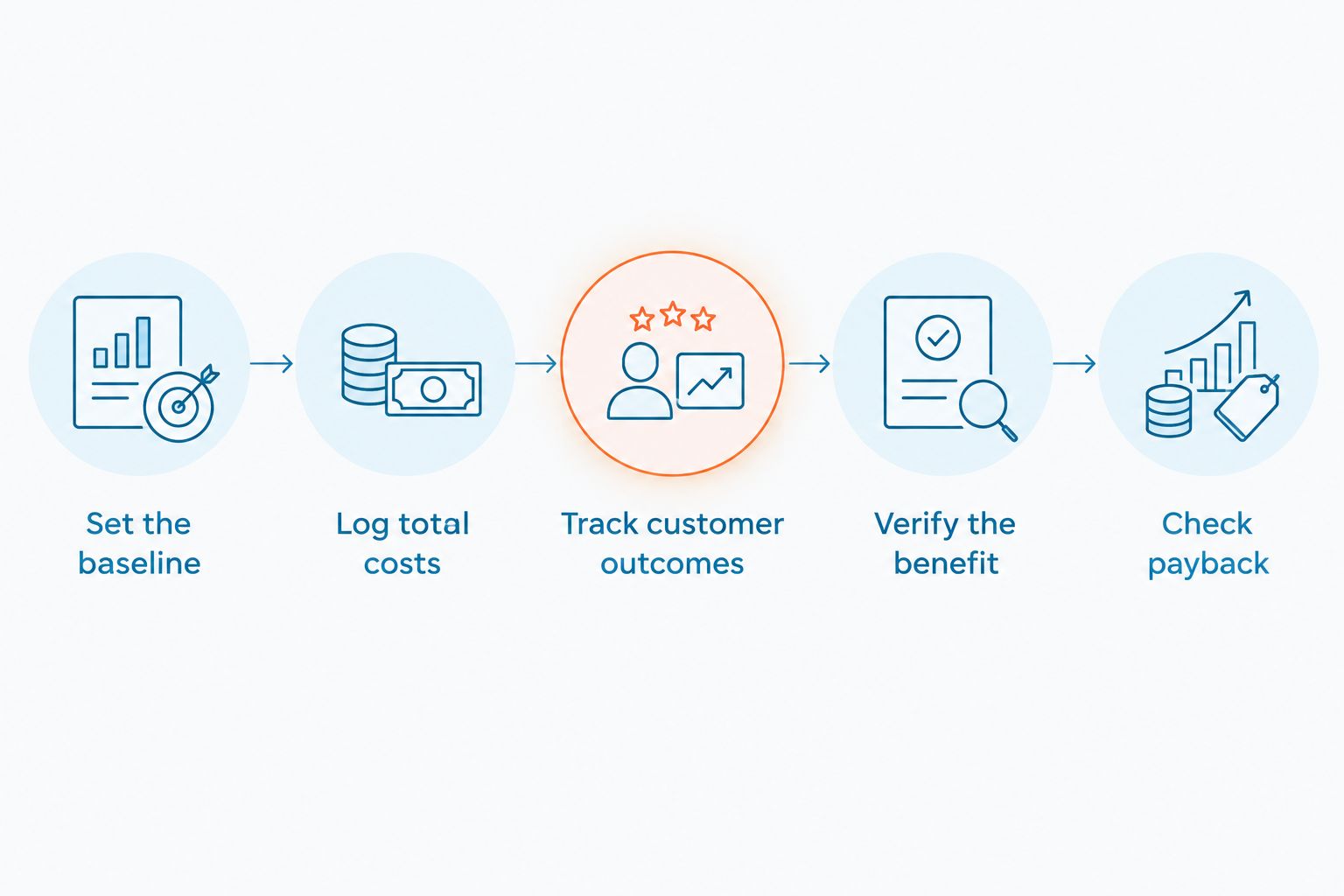
Use these steps to calculate your actual timeline:
- Set the baseline. Record how many comparable inquiries become completed sales before changing the process. Also record the staff time involved.
- Log total costs. Include the subscription, setup work, training, ongoing administration, and any other charges that apply to your account.
- Track customer outcomes. Connect texting conversations to completed work, collected payments, or measured reductions in handling time.
- Verify the benefit. Subtract delivery costs from additional revenue. Confirm that claimed time savings are real and usable.
- Check payback. Compare cumulative verified benefits with cumulative costs using the same start date and reporting period.
Keep the calculation consistent. Comparing a full period of costs with only the best-performing conversations makes the result unreliable.
Use a calculation your finance team can check
Calculate ROI as net benefit divided by total cost, expressed as a percentage. Net benefit is the verified financial benefit minus the total cost of the texting program.
For new business, use contribution profit: collected revenue minus the direct costs of delivering the additional work. Revenue alone overstates the return because your business still has to perform the service.
For labor savings, distinguish cash savings from available staff capacity. Time released for other work has operational value, but it does not automatically reduce payroll or increase profit.
Which texting workflow should you measure first?
Start with a customer problem you can observe and an outcome you can verify. Do not launch every workflow at once and then try to untangle which change produced the result.
The options below are measurement choices, not promised sources of savings.
| Workflow | Best for | Financial evidence to record | Advantage | Limitation |
|---|---|---|---|---|
| Lead follow-up | Teams losing track of incoming inquiries | Additional completed jobs and their contribution profit | Connects conversations to sales outcomes | Existing demand can be mistaken for new business |
| After-hours intake | Teams receiving inquiries outside staffed hours | After-hours inquiries that become completed work | Makes previously unhandled inquiries measurable | Capturing details still requires effective follow-up |
| Customer updates | Teams repeating routine status information | Measured handling time and actual staffing impact | Targets a specific administrative task | Moving work from calls to texts is not necessarily a saving |
| Appointment follow-up | Teams coordinating scheduled visits | Completed appointments compared with a comparable baseline | Connects messages to attendance outcomes | Cancellations and schedule changes complicate attribution |
Choose the workflow with the clearest records, not the largest imagined upside. A modest, traceable result is more useful than a large return built on assumptions.
In your 2026 worksheet, give each workflow a separate line. That prevents a successful lead-follow-up process from hiding an inefficient customer-update process.
What should you check after 7 days?
Use the first 7 days as an operational check, not a payback promise. This is a recommended review schedule, not an industry benchmark or a prediction about your business.
Confirm that messages reach the right place and someone owns the next action. Review whether staff can distinguish a new inquiry from an existing customer's question.
Check the practical details:
- Does each conversation have a responsible team member?
- Does the customer receive a relevant answer rather than a generic acknowledgment?
- Does the team record whether the inquiry becomes a booking?
- Can someone find the conversation when the customer calls instead?
- Are unresolved requests visible at the end of the working day?
Do not assign revenue to an inquiry just because it received a reply. At this stage, your strongest evidence is that the process works and produces records you can trust.
Fix broken handoffs before expanding the rollout. More incoming conversations will not solve unclear ownership.
What should you check after 30 days?
Use a 30-day review to connect conversations with outcomes. Treat this as a management checkpoint, not a claim that texting software pays back within a month.
Compare similar types of inquiries over comparable periods. Separate business-hours traffic from after-hours traffic, and new prospects from existing customers.
For each completed outcome, record the source, conversation owner, result, and financial value. Keep open opportunities separate from completed work; a quote awaiting approval is not collected revenue.
Your 2026 review should answer three practical questions:
- Which workflow produced a verified benefit?
- Which workflow added work without a measurable benefit?
- Which outcomes are still unresolved because the customer decision takes longer?
A weak result needs a diagnosis before a spending decision. Check whether the problem is insufficient inquiry volume, missed follow-up, poor qualification, or an incomplete measurement process.
What should you check after 90 days?
Use a 90-day review to assess cumulative results and repeatability. This is another recommended checkpoint, not a standard payback period.
Compare total verified benefits with every cost incurred since launch. Keep setup and training costs in the calculation even if those activities are now finished.
Check whether results depend on a single unusually valuable customer. A positive total matters, but you also need to know whether the workflow continues to produce useful outcomes.
Do not close the evaluation solely because the calendar says to. If customer decisions remain open, report those opportunities separately and continue tracking them without booking their expected value as a return.
For a 2026 renewal decision, document what you will retain, change, or stop. Tie each decision to an observed result rather than to inbox activity.
Why business texting ROI timelines vary
The payback date follows your operating model and customer behavior. These factors determine what your measurement needs to capture:
- Inquiry volume: More conversations create more opportunities to observe outcomes, but volume alone does not establish value.
- Customer decision time: A quick question and a service request requiring a detailed proposal reach financial outcomes differently.
- Contribution profit: Additional sales cover software costs through the profit they contribute, not through their full revenue value.
- Follow-up ownership: Captured inquiries need a named person responsible for the next action.
- Setup and administration: Training, conversation review, and inbox maintenance belong in the cost calculation.
- Existing performance: A team already handling inquiries effectively needs to identify what the new process actually improves.
Avoid comparing your payback date with another business unless the measurement methods match. Different definitions of revenue, savings, and setup costs produce different answers.
How do you avoid counting the same return twice?
Give each financial benefit a single place in your calculation. If a customer starts in webchat, continues by text, and books by phone, that is one customer outcome—not separate sales for each channel.
Use a consistent customer or job reference to join those interactions. Then record the channels involved without multiplying the value of the completed work.
Apply the same discipline to staff time. Do not count a shorter phone call as a saving while ignoring the time spent writing and reviewing the replacement messages.
What counts as additional business?
Additional business is work attributable to the changed process beyond what your existing process would have produced. A customer who already intended to book does not become an incremental sale simply by choosing text.
Use comparable periods and clearly defined customer groups to strengthen the comparison. Record changes in advertising, staffing, service availability, or demand that affect the result.
Can you count time savings before payroll falls?
You can report verified time released as an operational benefit before payroll changes. Keep it separate from cash savings unless it reduces spending or supports additional profitable work.
Record the task, time spent before and after the change, and how the released capacity is used. Avoid treating every saved minute as money returned to the business.
Where does VirtualPBX fit?
VirtualPBX is best for small businesses seeking a cloud phone system with optional AI call handling. For a texting-specific evaluation, VirtualText by VirtualPBX combines SMS, webchat, a shared team inbox, and an AI agent for small-business service teams.
The practical advantage is bringing those conversation types into a shared workspace. The operating requirement remains yours: assign ownership, define escalation, and connect conversations to completed customer outcomes.
Start with the workflow you selected for measurement. Confirm the current account terms and setup requirements, train the people who will answer, and test the customer journey before relying on it for live inquiries.
If your evaluation also includes calling, review VirtualPBX as the parent business-phone provider. Assess calling and texting against their own requirements rather than assuming that success in one proves a return from the other.
FAQ
How long does it take to see ROI from business texting software?
Business texting software produces positive ROI when verified financial benefits exceed its total costs. The timeline depends on completed customer outcomes, contribution profit, staff workload, and setup costs—not a universal number of days.
Should I expect business texting software to pay for itself in 30 days?
A 30-day payback is not a reliable assumption. Use a 30-day review to check completed outcomes and costs, while keeping unresolved opportunities separate from earned returns.
What should I measure during the first 7 days?
During the first 7 days, check message delivery, conversation ownership, relevant replies, and outcome tracking. This recommended operational checkpoint does not establish financial payback.
Is a 90-day review enough to prove texting ROI?
A 90-day review proves ROI only if verified benefits and complete costs support the calculation. Open proposals and expected future sales should remain separate from completed financial results.
Do faster text replies count as ROI?
Faster text replies are an operational measure, not ROI by themselves. Connect the improvement to additional contribution profit, reduced spending, or verified productive capacity before assigning financial value.
Can I include staff time savings in my calculation?
Include verified staff time savings, but distinguish released capacity from cash savings. Subtract the time required to manage the texting process and explain how the remaining capacity benefits the business.
Does VirtualPBX guarantee a payback date for business texting?
Do not treat VirtualPBX business texting as a guaranteed payback date. Establish your return through tracked customer outcomes, verified savings, and the complete costs of your own implementation.
One last thing
Your first useful finding might be that texting moved work rather than removed it. If phone handling falls but inbox handling rises by the same amount, you have changed the channel without proving a labor saving.
Before expanding, follow a customer conversation all the way to its outcome. Look for the point where a reply becomes a booking, a booking becomes completed work, and completed work produces contribution profit. That is the chain your ROI calculation must explain.