
Yes—SMS marketing is still effective for service businesses in 2026 when you use permission-based messages to move customers toward a clear next step, such as booking a visit or revisiting an estimate. It does not replace consent, a useful offer, or someone who answers replies; a delivered text alone is not a business result.
- Is SMS marketing still effective for service businesses? Yes—judge it by qualified replies and completed bookings, not delivery alone.
- Separate promotional SMS from appointment reminders; customers do not necessarily consent to both.
- Assign replies to a person before launching a campaign; a shared inbox needs clear ownership.
- VirtualPBX offers business SMS; confirm campaign requirements separately from everyday customer texting.
Is SMS marketing still effective for service businesses in 2026?
Yes, when the message matches an actual customer need and your team can handle the response. A maintenance reminder sent to an appropriately opted-in customer has a clear purpose. An unrelated promotion sent to every number in your records does not.
Start by separating marketing from service communication. Appointment confirmations, estimate follow-ups, and promotional campaigns have different purposes, customer expectations, and consent requirements. Do not treat an existing customer relationship as blanket permission for advertising.
Your response process matters just as much as your outgoing message. Use a shared team inbox for customer texts to plan who receives replies, who takes ownership, and when a conversation is finished.
| Texting approach | Best for | Practical advantage | Limitation |
|---|---|---|---|
| Permission-based promotional SMS | Relevant offers to opted-in customers | Gives customers a direct response channel | Requires appropriate marketing consent and campaign controls |
| Estimate follow-up | Customers considering a requested service | Keeps the conversation attached to a specific request | An unanswered estimate does not justify endless reminders |
| Appointment messaging | Confirmations and scheduling changes | Gives customers a simple way to respond | Service messages are not permission to add promotions |
| Customer reactivation | Opted-in customers with a relevant service need | Connects outreach to an existing relationship | Old contact details and outdated preferences need review |
These are different workflows, not interchangeable campaign labels. Choose the workflow before choosing the software.
Why this matters
For a service business, the useful outcome is usually a booked appointment, an accepted estimate, or a completed job. A customer reading a message is only an intermediate event. Your reporting should follow the conversation through to its outcome.
In 2026, the practical question is not whether texting feels current. It is whether your business can connect permission, relevance, reply handling, and booking in the same process.
That distinction also protects your customer experience. A short, relevant message offers a clear next step; repeated messages without a useful reason demand attention without giving the customer anything useful.
Promotional SMS: best for a specific, relevant offer
Use promotional SMS when you have appropriate permission and a concrete reason to contact that audience. For example, you can invite eligible customers to discuss a maintenance service they have expressed interest in. Keep the action specific.
Avoid combining unrelated services in the same message. If the customer needs to decode several offers before deciding what to do, rewrite the campaign around the most relevant action.
The advantage is directness: a customer can ask a question in the same conversation. The disadvantage is that every reply creates work, including questions, complaints, and requests to stop messaging.
Recommendation: send promotional SMS only when the audience, permission, offer, and reply owner are clear. Do not start with a purchased contact list or assume that having a mobile number establishes marketing permission.
Estimate follow-up: best for an unfinished customer decision
An estimate follow-up should reconnect the customer with the service they requested. Ask whether they have questions or want to discuss the next step. Do not imply that an appointment is reserved unless your scheduling process confirms it.
Give your team access to the relevant estimate before sending the message. A reply such as “Does that include disposal?” needs context, not another generic acknowledgment.
This workflow has a clear advantage: the conversation starts with a known request. Its limitation is equally important: a customer who requested an estimate has not necessarily agreed to unrelated promotional campaigns.
Recommendation: keep follow-up tied to the original inquiry and stop when the customer declines or withdraws permission. Record the outcome so another employee does not restart the same conversation.
Appointment messaging: best for scheduling coordination
Appointment messages work best when they identify the business, explain the scheduling purpose, and tell the customer how to respond. Keep promotional content separate. Adding an offer changes the purpose of a message that otherwise concerns an existing appointment.
A reminder should not invite a response your team cannot process. If you ask customers to request a different time, assign someone to review those requests and confirm the actual change.
The benefit is a straightforward coordination channel. The limitation is that texting alone does not update a calendar, resolve a scheduling conflict, or prove the customer will attend.
Recommendation: make appointment messaging part of your scheduling process, not a disconnected broadcast. Treat a request to reschedule as pending until someone confirms the new appointment.
Why SMS marketing results vary
No single response-rate benchmark can tell you whether your campaign works. The same message can serve very different audiences and business processes. Evaluate these factors before comparing results:
- Permission: The recipient should have agreed to the type of message you are sending. Keep the record connected to the contact.
- Relevance: Match the message to a requested service, expressed interest, or appropriate customer segment.
- Timing: Send when the message is useful and within applicable messaging restrictions. Do not equate automated delivery with permission to text at any hour.
- Clarity: Identify the business and give the customer a clear next step. Remove competing requests.
- Reply ownership: Assign responsibility for questions, booking requests, complaints, and opt-outs before sending.
- Outcome tracking: Connect the conversation to the appointment or job record. Otherwise, you cannot distinguish interest from completed business.
A weak result needs a diagnosis, not automatically another campaign. Check whether messages reached the intended audience, whether replies received attention, and whether the booking process stalled.
How should you set up a service-business SMS campaign?
Build the process around the customer response rather than the send button. For a 2026 campaign, use the following sequence before expanding to additional audiences or message types.
- Choose the goal. Decide whether you want estimate conversations, appointment requests, or another defined outcome. Keep that outcome consistent throughout the campaign.
- Check permission. Confirm that your consent records support the planned message. Exclude contacts whose permission is unclear or withdrawn.
- Write the message. Identify your business, state the reason for contacting the customer, and give a clear next step. Include required disclosures and opt-out instructions.
- Assign replies. Name the responsible employee and define coverage when that person is unavailable. Explain which questions require a specialist.
- Record outcomes. Track replies, bookings, completed work, and opt-outs against the campaign. Review the result before sending again.
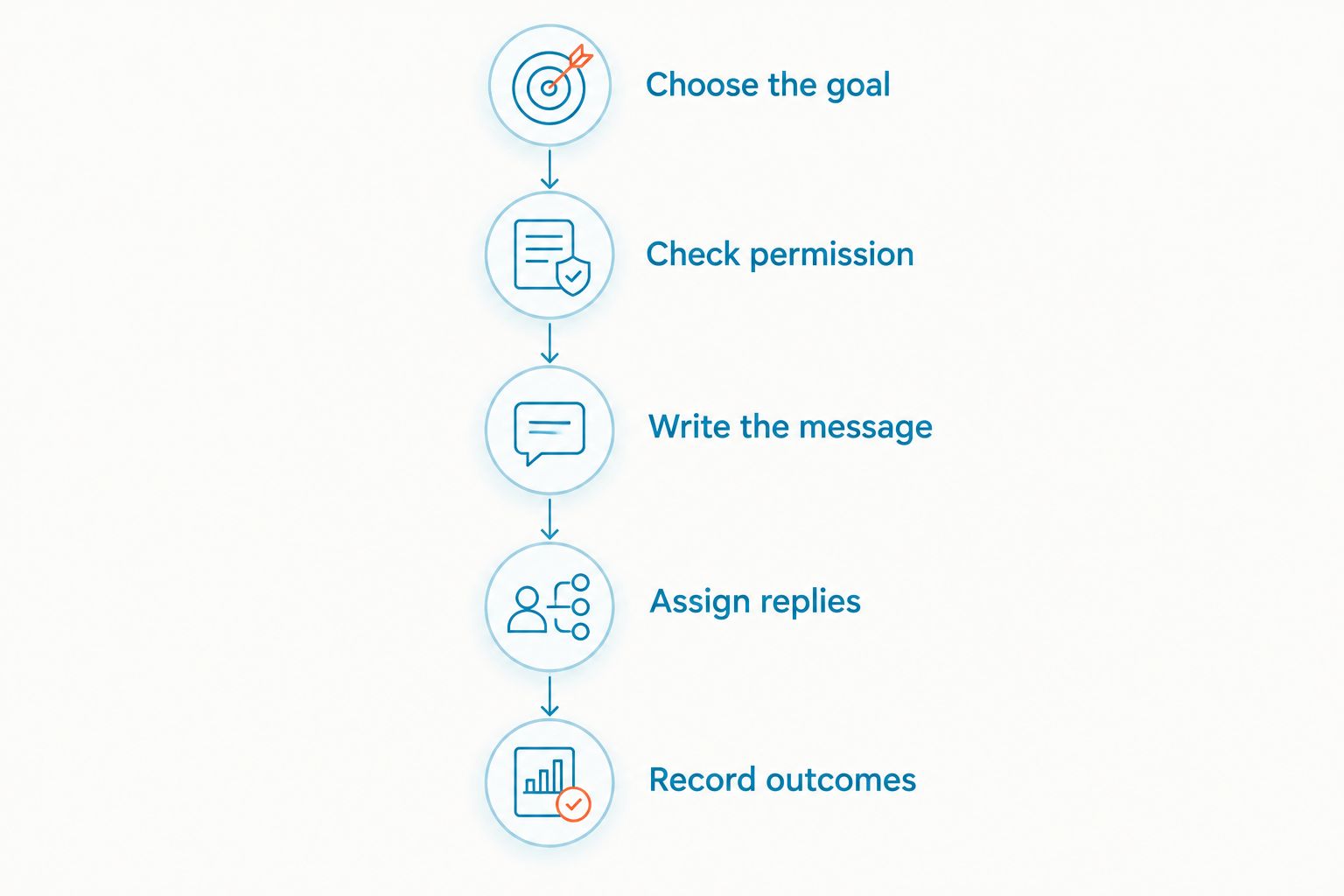
Test the entire conversation, not just delivery. Have a colleague respond with a scheduling question, an unclear request, and an opt-out. Confirm that each response reaches the right person or process before contacting customers.
What should a service-business marketing text include?
A useful text answers the recipient's immediate questions: Who is contacting me? Why am I receiving this? What should I do next? Write those answers before adding persuasive language.
Keep the content focused, but do not remove essential context merely to shorten it. Standard GSM-7 SMS supports 160 characters in a single segment. Longer concatenated GSM-7 messages commonly use 153 characters per segment because part of each segment carries joining information.
Messages using UCS-2 encoding generally allow 70 characters in a single segment. Character choice therefore affects message segmentation; some GSM-7 extension characters also consume extra space. Check the actual message preview rather than counting visible letters alone.
Those limits are technical constraints, not a reason to omit required information. A clear, properly disclosed message matters more than forcing every campaign into a single segment.
Keep sensitive information out of ordinary promotional texts. Healthcare, legal, financial, and insurance teams should apply their own approved communication and privacy procedures before including customer details.
How do you know whether SMS marketing is working?
SMS marketing is working when it contributes to the outcome you selected, not merely when messages are delivered. Connect campaign records to replies, appointments, and completed work so you can distinguish activity from business value.
Track these measures together:
- Delivery rate: Delivered messages divided by attempted messages. This measures delivery, not reading or interest.
- Reply rate: Responding recipients divided by delivered recipients. Separate useful replies from opt-outs and wrong-number responses.
- Booking rate: Booked customers divided by the audience basis you selected. Keep that denominator consistent across campaigns.
- Completed work: Jobs or appointments completed after campaign contact. Distinguish booked work from fulfilled work.
- Opt-outs: Requests to stop messaging. Review them alongside campaign relevance and audience selection.
For your 2026 reporting, define the attribution rule before reviewing results. A booking after a text does not automatically prove the text caused it. Customers can also interact with calls, email, search, and your website.
Where practical, compare a campaign audience with a comparable group that does not receive the promotion. Keep the comparison conditions consistent and avoid presenting ordinary changes in demand as proof of campaign success.
Can you text existing customers without marketing consent?
An existing customer relationship does not automatically establish permission for every marketing text. Requirements depend on the message, sending method, applicable law, and carrier rules; separate promotional outreach from requested service communication.
Before launching, review your consent language, suppression process, sender registration requirements, and recordkeeping. The business texting compliance guide provides a starting point for organizing that work; obtain legal advice for your specific program.
Where does business texting software fit?
VirtualPBX is best for small businesses that need cloud calling, business SMS, and support from real people. Confirm the requirements for promotional campaigns separately from everyday business messaging.
For this texting-focused workflow, VirtualText by VirtualPBX combines SMS, webchat, a shared team inbox, and an AI agent for small-business service teams. That combination addresses the need to collect conversations and coordinate responses across customer entry points.
The limitation is operational: software does not establish customer consent, choose an appropriate audience, or guarantee a booking. Before selecting a platform, confirm campaign permissions, opt-out handling, number setup, messaging rules, and how your team will record outcomes.
Start with the workflow you need, then verify the setup path with the provider. Do not assume that a business texting feature includes every bulk-marketing capability your campaign requires.
FAQ
Is SMS marketing still effective for service businesses in 2026?
Yes—SMS marketing remains useful for permission-based offers and relevant customer follow-up. Judge effectiveness by qualified replies, bookings, and completed work rather than delivery alone.
What's the best SMS campaign for a small service business?
The best starting campaign addresses a specific need among customers who have agreed to receive that type of message. Choose a clear outcome and assign someone to handle replies before sending.
Are appointment reminder texts the same as SMS marketing?
No—appointment reminders and promotional SMS have different purposes. Keep advertising separate from scheduling communication and confirm the permission required for each.
Can I send marketing texts to every customer in my database?
No—having a customer's phone number does not automatically establish permission for promotional texts. Check consent records and exclude contacts whose permission is unclear or withdrawn.
How many characters can a business text contain?
A single standard GSM-7 SMS segment supports 160 characters, while a single UCS-2 segment generally supports 70 characters. Longer messages use multiple segments, and character choice affects segmentation.
Does a delivered SMS mean the customer read it?
No—a delivery status does not establish that the customer read the message or wants the service. Use replies and recorded business outcomes to assess the campaign.
Does VirtualPBX offer business texting?
Yes—VirtualPBX offers business SMS as part of its small-business communications offering. Confirm the requirements and capabilities for your planned promotional campaign before choosing a setup.
One last thing
Before approving your next 2026 campaign, read the message as a customer and then answer it as an employee. If the customer cannot tell what to do, or the employee cannot complete the next step, fix the workflow first.
The campaign is not finished when the text goes out. It is finished when the reply has a clear outcome.