
Yes, you can text international customers from a US business number when your texting provider supports the destination country, your sender type, and the intended use. A US number alone does not guarantee delivery or replies; confirm the international route and applicable messaging rules before sending customer updates.
- Can you text international customers from a US business number? Yes, with supported international SMS routes and permitted sender types.
- SMS delivery and customer replies are separate checks; test both before using international business texting.
- US messaging registration does not replace destination-country requirements.
- Keep webchat or email available when international SMS cannot support the conversation.
Can you text international customers from a US business number?
Yes, but approve the complete route—not just the phone number. Your provider must support messages from your specific US sender to the customer's destination. The receiving network must accept that traffic, and your message must meet applicable requirements.
Start by separating voice capability from messaging capability. A number that receives international calls does not automatically support international texts. The guide to using one phone number for calls and texts explains that distinction.
For a 2026 rollout, use this verification sequence:
- Identify the destination. Record the country and the customer's complete international mobile number.
- Confirm sender support. Ask whether your exact US number type can send to that destination.
- Check requirements. Confirm registration, consent, content, and sender-identification requirements.
- Test delivery. Send a permitted test message to a consenting recipient.
- Test replies. Have the recipient answer and confirm that your team receives the response.
- Assign ownership. Decide who handles replies, failures, and requests to stop messaging.
A successful outbound test does not prove that the customer can reply. Treat two-way communication as a separate acceptance test.
Why this matters
An appointment reminder is useful only if the customer receives it. A request to confirm an appointment also needs a working reply path and someone responsible for the answer.
International texting adds destination-specific requirements to that workflow. Do not advertise international texting until you have confirmed the countries and conversation types you can actually support.
For small service teams, the practical question is not whether the software has a send button. It is whether a customer abroad can receive a useful message, respond, and reach the right person.
Which communication option fits an international customer?
Choose the channel around the customer's task. SMS, webchat, and email solve different problems; none is a universal replacement for the others.
| Option | Best for | Practical advantage | Limitation to check |
|---|---|---|---|
| SMS from your US business number | Existing customers on a confirmed international route | Keeps the conversation tied to your business number | Destination support, sender rules, and replies require verification |
| Website chat | Customers already visiting your website | Starts a browser conversation without sending an international SMS | Continuing after the customer leaves depends on the chat setup |
| Detailed instructions and written follow-up | Gives you room for documents and longer explanations | Spam filtering and response timing still need attention |
If international SMS is unsupported, offer another channel explicitly. Do not invite customers to reply to a message when that reply cannot reach your team.
For your 2026 contact instructions, name the supported channel and explain what customers should use when it fails. Keep those instructions consistent across appointment confirmations, website forms, and staff replies.
What should you ask your texting provider?
Ask a specific question: Can this US business number send and receive customer-service SMS with mobile numbers in this destination country?
That wording matters. Asking whether a platform supports international messaging leaves room for an answer that covers outbound delivery but not replies, or some sender types but not yours.
Request written confirmation of:
- Destination coverage: Which countries and receiving networks does the service support?
- Sender eligibility: Is your existing local or toll-free US number supported on that route?
- Message direction: Does support include outbound messages, inbound replies, or both?
- Registration requirements: What approvals apply before you start sending?
- Content restrictions: Are your intended reminders, service updates, or promotional messages permitted?
- Failure handling: What status information can your team see when delivery fails?
Do not interpret an international calling feature as an international SMS commitment. Calling and messaging use different services and support arrangements.
Keep the provider's answer with your operating instructions. Record the verification date so your team knows what was confirmed in 2026 rather than relying on an undated sales conversation.
Why international texting support varies
International business SMS depends on more than the sender's area code. These factors determine what you need to verify:
- Destination rules: Receiving countries set different requirements for business messaging and sender identification.
- Provider coverage: Your platform's supported destinations determine which routes you can use.
- Sender type: Local numbers, toll-free numbers, and other sender identities do not have interchangeable permissions.
- Message purpose: A requested service update and an unsolicited promotion require different compliance reviews.
- Receiving network: Carrier filtering and routing affect whether an accepted message reaches the handset.
- Reply support: An outbound route does not establish that inbound customer responses are supported.
A supported country is not permission to send every kind of message. Confirm the intended use, not merely the destination name on a coverage list.
Review your 2026 country list whenever you add a new market, change providers, or introduce a different message type. Do not extend an approval for appointment updates to promotional campaigns without checking the requirements.
How do you format an international customer's number?
Store international numbers in E.164 format: a plus sign, country code, and national number. Under the ITU's E.164 international numbering plan, a complete international number contains no more than 15 digits, excluding the plus sign.
The US uses country calling code +1. Other countries and territories also share that code, so a +1 prefix alone does not establish that a destination is domestic.
Ask customers for their country and mobile number rather than assuming a US format. Use country-aware validation; do not automatically add +1 to every number entered into your form.
Also distinguish the customer's location from the number's destination. Someone traveling abroad with a US mobile number is not the same routing case as someone using a foreign mobile number. Roaming and recipient-carrier conditions still deserve a check.
Correct formatting prevents avoidable addressing errors. It does not establish consent, confirm SMS capability, or prove that your provider supports the route.
How do you test international texting before launch?
Run a controlled test with a consenting recipient in the destination you intend to serve. Use a message that resembles the real customer-service task, rather than an unrelated promotional message.
Follow the same path your team will use in production:
- Check permissions. Confirm provider approval and the recipient's permission for the test.
- Send the message. Use the actual business number and intended sending application.
- Verify receipt. Ask the recipient to confirm that the complete message appeared.
- Receive a reply. Confirm that the answer arrives where staff expect it.
- Assign the conversation. Make a team member responsible for the next response.
- Check the fallback. Confirm how staff will continue if texting fails.
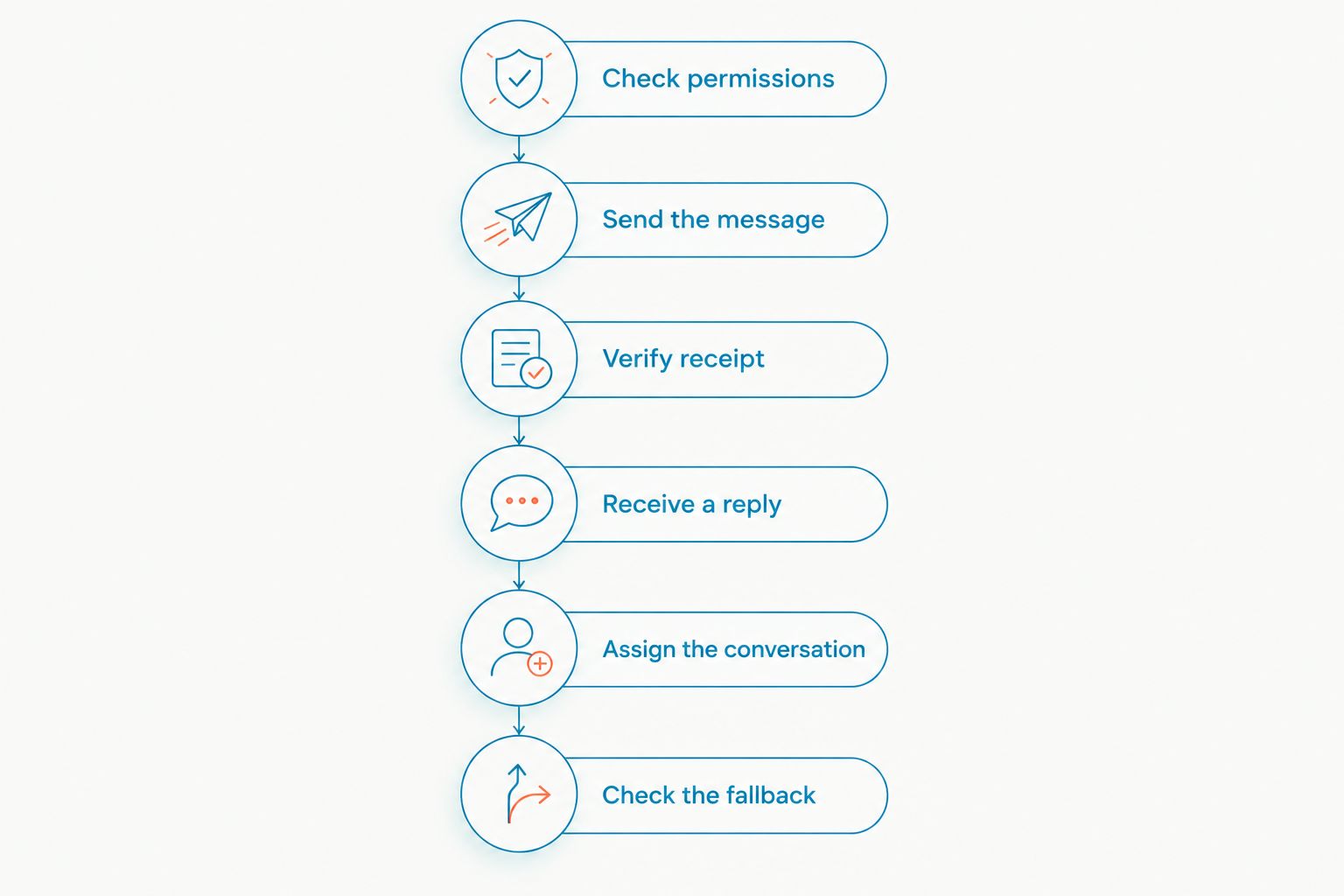
Record what you tested: destination, sender, message type, receipt, and reply outcome. A test supports that specific scenario; it does not prove universal delivery across every carrier or country.
Before expanding your 2026 workflow, repeat the checks for each newly supported destination. Keep failed routes out of automated customer messaging until you resolve them.
What changes when messages contain other languages?
Language affects both readability and SMS encoding. Under standard SMS encoding, a single GSM-7 message holds up to 160 characters, while a UCS-2 message holds up to 70 characters. Concatenated messages have lower per-segment limits because part of each segment carries reassembly information.
Characters outside the GSM-7 set can change how a message is encoded. Do not assume that a short-looking translation fits into the same number of segments as its English version.
Test the actual wording, including names and punctuation. Keep the business identity, purpose, and requested action clear, and ask a fluent reviewer to check important customer-facing translations.
Also assign language ownership. If customers can respond in another language, decide who will read the answer and handle requests to stop messages before enabling the workflow.
Where does VirtualPBX fit?
VirtualPBX is best for small-business teams that want business calling with support from real people. Its separate VirtualText offer combines SMS, webchat, a shared team inbox, and an AI agent for small-business service teams.
VirtualText's stated flat rate is $89/month. That describes the platform offer, not proof that a particular international destination or two-way SMS route is included; confirm those requirements separately.
Start with VirtualPBX and bring your destination list, existing number, intended messages, and reply requirements. Ask for confirmation of the complete workflow before moving international customer conversations into it.
The practical advantage of a shared inbox is team access to customer conversations. The limit is just as important: inbox organization cannot make an unsupported international route work. Choose the service around verified coverage first, then set up ownership and automation.
Do you need permission to text customers abroad?
Yes—establish the permission required for the destination and message purpose before sending. Do not treat a customer relationship or a phone number collected on a form as blanket permission for promotional texts.
Separate requested service messages from marketing. Keep a record of what the customer agreed to, identify your business clearly, and provide the withdrawal method required for the route and jurisdiction.
US business-messaging registration does not replace foreign requirements. Get destination-specific legal guidance when your campaign, customer data, or message content needs it.
Can customers reply to an international business text?
Customers can reply only when the route supports inbound responses to your sender. Ask your provider to confirm two-way support, then test it from the destination before inviting replies.
Do not use a reply-based appointment confirmation unless the answer reaches a monitored inbox. Give customers a working alternative when replies are unsupported.
Can you automate international appointment reminders?
You can automate reminders after confirming route support, permission, and reply handling. Schedule messages around the customer's local time and make the appointment's time zone clear.
Set a failure process before launch. If a reminder cannot be delivered, staff need another approved way to reach the customer rather than repeatedly sending the same text.
FAQ
Can I text any country from my US business number?
No. International SMS coverage depends on your provider, sender type, destination, and intended use. Confirm the exact route before sending.
Does international calling mean international texting is included?
No. International voice calling and SMS are separate capabilities. Ask your provider to confirm texting support for your specific number and destination.
Can international customers reply to my business texts?
Only if your provider supports inbound replies on that international route. Test a customer response before building a reply-based workflow.
Does US business-texting registration cover other countries?
No. US messaging registration does not replace destination-country requirements. Check the rules for the country, sender type, and message purpose.
Can VirtualPBX confirm whether my international texting workflow is supported?
Ask VirtualPBX to confirm your exact sender, destination, message purpose, and inbound-reply requirements. Do not treat general business SMS support as confirmation of international coverage.
Is webchat an alternative when international SMS does not work?
Yes. Website chat lets customers start a browser conversation without an international SMS route. Confirm how your team will continue the conversation after the visitor leaves.
What should I check before automating international texts in 2026?
Confirm destination support, sender eligibility, permission, delivery, replies, and staff ownership before automating international texts in 2026. Test the actual message and keep an approved fallback channel.
One last thing
Test an unexpected reply, not just a confirmation. Ask your test recipient to change an appointment or request a person, then follow the conversation through to resolution.
That test reveals whether you have a usable customer-service process or merely a working outbound message. International texting is ready only when your team knows what happens next.