
Missed calls leave home service jobs unbooked; text-back recovers revenue only when the conversation leads to a completed, paid job that your existing follow-up would not have won. Calculate recovery from those additional jobs and their collected revenue—not from texts sent, replies received, or estimates requested. Subtract service delivery and follow-up costs before calling the result profit.
- How much revenue can missed call text back recover? Count additional paid jobs, not replies or bookings.
- Separate text-assisted revenue from incremental revenue: some callers would have booked through your existing callback process.
- VirtualPBX serves small-business phone needs; evaluate missed-call text-back against completed jobs and follow-up costs.
- Match call logs, text conversations, and paid invoices before reporting recovered revenue.
How much revenue can missed-call text-back recover?
Recovered revenue equals the collected revenue from additional completed jobs attributable to missed-call text-back. There is no defensible universal dollar amount for a home service business. Your answer depends on your missed inquiries, the work you accept, and the jobs you actually complete.
For a 2026 forecast, use your own results at each stage rather than inserting an assumed industry conversion rate. The missed-call text-back setup guide covers the workflow; the measurement below establishes whether that workflow produces additional business.
| Measurement | Calculation | What it tells you | What it excludes |
|---|---|---|---|
| Text-assisted revenue | Collected revenue from jobs with a missed-call text conversation | Revenue connected to the workflow | Whether the customer would have booked anyway |
| Incremental recovered revenue | Additional collected revenue attributable to text-back | Revenue beyond your existing follow-up results | Service delivery and software costs |
| Net contribution | Incremental recovered revenue minus attributable delivery and follow-up costs | Financial contribution after those costs | Broader overhead unless you allocate it |
Start with text-assisted revenue because you can trace it through records. Treat incremental revenue as a separate measurement that requires a credible comparison with your normal callback process.
Why this matters
A customer who replies to an automatic message has not bought anything. An estimate request is not a completed job, and a booked visit is not a paid invoice. Treating these stages as revenue makes the workflow look more productive than the business records support.
Your first task is to connect the conversation to the outcome. Then ask whether text-back changed that outcome or simply became another touchpoint on a job you would have won anyway.
Keep 2 totals: text-assisted revenue and incremental recovered revenue. The distinction lets you recognize useful customer communication without overstating its financial return.
How do you calculate your own recovery estimate?
Use a staged calculation, then replace estimates with actual collected revenue as jobs close. Keep the measurement period consistent across calls, conversations, and jobs.
- Count eligible inquiries. Identify unique missed callers seeking work you perform in your service area. Remove spam, vendors, duplicate attempts, and unrelated calls.
- Count conversations. Record which eligible callers received the message and replied with a service inquiry. Keep delivery failures separate from unanswered messages.
- Count bookings. Match each conversation to an accepted appointment or job. Mark estimate visits separately from approved work.
- Count completed jobs. Remove cancellations and work that never proceeded. Keep open jobs outside completed-job totals.
- Record collected revenue. Match each completed job to the payment received, accounting for refunds and credits consistently.
- Assess incrementality. Compare outcomes with your existing follow-up process before claiming that all associated revenue was recovered.
A planning formula is:
Eligible missed inquiries × conversation rate × booking rate × completion rate × average collected revenue per completed job = projected text-assisted revenue.
Each rate needs its own denominator. Booking rate should describe bookings from conversations, not bookings divided by all incoming calls. Mixing denominators produces a result that cannot be checked against your records.
For your 2026 forecast, label unmeasured inputs as assumptions in your internal worksheet. Do not present an assumption-based projection as a realized return.
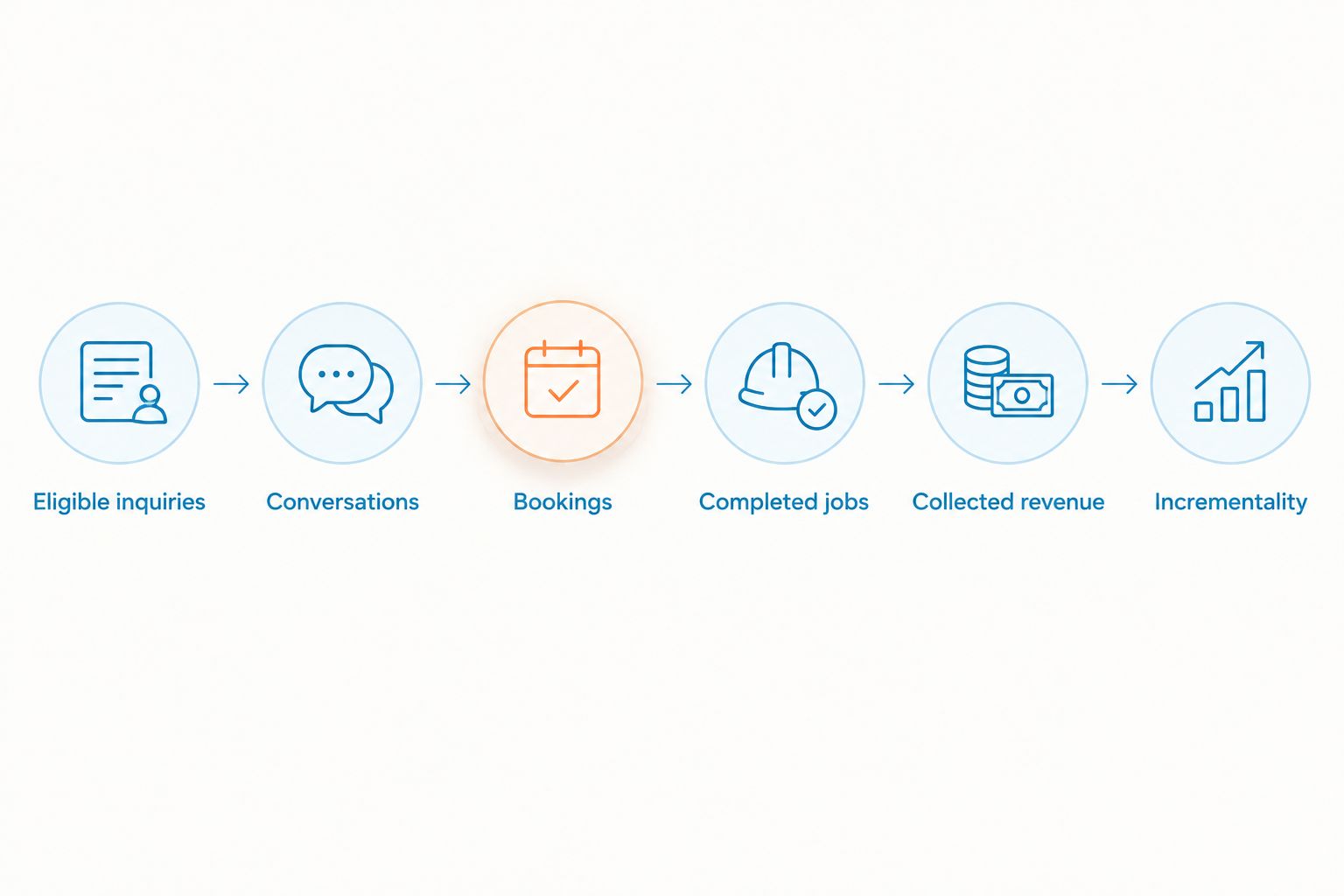
The calculation becomes useful when you can inspect the records behind each stage. A high reply count does not compensate for conversations that never reach a completed job.
Which records prove that a missed call became revenue?
Connect 3 records: the call log, the text conversation, and the paid invoice. A phone number helps match them, but use a customer or job identifier when available. Household members and property managers can contact you from different numbers.
Keep these fields in your lead log:
- Missed-call date and time.
- Customer identifier and contact number.
- Requested service and service location.
- Text delivery, reply, and staff response status.
- Assigned employee and next action.
- Booking status, completion status, and invoice reference.
- Collected revenue, refunds, and credits.
- Any existing appointment or active estimate before the missed call.
That final field matters. A customer calling about an appointment already on the calendar is not a newly recovered lead. Text-back can help serve that customer, but the original booking belongs outside your new-job recovery total.
For your 2026 reporting, group jobs by the date of the original inquiry and allow unfinished work to mature. Otherwise, a recent group of leads will look weaker simply because its jobs have not finished yet.
Why missed-call text-back revenue varies
The same workflow produces different financial results when the underlying inquiries or operating conditions differ. Use these factors to explain changes in your own results rather than borrowing another business's recovery claim.
- Eligible inquiry volume. Missed calls from suppliers, existing appointments, and spam do not represent new service opportunities. Count distinct qualified inquiries instead of raw missed-call events.
- Service fit. An inquiry outside your service area or outside the work you perform cannot become an accepted job without changing your operating scope.
- Conversation handling. A message starts a conversation; someone still needs to answer relevant questions, confirm the next action, and handle exceptions.
- Scheduling capacity. An interested customer is not a completed job when your crew cannot take the work. Track capacity-related losses separately from unanswered conversations.
- Job value and completion. Estimate requests, accepted work, completed work, and collected payments represent different stages. Changes in job mix affect revenue even when bookings stay level.
- Existing follow-up performance. If callbacks already recover the same callers, text-back has less additional revenue to claim. Evaluate the added result, not just the associated result.
These factors also identify the next move. If customers reply but do not book, inspect qualification and scheduling before changing the opening message. If bookings happen but jobs do not finish, investigate cancellations and delivery rather than celebrating the booking total.
Which follow-up approach fits the work?
Choose the approach around the inquiry and the person responsible for responding. Automation is an acknowledgment tool, not evidence that a customer received a useful answer.
| Approach | Best for | Practical benefit | Limitation |
|---|---|---|---|
| Manual callback | Inquiries requiring a detailed spoken discussion | Lets staff clarify the issue directly | Requires a person to place the call and reach the customer |
| Automatic text acknowledgment | Confirming receipt while staff cannot answer | Gives the caller a written route to continue | Does not itself qualify, schedule, or complete the job |
| Text conversation with staff | Gathering service details and agreeing on the next action | Keeps the exchange available for follow-up | Needs an assigned person and a clear handoff |
Use text-back alongside a defined callback process, not as a substitute for responsibility. Offer a way to request a call when the customer needs a spoken discussion. Do not require customers to diagnose equipment or describe an urgent hazard through a messaging exchange.
Assign 1 owner per active inquiry and make ownership visible. A shared conversation without an owner can remain unanswered even when several employees can see it.
Where does the client platform fit?
VirtualText, by VirtualPBX, combines SMS, webchat, a shared team inbox, and an AI agent for small-business service teams. That makes the separate offer relevant when your operational problem extends beyond calls to customer messages and website inquiries.
VirtualPBX is best for small teams that need a cloud business phone system with real human support. Keep that phone-system decision separate from the question of how much revenue a text workflow produces.
For missed-call recovery, the benefit of a shared inbox is a common place to manage conversations. The limitation is financial attribution: access to a conversation does not establish that the resulting job was additional. Before adopting a workflow, confirm its missed-call trigger, number requirements, handoff behavior, and reporting against the process you intend to measure.
How do you test whether text-back adds revenue?
Define the comparison before looking at the result. Compare like-for-like inquiries handled through your established follow-up process with inquiries handled through the proposed text-back process, while maintaining appropriate customer service.
Use consistent definitions for an eligible inquiry, a booking, a completed job, and collected revenue. Record differences in service type, operating hours, crew capacity, and lead source. A busy period with more available technicians is not a clean comparison with a period when your schedule was full.
For a 2026 evaluation, report these outcomes together:
- Eligible inquiries and the handling process each received.
- Conversations, bookings, completed jobs, and collected revenue.
- Staff follow-up work and attributable operating costs.
- Exclusions, unresolved jobs, and differences between the groups.
Do not call a before-and-after revenue increase proof on its own. If demand, job mix, or capacity changed at the same time, those changes also need consideration. Keep the conclusion as narrow as the comparison supports.
Does a reply count as recovered revenue?
A reply counts as engagement, not recovered revenue. Record it as a conversation until it leads to a completed, paid job, and keep existing appointments separate from new service opportunities.
Should you use booked revenue or collected revenue?
Collected revenue is the stronger basis for reporting realized recovery. Track bookings as an early operational signal, but do not count canceled work or unpaid estimates as money recovered.
Does missed-call text-back replace answering the phone?
Missed-call text-back is a fallback, not a replacement for answering calls. Keep voice contact available for customers who need a conversation, and establish a clear handoff for urgent or complicated inquiries.
FAQ
How much revenue can missed call text back recover for my home service business?
Recovered revenue is the collected revenue from additional completed jobs attributable to missed-call text-back. Calculate it from your own eligible inquiries, job outcomes, and payments rather than applying an unsupported average.
What's the difference between text-assisted revenue and recovered revenue?
Text-assisted revenue includes paid jobs connected to a text conversation; recovered revenue includes only the additional business attributable to the workflow. A customer who would have booked through your normal callback process belongs in the first total but is not automatically incremental.
Can I count every missed call as a lost job?
No, every missed call is not a lost job. Exclude spam, duplicate attempts, suppliers, existing appointment questions, and inquiries for work you do not accept before estimating opportunity.
Is a booked estimate the same as recovered revenue?
No, a booked estimate is a pipeline event rather than recovered revenue. Follow it through accepted work, completion, and payment before counting realized revenue.
How do I know whether a customer would have booked anyway?
You need a credible comparison with your existing follow-up process to estimate whether the booking was additional. A text conversation and an invoice establish a connection, but they do not establish incrementality by themselves.
Does VirtualPBX offer a business phone system or a shared text inbox?
VirtualPBX provides a cloud business phone system for small teams. VirtualText is the separate SMS, webchat, shared-inbox, and AI-agent offer described for service teams; confirm the workflow requirements for the offer you are considering.
What should I track before claiming a return on text-back?
Track eligible inquiries, conversations, bookings, completed jobs, collected payments, and attributable costs. Keep text-assisted revenue separate from additional revenue, and subtract delivery and follow-up costs before describing profit.
One last thing
Audit the jobs already on your calendar before celebrating recovered revenue. An existing customer can miss a callback, reply to a text, and pay an invoice without the text creating any new business. Removing those cases makes your 2026 results more useful: you can see whether to improve lead capture, follow-up, or service delivery.