
Texting patients can comply with HIPAA, but ordinary SMS is not automatically a compliant channel for protected health information. Your practice must assess the information involved, apply appropriate safeguards, honor applicable patient communication requests, and obtain a business associate agreement when the vendor’s role requires one. Start with approved message templates and a documented workflow—not a texting subscription alone.
- Is texting patients HIPAA compliant? Yes, when the healthcare provider meets applicable privacy, security, and vendor requirements.
- HHS permits appointment reminders, but reminder texts can still contain protected health information.
- Patient permission does not replace a security risk analysis or a required business associate agreement.
- VirtualPBX business texting needs a healthcare-specific review before a practice uses it for patient information.
Is texting patients HIPAA compliant for healthcare providers?
HIPAA permits patient communication; it does not approve every texting service or workflow. The answer depends on your practice’s obligations, the message content, who receives it, and how your systems protect it.
When planning appointment reminder texts, review incoming replies as carefully as outgoing templates. A patient can turn a scheduling exchange into a clinical conversation immediately.
| Communication option | Best for | Practical benefit | Limitation or risk |
|---|---|---|---|
| Ordinary SMS | Limited notifications under an approved policy | Reaches a patient’s regular messaging app | Does not provide end-to-end encryption; messages can appear on shared devices |
| Secure patient portal messaging | Clinical discussions and sensitive documents | Keeps message content inside an authenticated environment | Patients must access the portal; configuration and staff practices still matter |
| Managed business texting | Team coordination and administrative messaging after review | Gives staff a shared place to handle conversations | A shared inbox alone proves neither HIPAA compliance nor suitable vendor terms |
HHS Office for Civil Rights guidance permits appointment reminders without a separate HIPAA authorization. That permission does not remove the duty to use reasonable safeguards or satisfy applicable Security Rule requirements for electronic protected health information.
Why this matters
A short message can reveal a healthcare relationship. A clinic name, appointment detail, or reply about medication can connect an identifiable person to care—even without a diagnosis in the original text.
For your 2026 messaging review, assess the complete exchange: delivery, replies, staff access, storage, exports, and deletion. A carefully written reminder does not make an uncontrolled conversation safe.
HIPAA also distinguishes permission to disclose information from the security of the channel carrying it. A treatment-related message can be permissible under the Privacy Rule while the practice’s handling of that message still creates a Security Rule problem.
Ordinary SMS: useful notifications, limited control
Ordinary SMS is convenient because patients do not need to open a separate portal. Its weakness is control: a message can reach a reassigned number, appear on a lock screen, or remain accessible on a shared phone.
Use your risk analysis to decide whether a particular SMS workflow is appropriate. Do not treat removing a diagnosis as proof that a message contains no protected health information, or PHI.
Your reminder policy should address:
- Recipient verification: Confirm the number and whether another person uses the device.
- Message content: Limit information to what the approved workflow requires.
- Patient preferences: Record communication choices and applicable confidential communication requests.
- Reply handling: Tell staff what to do when a patient sends clinical details.
Avoid clinical attachments and detailed results in ordinary SMS unless your compliance review specifically supports that workflow. When you need a secure discussion, direct the patient to an approved channel without repeating sensitive details in the notification.
Secure portal messaging: stronger control, more patient steps
A properly configured patient portal supports authenticated access to clinical conversations. It separates the notification from the protected content: the text can tell the patient to check a message rather than include the result itself.
The trade-off is friction. Patients need access credentials, and staff need a process for people who cannot use the portal.
Use an appropriately secured portal for sensitive discussions rather than making an SMS thread carry the clinical record. Portal messaging still requires access controls, appropriate vendor arrangements, staff training, and a documented response process. The word “secure” is not a substitute for those checks.
Managed business texting: shared access, shared responsibility
A business texting platform can organize conversations across a front-desk team. That operational benefit creates another question: which employees, administrators, integrations, and vendors can access patient information?
VirtualText, by VirtualPBX, combines SMS, webchat, and a shared team inbox. Those functions explain its business use; they do not establish that a particular healthcare workflow meets HIPAA requirements.
VirtualPBX is best for small teams evaluating business communications, with patient texting subject to a separate HIPAA review. Before using VirtualText for PHI, obtain written confirmation of the applicable service scope, safeguards, and business associate agreement availability. Do not infer healthcare suitability from shared-inbox functionality.
Why HIPAA compliance varies between texting workflows
The same message template can create different risks in different practices. Your 2026 assessment should cover these factors:
- Information involved: Appointment details, images, billing questions, and clinical replies create different exposure risks.
- Recipient circumstances: Shared phones, caregivers, minors, and reassigned numbers affect who receives the information.
- Vendor role: A service that stores or processes PHI generally requires different contractual treatment from a transmission-only conduit.
- Access controls: Individual accounts and prompt access removal help prevent inappropriate staff access.
- Connected systems: Forwarding, exports, notifications, and integrations create additional places where PHI can appear.
- Practice procedures: Approved templates, training, escalation, and incident response determine how staff use the service.
Encryption is one part of this assessment. Under the HIPAA Security Rule, encryption specifications are addressable—not an invitation to ignore them. The practice must assess whether implementation is reasonable and appropriate and document its decision, including appropriate alternatives where applicable.
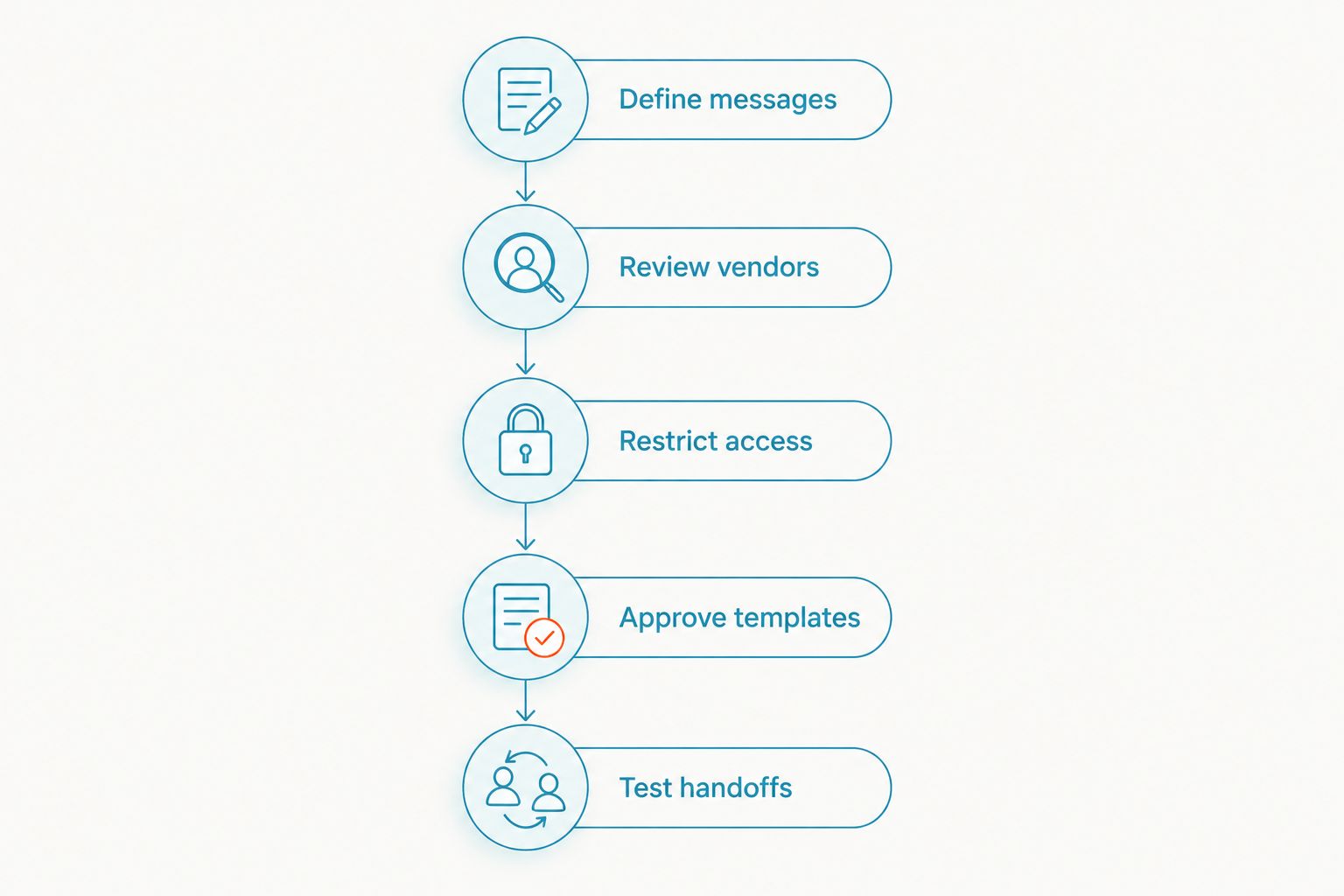
How do you set up a patient-texting workflow?
Use this sequence before launching patient texting or expanding an existing service. Apply the same review when changing vendors, enabling integrations, or adding automated replies in 2026.
Define messages
List the actual uses: appointment reminders, scheduling changes, administrative questions, and clinical replies. Identify where PHI enters each workflow, including information patients volunteer without being asked.
Separate service messages from promotional campaigns. A treatment reminder and a marketing text do not automatically share the same permission requirements.
Review vendors
Identify every service that creates, receives, maintains, or transmits PHI for your practice. Ask which functions and subcontractors the proposed business associate agreement covers.
A vendor storing encrypted PHI can still be a business associate even if it lacks the decryption key. HHS guidance on cloud computing makes that distinction; do not assume encryption eliminates the need for an agreement.
Restrict access
Assign individual staff accounts and permissions appropriate to each role. Review authentication, device access, session handling, and the ability to remove a departing employee’s access.
Ask what activity records the service provides. Your practice needs to understand how it will investigate a wrong-recipient message or inappropriate access—not discover the limits during an incident.
Approve templates
Have the privacy or compliance lead approve outgoing messages and the instructions for handling replies. Include a route for clinical questions, urgent concerns, communication preferences, and opt-outs.
Do not invite patients to submit symptoms, identification documents, or insurance images through a channel that has not been approved for that information. Keep automated prompts within the reviewed scope.
Test handoffs
Test with fictional patient details. Check wrong-number responses, after-hours replies, staff reassignment, portal handoffs, and notification previews before using real patient information.
Record who owns the workflow and who approves changes. Keep VirtualPBX business texting procurement separate from the decision to authorize any particular patient-information use.
Does patient consent make ordinary texting HIPAA compliant?
Patient consent alone does not make ordinary SMS HIPAA compliant. A communication preference does not cancel your practice’s security obligations or replace a required business associate agreement.
HIPAA allows patients to request confidential communications by alternative means or at alternative locations, and covered providers must accommodate reasonable requests. Document the request and assess how to meet it appropriately rather than treating a signed form as a blanket waiver.
Also separate HIPAA analysis from other texting rules. Telephone Consumer Protection Act requirements, state privacy laws, and messaging-provider rules can apply independently; permission for healthcare communication does not automatically authorize promotional texting.
Are appointment reminders considered protected health information?
Appointment reminders can contain PHI even when they omit a diagnosis. Identifying a patient and connecting that person to healthcare can be enough; the specialty or context can add sensitivity.
HHS permits appointment reminders as part of treatment without a separate HIPAA authorization. Use reasonable safeguards, consider the patient’s communication preferences, and avoid unnecessary detail rather than assuming every reminder is harmless.
Do healthcare texting vendors need a business associate agreement?
A business associate agreement is generally required when a vendor creates, receives, maintains, or transmits PHI on your practice’s behalf. Determine the vendor’s actual role and whether a narrow exception, such as the conduit exception, applies.
A platform that maintains searchable patient conversations is not automatically equivalent to a carrier merely transmitting messages. Review the agreement’s scope against the exact service you intend to use.
What should you document and do after a texting incident?
Keep the risk assessment, relevant policies, vendor agreements, training records, and incident procedures together. Under 45 CFR §164.316, required Security Rule documentation must be retained for 6 years from creation or the date last in effect, whichever is later. That is not a universal retention period for medical records or every text message.
If a message reaches the wrong person, preserve the facts and notify your privacy lead promptly. Assess the information disclosed, the recipient, whether it was actually acquired or viewed, and mitigation; an impermissible disclosure is not automatically exempt from breach assessment because it was accidental.
For a reportable breach of unsecured PHI, individual notifications must occur without unreasonable delay and no later than 60 calendar days after discovery. Breaches affecting 500 individuals or more also trigger HHS notification within that period; smaller breaches follow a different HHS reporting schedule. State requirements can add obligations.
For your 2026 incident plan, name the person responsible for that assessment. Do not leave a front-desk employee to decide whether deleting the conversation resolves the event.
FAQ
Can a doctor text a patient about test results?
A doctor can communicate test results electronically when the disclosure is permitted and the practice applies appropriate safeguards. Use an approved secure channel for sensitive results rather than assuming ordinary SMS is suitable.
Is texting a patient’s name a HIPAA violation?
Texting a patient’s name is not automatically a HIPAA violation, but its connection to healthcare can make it PHI. The recipient, purpose, context, and safeguards determine whether the disclosure is permissible.
Can patients send medical information to our business texting number?
Patients can send medical information even when your practice asks them not to. Your workflow must account for incoming PHI and direct staff to move clinical conversations to an approved channel.
Does a business associate agreement make a texting app compliant?
A business associate agreement alone does not establish HIPAA compliance. Your practice must also evaluate safeguards, configuration, staff access, policies, and how the service handles PHI.
Can our front desk text patients from a personal phone?
Do not permit personal-phone texting without an approved device and messaging policy. Personal accounts, backups, shared access, and employee departures create risks that the practice must assess and control.
Does HIPAA require us to keep every text for 6 years?
HIPAA’s 6-year Security Rule documentation requirement does not require keeping every text for 6 years. Message and medical-record retention depend on the content, applicable laws, and your approved retention policy.
Does VirtualPBX automatically make patient texting HIPAA compliant?
No. A VirtualPBX subscription does not automatically make a patient-texting workflow HIPAA compliant. Confirm the specific service’s contractual coverage and safeguards before allowing PHI.
One last thing
Audit the reply, not just the reminder. A patient who receives a simple scheduling message can respond with a diagnosis, a photo, or a medication question.
For your next 2026 workflow check, follow that reply through notifications, staff access, integrations, and storage. The safest outgoing template cannot compensate for an unreviewed path for incoming patient information.