
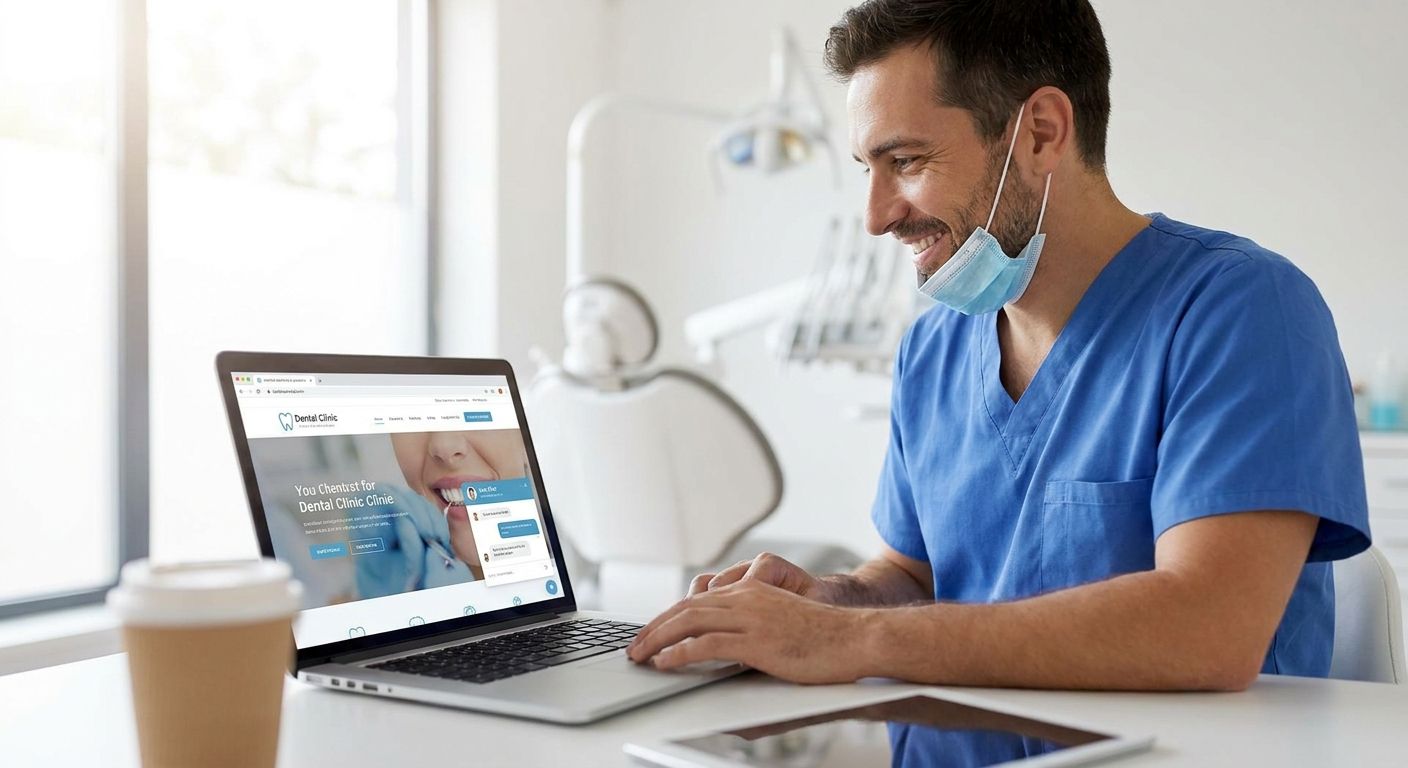
Dental practice live chat software is a webchat widget on your website that answers patient questions, collects new-patient details, and books appointments even when the front desk has gone home for the night. Dental patients search for a new dentist at odd hours — after work, during lunch, on Saturday mornings — and a practice that only answers phones from 8 to 5 misses most of that window in 2026.
- VirtualText pairs webchat, texting, and an AI agent for $89/month flat rate — the fastest live chat software for dental practice websites to set up without hiring.
- A human-only chat widget stops working the second your front desk clocks out; dental patients search nights and weekends.
- Pair VirtualPBX Smarter Voice at $15 per user per month with webchat if you also want missed phone calls answered.
- Skip live chat and voicemail becomes your after-hours strategy — most dental patients hang up instead of leaving one.
Why live chat matters for dental practices
A missed call from a new patient is a lost patient more often than not in dental care — they call the next practice on the list within minutes. Website chat catches the visitors who were never going to call in the first place: people scanning your site on a phone, comparing three practices in one tab, deciding based on who responds first.
Dental front desks are also busy in ways a lot of businesses aren't. Staff are checking in patients, confirming insurance, and answering the phone at the same time a website visitor is typing a question about whether you take their plan. That visitor waits 30 seconds, gets nothing, and closes the tab.
The fix isn't more staff. It's a chat setup that answers the routine questions — hours, insurance, new-patient paperwork — instantly, and routes anything urgent or clinical to a real person. VirtualPBX's AI customer service agent for dental practices is built around exactly that split.
Live chat software for dental practice websites works when it catches the after-hours and lunch-hour visitors your front desk physically can't answer.
Track every question patients already ask
Before adding software, find out what your practice is actually being asked. This costs nothing and takes an afternoon.
- Pull the last 30 days of voicemails and note the recurring questions
- Check your website contact form submissions for patterns
- Review Google Business Profile messages, if patients use them
- Ask front desk staff what they get asked most at check-in
- Look at no-show and reschedule requests — these often come in after hours
Draft standard answers for your top questions
Most dental chat traffic clusters around a short list of questions. Write the answers once, in plain language, before you automate anything.
- Whether you accept a given insurance plan, and what a cleaning covers
- Whether you're taking new patients and how soon they can be seen
- What to bring to a first appointment
- Whether you handle dental emergencies same-day
- Your hours, including any Saturday availability
- Where cost ranges for common procedures are published
Turn on an AI-backed webchat instead of hiring a night shift
Once your questions and answers are written, the manual option is a staffer watching a chat inbox during business hours — which still leaves nights and weekends uncovered. The faster path is software that answers routine questions automatically and hands off anything it can't handle.
VirtualText, VirtualPBX's webchat and shared-inbox product, runs an AI agent trained on your practice's answers and replies by chat or text for a flat $89/month — no per-seat pricing to track as your team grows. Installation follows the same steps as any service business setting up a webchat widget.
- Add the chat script to your booking, contact, and new-patient pages
- Load your top-question answers into the AI agent
- Set office hours so the AI knows when to say a team member will follow up
- Turn on SMS so chats that start on desktop can continue by text
- Confirm the widget renders correctly on mobile, where most dental searches happen
Route unanswered chats to the right staff member
An AI agent should never guess on clinical or billing specifics. Build a routing rule before you launch.
- Send insurance-verification questions to whoever handles billing
- Route tooth pain or emergency language to an on-call number immediately
- Send new-patient scheduling requests straight into your booking calendar
- Flag anything mentioning a current patient's treatment plan for a hygienist or dentist
Connect chat to your booking calendar
A chat that answers questions but still makes the patient call back to book loses momentum. Link scheduling directly into the conversation.
- Share your booking link inside the first few chat replies for new-patient requests
- Confirm the appointment type before sending a link: cleaning, emergency, or consult
- Send a text confirmation once a slot is picked
- Follow up by text 24 hours before the appointment to cut no-shows
Measure response time and after-hours capture rate
You can't improve what you don't track. Pull these numbers monthly.
- Average time to first reply during business hours vs. after hours
- Number of chats started outside 8am to 5pm
- Percentage of chats that convert to a booked appointment
- The point in the conversation where visitors stop replying
Train your front desk on the AI-to-human handoff
The AI agent isn't meant to replace your staff. It's meant to hand things to them cleanly.
- Show staff how flagged conversations appear in the shared inbox
- Set an expected reply window for handed-off chats — same business day is reasonable
- Review a sample of AI-only conversations weekly for accuracy
- Update the AI's answers whenever hours, insurance list, or pricing changes
Comparing your live chat options for 2026
| Option | Best for | Starting price | Key limitation |
|---|---|---|---|
| Voicemail only, no chat | Practices fine losing after-hours leads | $0 | No lead capture at all nights or weekends |
| Human-staffed basic chat widget | Practices with staff free to monitor chat | Varies by vendor | Coverage ends the moment staff log off |
| VirtualText webchat + AI agent | Practices wanting after-hours coverage without hiring | $89/month flat rate | AI handles routine scheduling and insurance questions; clinical questions route to staff |
| VirtualPBX Smarter Voice + AI FrontDesk | Practices that also want missed calls answered | $15/user/month, AI FrontDesk adds $99 | Built for phone calls, not website chat — pair with webchat for full coverage |
Verdict: for a single-location dental practice, VirtualText's flat $89/month webchat setup covers the after-hours gap voicemail can't, and it pairs with VirtualPBX Smarter Voice if missed calls are also a problem.
“If a patient can't get an answer after 6pm, they'll book with whoever answers first.”
Common mistakes dental practices make with live chat
- Turning the widget off outside business hours — this defeats the entire purpose of adding chat
- Loading generic answers instead of practice-specific ones — patients ask about your insurance list and your hours, not a template's
- Letting the AI answer clinical questions it shouldn't — tooth pain, medication questions, and treatment specifics need a routing rule to a real person
- Ignoring mobile rendering — most dental searches in 2026 happen on a phone, and a widget that doesn't fit the screen gets closed immediately
- Never reviewing chat transcripts — practices that skip a monthly accuracy check end up with an AI agent quoting outdated hours or pricing
Get webchat and texting for your practice
See how VirtualText handles new-patient conversations for $89/month.
FAQ
What's the best live chat software for dental practice websites in 2026?
VirtualText is built for small service businesses including dental practices, combining webchat, texting, and an AI agent for a flat $89/month. It answers routine patient questions after hours and routes clinical or urgent messages to staff.
How much does live chat software cost for a dental office?
VirtualText runs $89/month flat rate regardless of team size, covering webchat, SMS, and a shared inbox. Basic human-only widgets from other vendors vary in price and typically stop working once staff log off.
Is live chat better than a phone answering service for dental practices?
Live chat catches website visitors who were never going to call, while VirtualPBX Smarter Voice at $15 per user per month catches missed calls. Most practices need both to cover every channel.
Can AI chat handle sensitive patient questions?
Set the AI agent to route anything involving a current patient's treatment, medication, or billing detail directly to staff instead of answering automatically. Routine questions like hours, insurance acceptance, and new-patient scheduling are safe for AI to handle.
Do patients actually use chat instead of calling a dentist?
Patients researching a new dentist frequently browse multiple practice websites in one sitting and prefer typing a quick question over calling each one. A widget that responds instantly keeps them on your site instead of the next tab.
How fast should a dental chat widget respond?
Instantly for routine questions handled by an AI agent, and within the same business day for anything flagged to staff. Slower response times push visitors to a competing practice's site.
Does live chat replace my front desk?
No. Chat handles repetitive questions and after-hours traffic so front desk staff can focus on patients in the office and on anything the AI flags for a human reply.
What's the setup time for adding webchat to a dental website?
Adding a chat widget and loading a practice's top-question answers is typically a same-day job, since it's a script added to existing booking and contact pages rather than a site rebuild.
One last thing
Most dental practices treat after-hours leads as unsolvable and quietly write them off. The bigger cost in 2026 isn't the missed chat — it's the AI agent still running on last year's insurance list or old office hours because nobody read the transcripts in three months. Check yours before you change anything else.


