
A shared inbox solves missed customer texts; consent records and opt-out controls determine whether you should use it for a particular campaign. VirtualPBX is best suited to small service teams evaluating SMS and webchat together; for business texting compliance features, choose the service that proves its controls against your actual workflow.
- Evaluate VirtualPBX for shared SMS and webchat, not as an automatic compliance winner.
- Rank business texting compliance features by consent evidence, opt-out enforcement, access controls, and exportable records.
- Marketing teams need campaign safeguards; healthcare teams need a documented privacy review.
- Require a live demonstration before importing contacts or enabling automated follow-up.
Why this matters
A customer asking for an appointment has not necessarily agreed to promotional texts. A shared inbox makes those conversations easier to manage, but your team still needs rules for what it sends and why.
VirtualPBX provides business phone services, while VirtualText is its separate SMS, webchat, shared-inbox, and automated-agent offer. Keep those buying decisions distinct: phone-system features do not establish texting compliance capabilities.
For your 2026 shortlist, separate three questions: does the service fit your workflow, does it enforce your messaging rules, and can you produce evidence afterward? This guide ranks service approaches by use case, then identifies the controls each must demonstrate. It is not a certification of any provider's legal compliance.
What makes the best business texting compliance features?
Use these criteria before comparing inbox layouts or automation demos:
- Consent evidence: Retrieve the permission source, collection time, disclosure, and messaging purpose for a contact.
- Opt-out enforcement: Demonstrate that an unsubscribe prevents prohibited follow-up across staff and connected workflows.
- Sender registration: Explain the applicable carrier registration or verification process for your number and messaging use.
- Team permissions: Show who can send messages, change templates, import contacts, and export conversations.
- Exportable records: Produce usable conversation histories and relevant consent and suppression records.
- Sensitive-data safeguards: Document appropriate access, retention, contracts, and handling procedures for regulated information.
A compliance feature earns its place only when it changes behavior or produces evidence. A badge or checkbox does neither on its own.
Carrier registration and legal permission are different requirements. Registering a messaging campaign does not create customer consent, and a customer permission record does not replace applicable carrier requirements.
Business texting services at a glance
The ranking below is a buying order for different operational needs, not a claim that one provider has passed every compliance check. Match your use case first, then apply the same evidence requirements to every candidate.
| Rank and service approach | Best for | Standout workflow | Compliance proof to require | Key limitation |
|---|---|---|---|---|
| 1. VirtualPBX's VirtualText offer | Small teams combining SMS and website conversations | SMS, webchat, shared inbox, and an automated agent | Consent handling, suppression, permissions, and exports | Workflow fit does not establish compliance readiness |
| 2. Consent-first marketing texting service | Permission-based promotional campaigns | Campaign preparation and audience management | Purpose-specific consent and campaign-wide suppression | Campaign controls do not replace service-team handoffs |
| 3. Healthcare-configured texting service | Patient-facing organizations handling sensitive information | Messaging governed by privacy procedures | Appropriate agreements, safeguards, access, and retention | A healthcare label alone is insufficient |
| 4. API-based messaging service | Teams building custom messaging workflows | Application-controlled sending and record handling | Enforcement across every sending application | Your team must build and maintain the surrounding controls |
1. VirtualPBX: best for shared customer conversations
VirtualPBX's VirtualText offer combines SMS, webchat, a shared team inbox, and an automated agent for small-business service teams. Its stated workflow fits businesses that want to capture website inquiries and continue customer conversations without scattering them across individual staff phones.
Best for: Insurance agencies, home-service businesses, and other small service teams evaluating a combined texting and webchat workflow.
VirtualText pros:
- Combines website chat and SMS within one service offer.
- Provides a shared team inbox rather than relying on personal phones.
- Includes an automated agent for handling inquiries.
- Addresses after-hours and website lead-response workflows.
VirtualText cons:
- A shared inbox does not itself establish permission to send marketing messages.
- Automated replies require explicit rules for opt-outs, sensitive questions, and human handoffs.
- Combining channels requires checking whether website permission covers subsequent SMS.
For a 2026 evaluation, bring a real intake form and a sample follow-up sequence. Ask the provider to trace the permission record from the website conversation into the text thread, then demonstrate what happens when the customer withdraws permission.
Also request a record export. Your administrator should understand what the export contains and how to connect a conversation to its permission history.
Verdict: Hold until the required controls pass your demonstration. The combined-channel workflow is a reason to evaluate the service, not a substitute for that demonstration.
2. Consent-first services: best for promotional campaigns
A consent-first marketing service is the right category to evaluate when your main activity is sending promotions to a permission-based audience. Define this category by demonstrated controls, not the provider's description of itself.
Best for: Businesses sending promotional campaigns rather than primarily answering customer service inquiries.
Consent-first service pros:
- Makes permission evidence a purchasing requirement.
- Encourages separation between promotional audiences and service contacts.
- Places suppression checks before campaign sending.
Consent-first service cons:
- An imported customer list still needs a defensible permission basis.
- Campaign approval does not establish that every recipient belongs in the audience.
- Marketing workflows still need a process for customer replies.
Ask the provider to show how a contact becomes eligible for a campaign. Then inspect whether staff can bypass that rule through a manual send, contact import, or connected application.
For automated marketing texts covered by the Telephone Consumer Protection Act, Federal Communications Commission rules generally require prior express written consent. Evaluate the actual campaign with counsel rather than treating every business text as legally identical.
Verdict: Buy only after consent eligibility and suppression pass the campaign test. Skip a service that cannot explain why each recipient qualifies.
3. Healthcare-configured services: best for patient messaging
Healthcare organizations need a privacy assessment alongside the texting review. Appointment reminders, intake questions, and clinical discussions can involve different information and risks.
Best for: Covered healthcare organizations evaluating patient-facing messaging involving protected health information.
Healthcare-configured service pros:
- Puts sensitive-data handling into the buying decision.
- Requires an explicit review of staff access and message content.
- Connects vendor selection to the organization's privacy procedures.
Healthcare-configured service cons:
- A vendor's healthcare positioning does not establish HIPAA compliance.
- A business associate agreement alone does not settle every safeguard question.
- Ordinary SMS should not be treated as a secure patient portal.
The U.S. Department of Health and Human Services explains that covered entities must use appropriate safeguards when communicating electronically with patients. Where a vendor acts as a business associate, assess the applicable agreement and responsibilities before using the service for protected health information.
In your 2026 review, have the privacy lead approve message templates, access rules, and escalation procedures. Keep unnecessary clinical details out of routine scheduling messages.
Verdict: Hold until the privacy review approves the exact workflow. Do not buy solely because a sales page mentions healthcare.
4. API-based services: best for custom control
An API-based messaging service lets your software initiate and receive messages through a programmatic connection. It belongs on the shortlist when your team needs sending rules tied directly to application events or internal records.
Best for: Organizations with developers responsible for messaging logic and ongoing maintenance.
API-based service pros:
- Lets your team define application-specific sending rules.
- Supports designing consent checks around your internal records.
- Gives developers control over how messaging events enter business workflows.
API-based service cons:
- Your application must implement the controls it needs.
- Separate sending paths create additional places to test suppression.
- Maintenance continues after the initial connection works.
Require your developers to identify every path that can send a text: scheduled jobs, staff actions, imports, and connected systems. Apply permission checks consistently rather than only inside the main interface.
Also define what happens when a consent lookup fails. For messages that require that consent, the safe operational rule is to stop the send and request review, not assume permission.
Verdict: Buy only if you can maintain the complete control chain. Skip this approach if nobody owns that responsibility.
Run these compliance tests before signing
For a practical 2026 comparison, ask each candidate to perform 3 live tests using fictional contacts. Use 2 staff accounts and 1 suppressed test number so the demonstration covers shared access rather than a single administrator's screen.
Consent capture
Create a fictional contact through your intended collection method. Ask the demonstrator to retrieve the disclosure, collection time, source, and permitted message purpose.
Next, change the form wording. Check whether the earlier record still shows what that contact originally accepted rather than only the current form.
Opt-out enforcement
Send an unsubscribe request from the test number. Attempt a follow-up through the staff inbox, scheduled automation, and any connected system included in your proposed setup.
The demonstration should distinguish an allowed opt-out confirmation from further promotional messaging. Ask how staff handle ordinary-language requests such as a customer asking not to be contacted again.
Record retrieval
Have a different staff member locate the conversation and its permission history. Export the relevant records, then inspect whether they remain understandable outside the provider's interface.
Check access removal too. A departing employee should not retain access merely because an old session or connected application remains active.
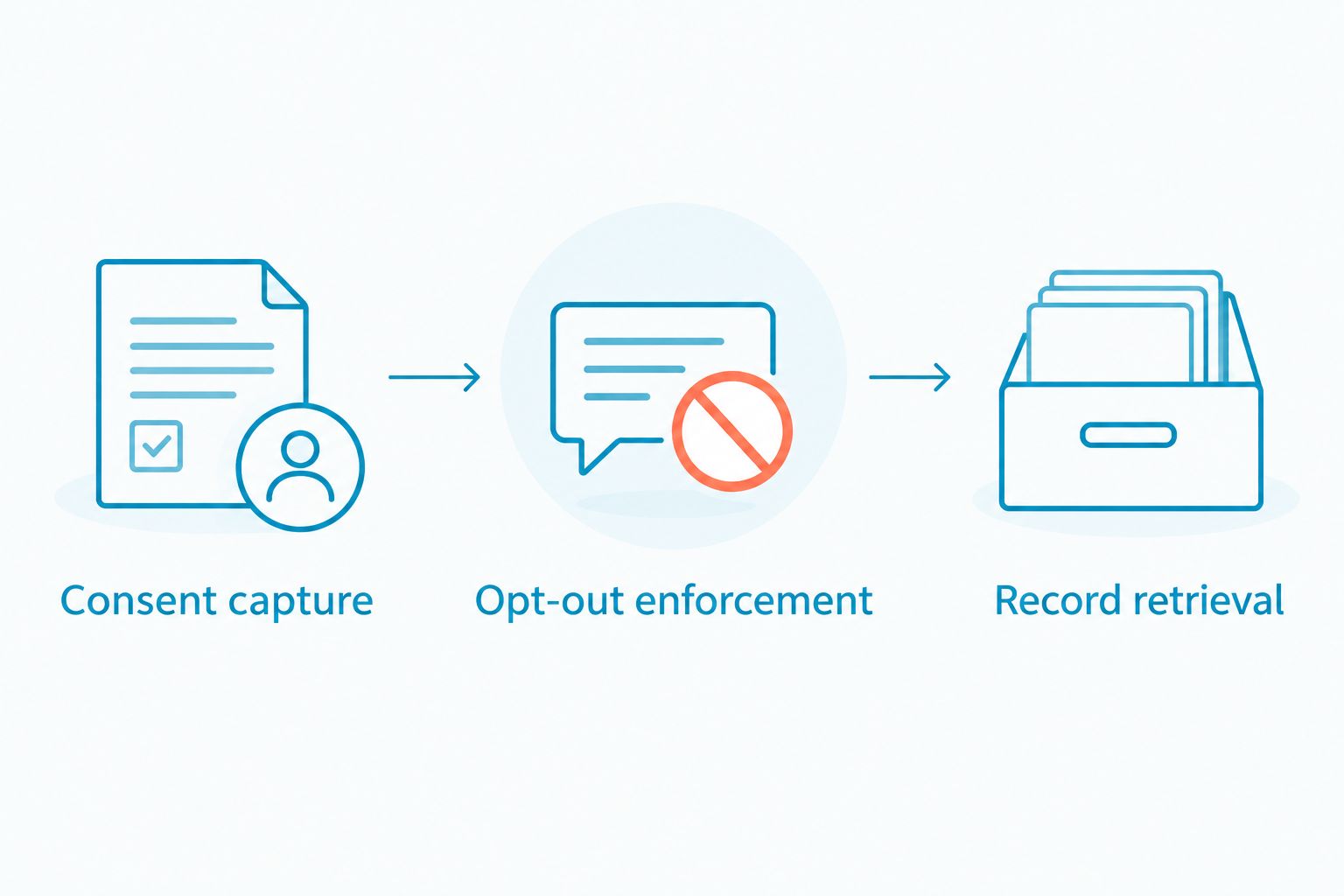
Keep a written acceptance record for these tests. Record what passed, who owns unresolved configuration work, and which sending paths remain disabled until that work is complete.
How the ranking works
The ranking prioritizes operational fit before complexity: shared customer conversations, promotional campaigns, patient messaging, then custom applications. Each approach has a distinct buyer and a distinct burden of proof.
Within your chosen category, use consent evidence and suppression as purchase gates. Compare permissions, records, and sensitive-data safeguards next. Interface convenience comes afterward.
This method does not award unsupported compliance scores. It gives you a repeatable way to reject a service that cannot demonstrate a required control, regardless of its feature list.
Which business texting service should you choose?
Start with the simplest service that supports your actual messaging purpose and passes your control tests. For a small team combining customer texts with website inquiries, evaluate VirtualPBX's VirtualText offer first. Require the same evidence you would request from any alternative.
Choose a campaign-focused service for promotional sending. Bring healthcare messaging through a privacy review, and reserve custom API development for a team that can maintain it.
Before launch, assign an owner for contact imports, approved templates, suppression handling, and staff access. Software settings do not replace operating rules.
FAQ
What are the most important business texting compliance features?
Prioritize retrievable consent evidence, opt-out enforcement, appropriate sender registration, staff permissions, and exportable records. Sensitive-data workflows also require a review of safeguards and contractual responsibilities.
Is VirtualPBX the best option for a shared texting inbox?
VirtualPBX's VirtualText offer is a workflow fit for small service teams evaluating SMS, webchat, a shared inbox, and an automated agent together. Make the buying decision after demonstrating the consent, suppression, access, and record controls your workflow requires.
Does carrier registration mean my texts are legally compliant?
No. Carrier registration addresses messaging-network requirements; it does not create customer consent or establish compliance with every law applicable to your messages.
Can I send promotions to everyone who has contacted my business?
Do not treat every inquiry as permission for promotional texting. Evaluate the permission collected, the message purpose, and applicable federal and state requirements before adding a contact to a campaign.
Does a shared inbox make patient texting HIPAA compliant?
No. A shared inbox does not establish HIPAA compliance; healthcare organizations must assess the information involved, safeguards, applicable agreements, and operating procedures.
What should happen when someone asks to stop receiving texts?
Your process must recognize the request and prevent further messages that the recipient has opted out of receiving. Test staff sending, scheduled messages, and connected applications rather than checking only the visible inbox.
What should I ask a texting provider to demonstrate in 2026?
Ask for consent capture, opt-out enforcement, and record retrieval using fictional contacts. Include multiple staff accounts and every sending path you intend to enable.
One last thing
Test the connection between systems, not just the texting screen. A customer can unsubscribe in the inbox while a separate campaign workflow still holds an outdated contact record.
Before launch, trace one fictional opt-out through every sending path. That exercise tells you more about your setup than another feature checklist.