
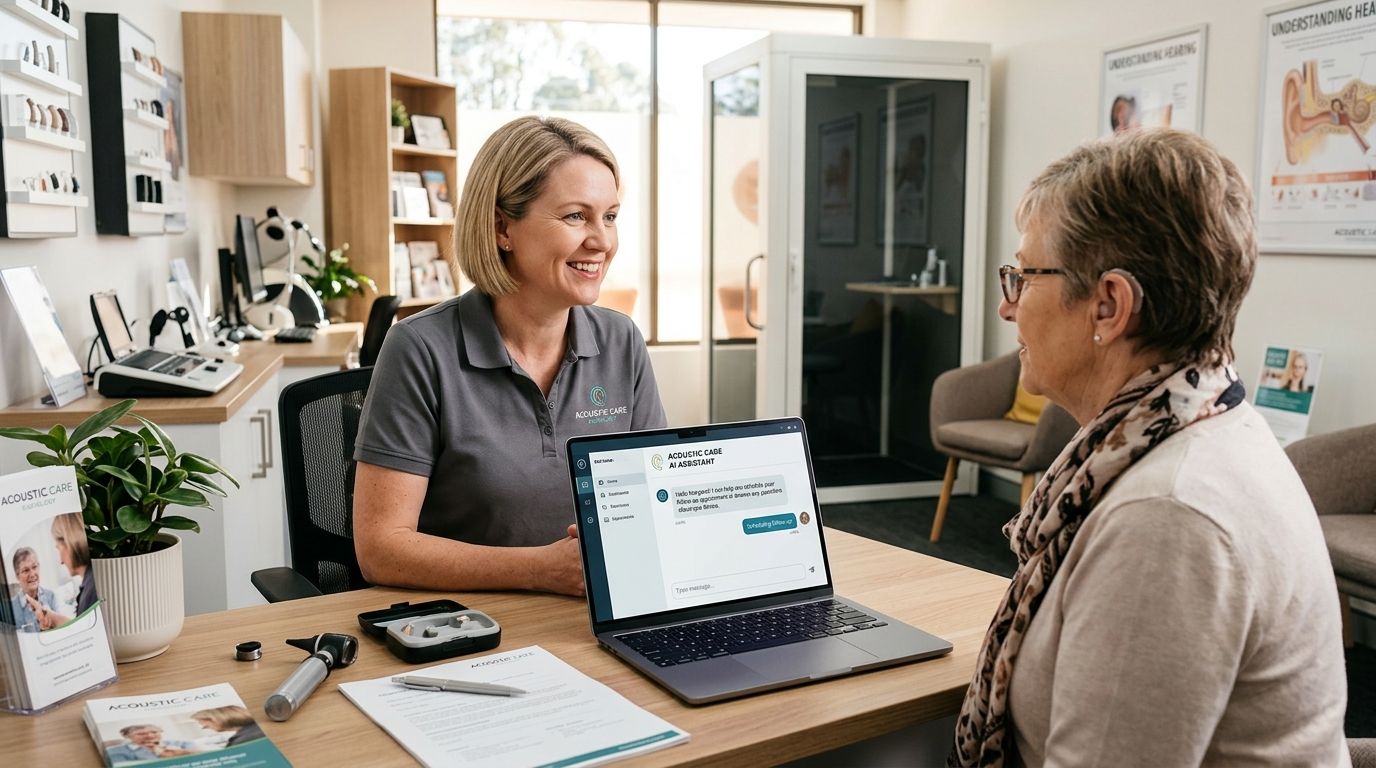
Audiology clinics use an AI customer service agent to answer calls, texts, and website chats when the front desk is mid-appointment, booking hearing tests and follow-ups without a live receptionist tied to every line. Hearing care patients skew older, call more than they text on their own, and ask questions — insurance coverage, walk-in policy, which hearing aid brands you carry — that a generic healthcare chatbot script gets wrong.
- VirtualText's ai customer service agent for audiology clinics answers missed calls with a text instead of voicemail.
- Automatic missed-call text-back keeps first-time callers from booking with the next clinic on Google.
- Appointment reminder texts cut no-shows for hearing tests and fittings booked weeks in advance.
- Best for multi-provider clinics losing calls during testing blocks, not for solo practices with light call volume.
- A shared team inbox routes messages to the right audiologist instead of one person's cell phone.
Why an AI customer service agent matters for audiology clinics
Audiologists spend 30 to 60 minutes per patient in a sound booth or fitting room, which means the phone rings unanswered for long stretches of the workday. A missed call from a caller who found you through a Google search rarely converts into a voicemail — they hang up and call the next clinic in the results.
The fix isn't a bigger front desk staff. It's after-hours lead capture software for healthcare providers that texts back the moment a call is missed, so the patient gets a response before they've closed the browser tab.
An audiology clinic that texts back within minutes of a missed call keeps patients who would otherwise book elsewhere — that's the entire case for adding an AI customer service agent in 2026.
How audiology clinics set up an AI customer service agent
Audit your missed-call and after-hours volume
Before adding anything, find out how many calls and messages you're actually losing. Most clinics underestimate this until they look.
- Pull call logs for a full week and count calls that hit voicemail during testing blocks
- Count after-hours voicemails left between 5 p.m. and 8 a.m.
- Check how long website contact-form submissions sit before someone replies
- Compare no-show rates for appointments booked by voicemail callback versus booked live
- Note how many messages mention hearing aid repair versus new hearing test requests
Text back every missed call within the hour
Start manual. Assign one staff member to scan the missed-call log between patients and send a quick text: office hours, a booking link, an apology for the wait. Log it in a spreadsheet if you have to.
- Check missed calls every hour during clinic hours, not just at close of day
- Draft two or three text templates so replies are fast and consistent
- Use your phone carrier's basic missed-call alert if it has one
- Track how many callbacks turn into a booked appointment
An AI agent removes the manual check. VirtualText fires the text-back automatically the moment a call goes unanswered, so no one has to remember to look between patients.
Script answers to the questions you get every day
Most incoming calls and texts at an audiology clinic repeat the same five or six questions. Write those down before you automate anything.
- List your top 10 caller questions: accepted insurance, walk-in availability, hearing aid brands carried, testing wait time
- Post an FAQ page on your clinic's website with plain-language answers
- Train new front-desk hires on those same questions in their first week
- Keep a laminated answer sheet at the desk for quick reference
Once those answers are written down, VirtualText's ai customer service agent for audiology clinics can handle the scripted ones over text and web chat, freeing an audiologist from stopping mid-appointment to explain insurance networks.
Send appointment reminder texts to cut no-shows
Hearing tests and hearing aid fittings get booked weeks out, which is exactly the window where patients forget.
- Call each patient 48 hours ahead if you're doing this manually
- Set a calendar reminder for staff to make those calls in batches
- Mail postcards for annual hearing checks as a backup
- Ask patients to write the date on a card before they leave
Texting reminders instead of calling closes the loop faster — see appointment reminder texts that reduce no-shows for the specific timing that works best.
Route messages to the right person
A solo audiologist and a two-location practice with three providers need different routing. Don't let every message land in one inbox by default.
- Keep a shared paper log at the front desk if you're small
- Forward messages to the correct audiologist by hand each morning
- Hold a quick daily huddle to review overnight voicemails
- Use a shared email inbox instead of one employee's personal phone
A shared team inbox solves this at scale without the daily huddle. It's the same problem healthcare front desks run into across specialties, not just audiology.
Measure response time and booked-appointment rate monthly
You can't fix what you don't track. Set a simple monthly check.
- Track average time-to-reply for after-hours messages in a spreadsheet
- Count how many after-hours texts and chats convert to a booked appointment
- Review missed calls versus completed callbacks each month
- Ask new patients how they first reached the clinic
Comparison: front-desk options for audiology clinics
| Option | Best for | Key limitation |
|---|---|---|
| Front desk phone only | Solo-audiologist practices with low call volume | Calls during testing blocks go to voicemail with no automatic follow-up |
| Human answering service | Clinics wanting a live voice around the clock | No text or web chat capture, and scripts are generic healthcare, not audiology-specific |
| Live chat widget only | Clinics wanting daytime website capture | Visitors who leave the site rarely come back to finish a chat, and there's no SMS follow-up |
| VirtualText AI agent + shared inbox | Multi-provider clinics juggling calls, texts, and web chat across locations | Needs a short setup period to script clinic-specific answers before it runs unattended |
“If a patient calls after your testing block ends and hits voicemail, they call the next clinic in the search results before you call them back.”
Common mistakes audiology clinics make
- Routing every after-hours message to one person's cell phone. Audiologists seeing patients back-to-back can't reply in real time, and replies stack up.
- Using a generic healthcare chatbot script. It can't tell the difference between a new hearing test request and a hearing aid repair, so patients get routed to the wrong step.
- Reminding for the first appointment but not the follow-up. Hearing aid fitting adjustments get skipped because clinics only build reminder texts around the initial test.
- Skipping insurance scripting. Hearing aids aren't covered the same way diagnostic testing is, and an AI agent without accurate coverage details creates billing disputes down the line.
- Checking the shared inbox less often than voicemail. Texts don't feel urgent the way a ringing phone does, so they sit unanswered longer than calls ever would.
Stop losing after-hours patients
See how VirtualText handles calls, texts, and chat for healthcare front desks.
FAQ
What is an ai customer service agent for audiology clinics?
It's a texting, web chat, and messaging tool that answers patient questions and books appointments when your front desk can't pick up. VirtualText runs this as a shared inbox plus an AI agent trained on your clinic's specific answers.
Can an AI agent book a hearing test appointment automatically?
Yes, once it's connected to your booking process it can text back available slots and confirm a time. Most clinics start with scripted FAQ answers first, then add booking once the responses are accurate.
Is an AI customer service agent better than a human answering service for audiology clinics?
An AI agent handles text and web chat, which a phone-only answering service can't, and it can be scripted specifically for hearing test and hearing aid questions instead of generic healthcare scripts. A human answering service still wins if patients strongly prefer a live voice.
Does VirtualText replace my front desk staff?
No. It catches the calls, texts, and chats staff can't get to during testing blocks and after hours, and staff still handle bookings that need a human judgment call.
How does automatic text-back reduce no-shows for hearing aid fittings?
A reminder text sent a day or two before the appointment gives patients an easy way to confirm or reschedule instead of forgetting entirely. Clinics that switch from mailed postcards to text reminders typically see faster confirmation turnaround.
Can the AI agent handle insurance questions for hearing aids?
It can answer scripted questions about which insurance networks you accept, but hearing aid coverage varies enough by plan that complex cases should route to a staff member. Script the boundary clearly so the AI hands off rather than guesses.
Does a shared team inbox work across multiple clinic locations?
Yes, a shared inbox lets any staff member across locations see and reply to a message, which matters when a patient texts one location but is scheduled at another. It replaces the habit of routing every message to one person's personal phone.
How much does an ai customer service agent for audiology clinics cost?
Pricing for tools like VirtualText is typically a flat monthly SaaS fee rather than a per-minute or per-call answering service charge. Check current plan details directly since offerings change.
One last thing
The highest-value automation isn't the AI agent's FAQ script — it's the missed-call-to-text trigger. Turn that on first, watch which questions actually come in over a few weeks, then build out scripted answers around what patients are really asking instead of guessing upfront. Clinics that build the script backward from real message data in 2026 waste far less setup time than ones that try to write every answer on day one.


