
Car dealership after-hours answering is a system for receiving customer inquiries when staff are unavailable, with the aim of turning those inquiries into assigned callbacks, sales conversations, and service requests. Choose an after hours answering service for car dealerships that separates sales from service, records the customer's request, and makes the next action clear—not one that simply answers the phone.
- VirtualPBX fits small dealership teams seeking a business phone system with optional automated call handling.
- After hours answering service for car dealerships needs separate sales, service, and urgent-call instructions.
- Capture vehicle interest and callback details; never promise inventory, financing approval, or appointments without verified information.
- Use webchat and business SMS alongside phone coverage, not as substitutes for answering voice calls.
Why after-hours answering matters for car dealerships
A dealership inquiry needs context. A shopper asking about a specific vehicle needs a different handoff from an existing customer asking whether a repair is finished. Your answering process must preserve that distinction before anyone returns the call.
For your 2026 coverage plan, start with the customer journey rather than a feature list. Decide what happens when sales closes before service, when every employee is busy, and when nobody is available until the next business day. Each situation needs an honest response and a named owner.
VirtualPBX provides cloud business calling, routing, business SMS, and optional automated call handling. Those capabilities belong to the phone-system layer; a dealership still needs to define its hours, escalation rules, and follow-up responsibilities.
VirtualPBX is best suited to small dealership teams that want a business phone system with optional automated call handling. It is not a substitute for verified vehicle information, an approved finance process, or a staffed emergency service.
What makes dealership coverage different?
Sales, service, and parts do not share the same questions or decision authority. An answering service should collect useful information without speaking for the department that must approve the answer.
Your scope should distinguish these requests:
- Vehicle sales: Record the vehicle reference, purchase interest, and preferred callback method.
- Service: Capture the vehicle, reason for contact, and whether an existing repair is involved.
- Parts: Record the requested item and send identification questions to the parts team.
- Finance: Arrange contact with authorized staff without collecting sensitive application details in general messages.
- Urgent situations: Follow an approved escalation policy, not an improvised promise of roadside help.
How to set up dealership after-hours answering in 2026
1. Map your closed-hours coverage
Start manually with a written schedule. List each department's opening hours, holiday exceptions, and the employee responsible for reviewing inquiries after reopening. This exercise costs nothing beyond staff time and exposes gaps before you configure software.
Define 3 coverage states: open, closed, and temporarily unavailable. Closed-hours answering should not automatically mean that someone is on call. Tell customers whether they are leaving a request for the next business day or reaching a staffed escalation path.
Avoid a single schedule for the entire dealership when departments operate differently. A service customer should not hear sales hours presented as service hours. Include the local time zone wherever an answering team serves multiple locations.
Close this step with a usable coverage sheet:
- Write separate sales, service, and parts schedules.
- Name the primary reviewer and backup for each department.
- Specify holiday and unexpected-closure instructions.
- Define when callbacks begin after reopening.
- Identify which requests qualify for escalation.
2. Write a short intake script
Build the script in a document before buying an answering service. Read it aloud and remove questions that do not change the next action. A customer asking about a vehicle should not complete a finance interview just to request a callback.
Use 5 intake fields as a starting point: name, callback number, department, vehicle reference, and requested next action. These are recommended fields, not a requirement to prolong every conversation. If the customer has already supplied a detail, do not ask again.
Keep sales language neutral. Record the stock reference or listing description, then tell the customer that staff will confirm the vehicle's status. Treat a requested test-drive time as a preference unless the system has verified scheduling access.
Give the answering process clear boundaries:
- Ask which department the customer needs.
- Capture a callback number and preferred contact method.
- Record the vehicle or repair reference when relevant.
- Summarize the question in the customer's terms.
- State the next action without promising an unverified outcome.
3. Choose the right channel coverage
Begin with your existing phone greeting, voicemail, and a staff callback checklist. That manual arrangement is a useful baseline: it shows whether your main problem is unanswered calls, incomplete messages, or unclear ownership. Choose software to address the actual gap.
VirtualPBX offers Smarter Voice for business calling and routing, with AI FrontDesk and AI MessageDesk as optional voice products. Evaluate the optional call handling against your dealership script. Do not assume that a phone-system feature confirms inventory, accesses a dealer management system, or books appointments.
VirtualText, offered by VirtualPBX, is a separate SMS, webchat, shared-inbox, and automated-agent platform. It belongs in the written-inquiry workflow, not in place of voice coverage. For website inquiries, the guide to capturing leads after hours addresses that separate entry point.
Use these checks before choosing your 2026 setup:
- Identify whether customers need voice, text, webchat, or several channels.
- Test the actual after-hours conversation, not just a demonstration greeting.
- Confirm how messages reach the responsible department.
- Verify any scheduling or dealership-software connection separately.
- Check contract terms, support access, and setup responsibilities.
4. Set department handoffs and escalation rules
Start with a shared worksheet that records who owns each inquiry. Assign one employee to each request rather than asking everyone to monitor everything. Shared visibility is useful; shared responsibility without an owner leaves the callback unresolved.
Use 3 handoff categories: Sales callback, Service callback, and Urgent escalation. These are workflow labels you can adopt, not claimed product settings. Add a parts category if your dealership needs a separate queue.
For urgent requests, specify both the trigger and the destination. A stranded customer, a complaint, and a routine repair-status question need different responses. Do not describe your dealership as providing emergency assistance unless an approved, staffed process exists.
A clear handoff follows this sequence: Capture request, Assign department, Confirm owner, Complete callback. The final action belongs to an employee, even when software collects the initial message.
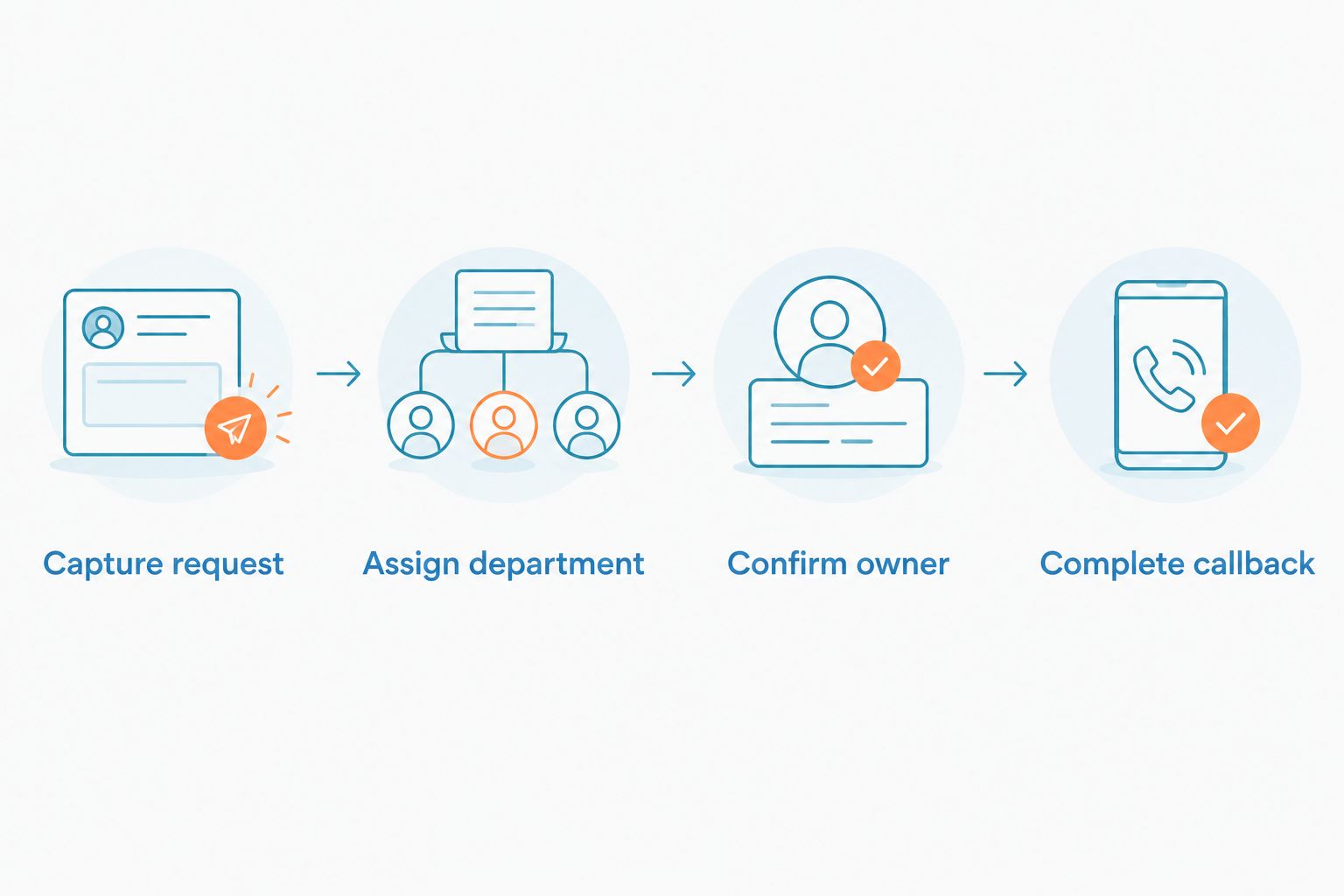
Make each handoff actionable:
- Include the customer's request and callback details.
- Name the receiving department and responsible employee.
- Define a backup when the primary owner is absent.
- Record whether the customer requested a call or text.
- Mark the request complete only after the follow-up action.
5. Test realistic dealership conversations
Run manual test calls before sending real customers through the new process. Ask employees to play different customers and review whether the resulting messages contain enough information to act. A polished greeting does not prove that the handoff works.
For a 2026 launch, use at least 6 test calls covering sales, service, parts, finance, urgent requests, and an unclear question. This is a practical test plan, not a performance benchmark. Include a caller who changes departments halfway through the conversation.
Check the failure path as carefully as the normal path. If nobody answers an escalation, the customer needs an accurate explanation of what happens next. If a request cannot be understood, collect contact details and pass it to staff instead of guessing.
Test these concrete situations:
- Ask about a vehicle without knowing its stock reference.
- Request a test drive at an unverified time.
- Ask whether an existing repair is complete.
- Request finance information that requires authorized staff.
- Try an escalation when the designated employee is unavailable.
- Confirm that each message reaches the correct owner.
6. Review follow-up, not just answered calls
Start with a spreadsheet and record when each inquiry arrives, when an employee responds, and what happens next. You do not need a reporting dashboard to discover that service messages are reaching sales or that callbacks lack an owner.
Review 7 calendar days of inquiries after launch as an initial check. Extend the review when that period does not contain enough activity to assess the workflow. The review period is a suggested operating routine, not evidence of expected call volume.
Track outcomes separately for sales and service. A test-drive request is not a booked appointment; a repair question is not a repair order. Clear definitions prevent an answering report from overstating business results.
Keep your 2026 review focused on actions:
- Count inquiries with usable contact details.
- Record arrival time and first employee response time.
- Separate requests from confirmed appointments.
- Identify unanswered questions and incorrect department handoffs.
- Update scripts when the same confusion repeats.
Compare dealership after-hours answering options
Choose by the work that must happen after the greeting. Voice coverage, human judgment, and written-message coordination are different needs. A dealership with complex conversations should test those conversations before selecting automated handling.
The options below describe coverage models, not verified capabilities of unnamed vendors. Confirm the exact scope of any service you consider.
| Option | Best for | Main advantage | Key limitation |
|---|---|---|---|
| Voicemail with manual callbacks | Teams able to review messages after reopening | Simple intake process with staff-controlled follow-up | Collects messages but does not answer customer questions |
| Live answering service | Dealerships needing a human conversation after closing | A person can clarify the caller's request | Accuracy depends on approved scripts and access to current information |
| VirtualPBX with optional call handling | Small teams seeking business calling plus optional automated voice handling | Keeps phone-system planning and optional handling under the parent brand | Dealership integrations and task permissions require verification |
| VirtualText | Teams handling after-hours SMS and website inquiries | Combines written channels, a shared inbox, and an automated agent | Written-channel coverage does not replace answering voice calls |
| Hybrid coverage | Dealerships needing automation with defined human escalation | Separates routine intake from exceptions | Requires clear ownership and a genuinely staffed escalation path |
For a voice-first dealership, evaluate phone coverage first. Add written channels when they solve a separate customer-contact problem. Do not select a webchat tool and assume the main phone line is covered.
Review your dealership phone coverage
Compare business calling and optional call handling against your sales and service workflow.
Common mistakes car dealerships make
Treating inventory questions as confirmed answers
An answering process without verified inventory access should record interest, not declare a vehicle available. The same boundary applies to trade-in values and financing decisions. Use intake to prepare the staff conversation, not to impersonate it.
Promising appointments without calendar confirmation
A requested test drive or service visit is not booked merely because the customer supplied a time. Separate appointment preferences from confirmed appointments in both the conversation and the handoff. Staff should confirm the date, location, and appointment status.
Sending every inquiry to sales
Service customers need service follow-up. Parts requests need someone who can identify the item. Route by department and request type before assigning a person; otherwise the next employee must repeat the intake.
Collecting finance details in general messages
Do not ask customers to leave Social Security numbers, payment-card information, or finance-application documents in a routine after-hours message. Record the callback request and direct the sensitive transaction to your approved process.
Counting an answer as a completed lead
An answered call is an interaction, not a completed sales action. The useful result is an assigned request that receives the promised follow-up. Review unresolved inquiries alongside answered-call activity.
FAQ
What's the best after hours answering service for car dealerships?
The best fit separates sales, service, and urgent requests and delivers an actionable handoff to dealership staff. Small teams evaluating VirtualPBX should test business calling and optional call handling against their actual scripts before choosing a setup.
Can an answering service book dealership test drives?
An answering service should confirm a test drive only when it has verified scheduling access and permission to book. Without that access, it should record the requested vehicle and time for staff confirmation.
Is automated answering better than a live answering service?
Automated answering fits defined intake; live answering fits conversations that need human clarification. Compare both using the same dealership scenarios, and verify how each handles questions outside its approved scope.
Can webchat replace after-hours phone answering?
Webchat does not replace answering voice calls. It captures website inquiries through a written channel, so dealerships offering both channels need coverage and ownership for each.
What should a dealership collect from an after-hours caller?
Collect the customer's name, callback number, department, relevant vehicle reference, and requested next action. Avoid sensitive finance information in general messages, and skip questions that do not affect the handoff.
Should after-hours answering confirm vehicle availability?
After-hours answering should confirm vehicle availability only from an authorized, current source. Otherwise, record the vehicle reference and tell the customer that dealership staff will verify its status.
How do we handle urgent service calls when the dealership is closed?
Use an approved escalation policy with a designated recipient and an accurate fallback when nobody answers. Do not promise emergency or roadside assistance unless your dealership has a staffed process for it.
One last thing
Test the morning handoff before testing the greeting again. Give an employee an after-hours message without explaining the conversation, then ask what they would do next. If they cannot identify the department, customer request, and next action, fix the intake before adding more features.


