
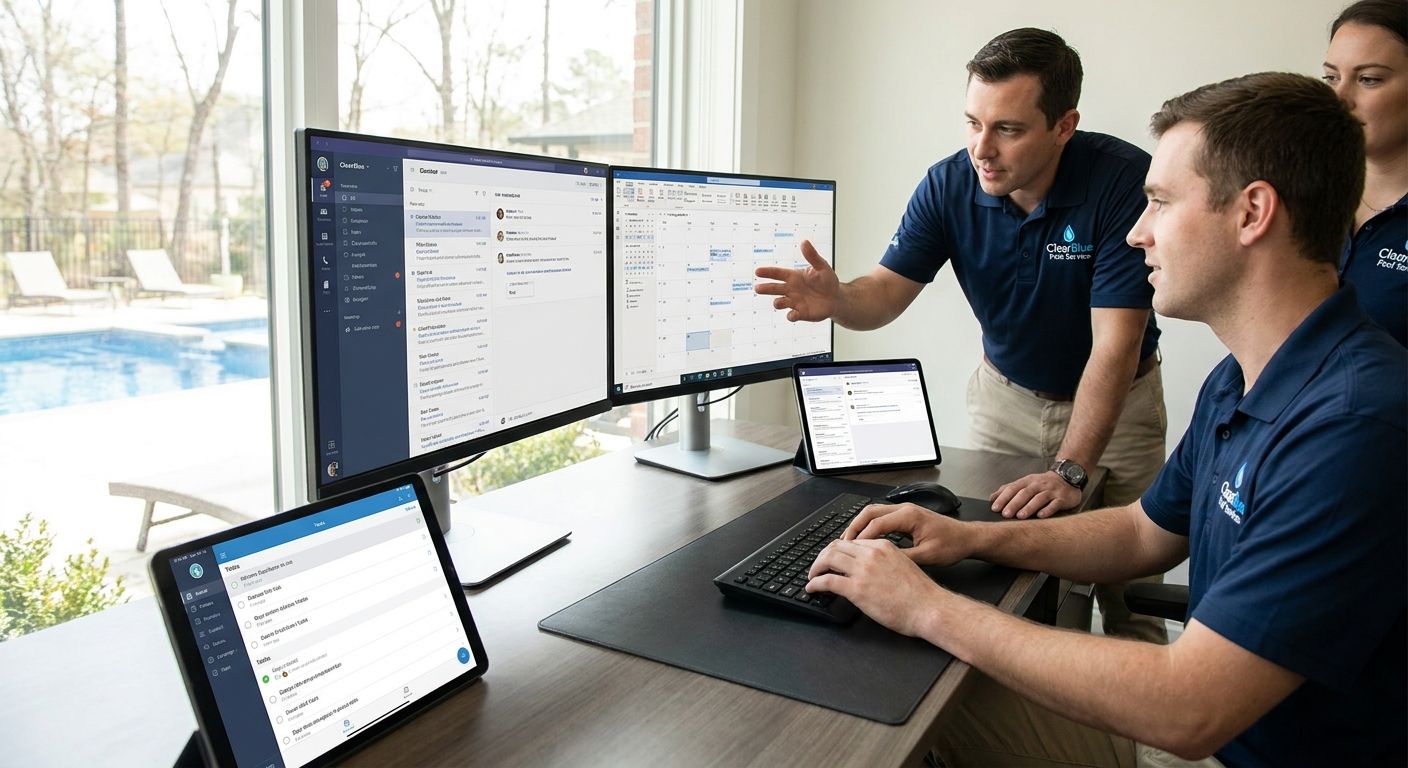
Pool service company team inbox software is a shared texting and webchat system that routes customer messages to the right tech instead of piling up on one owner's cell phone. Route techs are elbow-deep in a filter most of the day, so a system built for team inbox software for home service dispatchers matters more here than it does for a desk-bound business — green-pool emergencies, chemical questions, and reschedule requests all show up as texts while the crew is on a route, not sitting by a phone.
- Team inbox software for pool service companies routes SMS and webchat into one shared thread so techs on routes never lose a message.
- VirtualText combines texting, webchat, and an optional AI agent for around-the-clock lead capture without adding a call center.
- Missed-call text-back and after-hours auto-replies close the gap between a ringing phone and a tech's hands in a skimmer basket.
- A single owner-only phone number is the most common mistake pool companies make in 2026 — it caps growth at one person's attention span.
Why team inbox software matters for pool service companies
A pool tech can't take a call mid-service without stopping work, rinsing hands, and breaking the flow of a route that might have 12 more stops before dark. A text waits in the queue until the tech has a free minute between pools. That single difference is why texting and webchat fit this industry better than a ringing phone ever will.
Seasonal demand makes the problem worse. Spring openings and fall closings compress weeks of scheduling questions into a short window, and summer brings a spike in green-pool emergency requests that all land at once. A shared inbox means any available person — owner, office admin, or a second tech — can see and answer those messages instead of routing everything through one phone that's already full.
Customers also expect texting by 2026. A missed call from a pool company rarely gets a voicemail check-back; it gets a text to a competitor instead. Team inbox software closes that gap by keeping every SMS, webchat, and missed-call reply in one shared thread the whole team can see.
Update your intake so nothing goes to one phone
Start with the routing problem before anything else. Most pool companies begin with the owner's personal cell number as the de facto business line, and that's the first thing to fix.
- Publish one business number for texting on the website, invoices, and service tags — not the owner's personal cell
- Set up call forwarding so missed calls don't disappear into a full voicemail box
- Give every tech or office staffer visibility into the same inbox instead of separate phones
- Tag conversations by route or zip code so anyone can pick up context fast
- Archive closed conversations weekly so the active queue stays short
Set up missed-call text-back for busy techs
A missed call during a pool cleaning route shouldn't mean a lost job. An automatic text sent the moment a call goes unanswered keeps the customer engaged instead of dialing the next company on the list.
- Turn on an automatic reply for every missed call that says you'll text right back
- Include a short line asking what the customer needs: green pool, chemical delivery, or a service reschedule
- Route the reply into the same shared inbox techs already check between stops
- Track how many missed calls convert to booked jobs after the text goes out
- Review the auto-reply wording each season — summer language differs from a fall closing rush
Build text templates for common pool-service questions
Most incoming messages repeat: algae questions, chemical delivery timing, opening and closing dates, and requests to come earlier. Templates cut response time without making replies feel robotic.
- Write a template for green-pool or algae-bloom requests with a same-day or next-day response option
- Write one for chemical delivery scheduling that confirms date and gate access
- Write one for season opening and closing that lists what the customer needs to do before the visit
- Keep templates short — two sentences, not a paragraph — since customers read texts on the move
- Update templates each spring and fall when seasonal volume shifts
Automate after-hours lead capture from your website
A pool company's busiest inquiry hours often fall outside business hours: evenings when a homeowner notices cloudy water, or weekends when a new resident is comparing service companies. An AI answering service for home service businesses answers those first questions before a human ever logs back in.
- Add a webchat widget to the site that stays active nights and weekends
- Let an AI agent answer basic questions — service area, general availability, what a cleaning visit covers — without inventing pricing
- Hand off anything specific, like a quote request or a complaint, straight to the shared inbox for a human
- Log every after-hours conversation so the morning team sees what came in overnight
- Review AI transcripts monthly to catch questions it's answering poorly
Keep the inbox organized across routes or locations
A company running two or three routes, or operating in more than one town, needs more than a single unsorted inbox. The guide on how to keep a team inbox organized across locations covers the tagging and assignment habits that stop multi-route companies from stepping on each other.
- Assign conversations to the tech or route they belong to, not to whoever answers first
- Use tags for job type: cleaning, repair, chemical delivery, opening and closing
- Set a rule for who owns unassigned messages after a fixed number of hours
- Separate customer-facing texting from internal crew chatter so nothing gets lost
- Run a weekly check on any conversation sitting unanswered more than 24 hours
Ask for reviews right after a fix
The hour right after a tech clears a green pool or fixes a pump is the best time to ask for a review. Satisfaction is high and the memory is fresh.
- Send a short review-request text within an hour of marking the job complete
- Link directly to the review platform, not a generic contact page
- Skip review requests for jobs that involved a complaint or a reschedule
- Track response rate by season — post-storm repair jobs often get the strongest reviews
Comparing your options
| Option | Best for | Key limitation |
|---|---|---|
| Personal cell phone with call forwarding | A solo operator with one route and no staff | No shared visibility; a missed call or dead battery means a missed job |
| Generic internal team chat app | Coordinating crew schedules internally | Not built for customer-facing SMS or webchat threads |
| Call-only answering service | Emergency after-hours phone coverage | Doesn't capture webchat leads or keep a text history |
| VirtualText shared team inbox | Multi-tech pool companies juggling SMS, webchat, and after-hours leads in one place | Needs an internet-connected app; it isn't a replacement for inbound voice call handling |
Verdict: a personal cell works for a one-truck operation in year one, but any pool company running more than one tech by 2026 needs a shared inbox before the phone becomes the bottleneck.
“A pool tech mid-service can't answer a ringing phone, but a text waits until there's a free minute between pools.”
Common mistakes pool service companies make
- Routing everything to the owner's cell. It works until the owner is on a pool deck and misses six calls in an hour — and every one of those could have been a text.
- Ignoring webchat leads over weekends. Pool emergencies spike Friday evenings and Saturday mornings, exactly when most companies aren't watching a webchat inbox.
- Using one number for dispatch and customer service. Techs coordinating routes and customers asking about service shouldn't share the same thread.
- Not updating auto-replies seasonally. A missed-call text written for summer green-pool emergencies reads wrong during a fall closing rush.
- Waiting days to ask for a review. By the time a follow-up email goes out a week later, the customer has forgotten the specifics of the visit.
See VirtualText for your pool business
Shared SMS, webchat, and AI lead capture in one team inbox.
FAQ
What is team inbox software for pool service companies?
It's a shared texting and webchat system that routes customer messages to the right tech or office staffer instead of piling up on one phone. VirtualText combines SMS, webchat, and an optional AI agent into one inbox built for small service teams.
Is texting better than calls for pool service companies?
Yes, for most day-to-day questions. A tech mid-service can't answer a ringing phone, but a text waits until there's a free minute between pools, which fits route-based work better than voice calls.
How does missed-call text-back help a pool company?
It automatically sends a text the moment a call goes unanswered, so the customer gets a response even when nobody picks up. That keeps the lead engaged instead of dialing a competitor.
Can an AI agent handle pool service questions?
An AI agent can answer basic questions like service area and general availability, then hand anything specific to a human in the shared inbox. It should never invent pricing or make commitments a human hasn't confirmed.
Do multi-route pool companies need a different setup than a single truck?
Yes. Multi-route companies need conversations tagged by route or tech plus a rule for who owns unassigned messages, otherwise texts get answered twice or not at all.
How much does team inbox software cost for a small pool company?
Pricing varies by provider and plan size. Check the current pricing on the VirtualText site before comparing options.
What's the biggest mistake pool companies make with customer texting?
Routing every text and call through the owner's personal cell phone. It caps the business at one person's attention span and breaks down the moment call volume spikes.
Should webchat be active after hours?
Yes. Pool emergencies and new-customer inquiries spike on evenings and weekends, exactly when most companies aren't staffed to answer webchat manually.
One last thing
The pool companies that struggle most in 2026 aren't short on leads — they're losing leads they already generated because a text sat unanswered for six hours while the tech was on a route. Fixing that gap costs nothing but attention: turn on missed-call text-back this week and count how many of those replies turn into booked jobs by the end of the month.


