
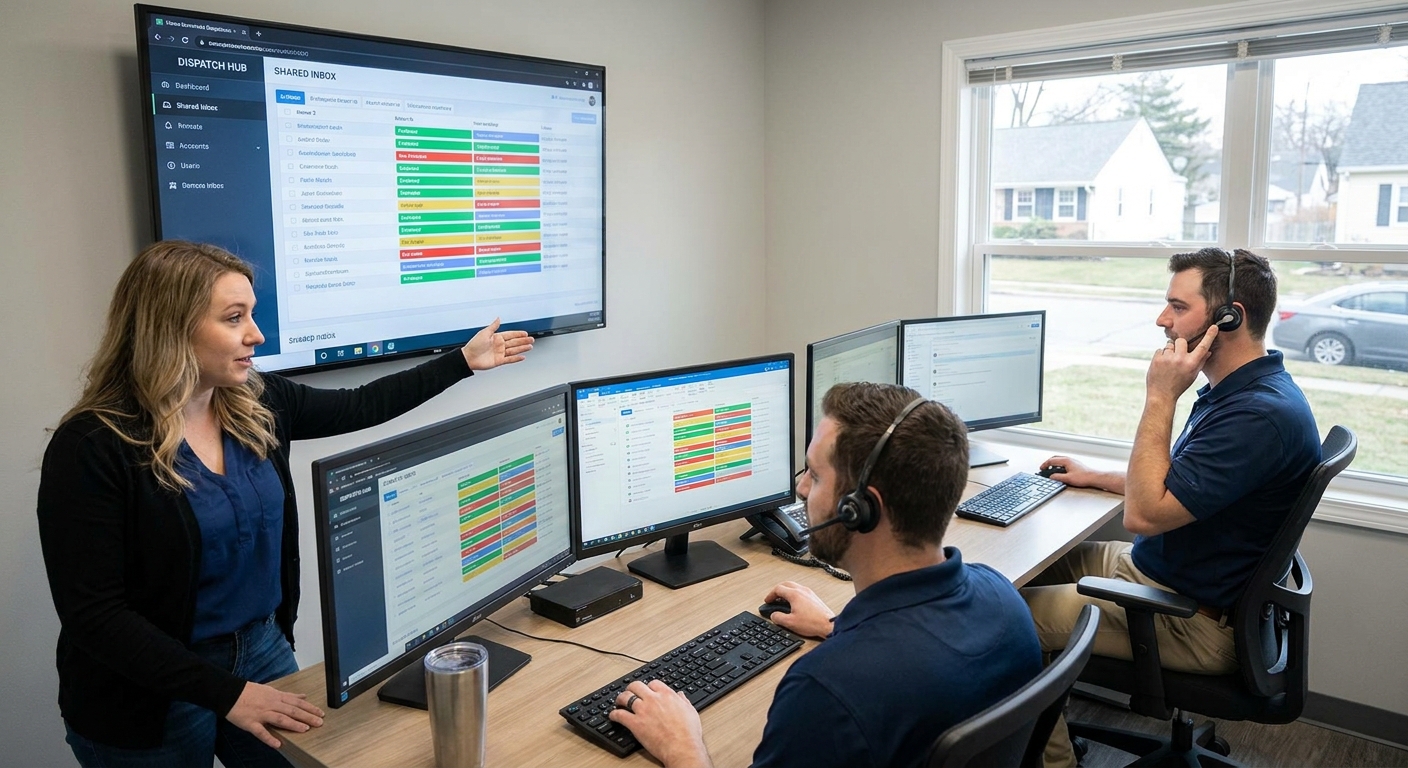
Home service dispatchers run three inboxes at once — phone, SMS, and website chat — and a job slips to a competitor every time one of those channels sits unanswered. Team inbox software for home service dispatchers puts all three in a single shared queue so nobody duplicates work or drops a lead.
- VirtualText's team inbox software for home service dispatchers combines SMS, webchat, and a shared inbox for $89 a month flat. Buy.
- Multi-location HVAC and plumbing companies need one shared queue, not five dispatcher cell phones. VirtualText routes by branch in 2026.
- An AI agent answers after-hours home service leads before a human dispatcher logs on, then hands the thread over at shift start.
- Skip generic email ticketing tools for dispatch work — texts and web chats need a live queue, not a support ticket.
Why this matters
A missed call gets voicemail. A missed text or web chat gets silence — and silence reads as "they don't want the job." Home service leads move fast: a homeowner with a broken AC unit in July or a burst pipe at midnight texts two or three companies at once and books whichever one answers first.
Dispatchers juggling a landline, a personal cell for texts, and a website chat widget miss that window constantly. Each tool lives in its own app with its own login, and nobody owns the whole picture. A tech might take a call while a text from the same customer sits unread in a different app for an hour. That's the gap team inbox software closes, and it's the approach VirtualText takes for home service companies heading into 2026.
Most home service companies now run some mix of phone, SMS, and web chat, but very few route all three into one queue a dispatcher can watch start to finish. The gap shows up worst overnight — exactly where an AI customer service agent for home service businesses picks up the slack while dispatchers are off shift.
Who this is for
This is for dispatchers and office managers at HVAC, plumbing, electrical, and general home repair companies handling anywhere from 20 to 200-plus inbound leads a week across phone, text, and web chat — often with technicians split across two or more service areas.
If your team still forwards texts to one person's personal phone, or your website chat widget dumps leads into an inbox nobody checks until Monday, this is your problem to fix. Multi-location operators have it worse: a lead meant for the Denver branch can sit in a shared queue a Phoenix dispatcher happens to be watching, and nobody notices until the customer calls back angry. A dispatcher covering five zip codes solo has the same problem in miniature — texts and chats piling up faster than one person can sort them by hand.
What to look for in team inbox software for home service dispatchers
Dispatch teams don't need more software — they need fewer places to look. These six things separate a tool that actually gets used from one that becomes another tab nobody opens.
One shared queue for SMS and webchat
If a text and a website chat land in two different tools, a dispatcher has to check both constantly or risk missing one. A shared queue puts every inbound message — text or chat — in the same view, so one person, or a rotating shift, owns all of it without app-switching.
Routing by service area or branch
A dispatcher covering five zip codes needs leads sorted so the right technician gets notified, not just whoever types fastest. Companies running more than one location need this even more — a lead for one branch shouldn't sit in a queue a different city's dispatcher is watching.
AI backup for after-hours and overflow
Emergency plumbing and HVAC calls don't stop at 5 p.m. An AI agent that answers basic questions, captures the job details, and texts back instantly covers the hours a human dispatcher isn't logged in, then flags the thread for a person the next morning.
A human handoff, not a dead end
AI backup only works if a real person picks up the thread when it matters. Software that traps a panicked customer in an automated loop with no exit does more damage than no automation at all.
Flat, predictable pricing
Dispatch teams add and drop seasonal technicians constantly. Per-seat pricing that spikes every time you hire a summer HVAC installer makes budgeting harder than it needs to be. A flat monthly rate removes that variable entirely.
Fast setup with no new hardware
Field teams don't have time for a hardware install or a two-week onboarding. Software that works from a phone number you already have, live within a day, beats anything that requires new devices in trucks.
Best setups for home service dispatch teams
The right setup depends on how many locations you run and how much of your business happens after hours. Here's how VirtualText's lineup breaks down by situation.
The single-location pick: HVAC dispatch teams One spec that matters: VirtualText's business SMS service for HVAC companies runs SMS and webchat through one shared inbox for a flat $89 a month, no matter how many technicians are in the field. When call volume spikes during a heat wave, the queue doesn't change price or get harder to manage. Verdict: Buy for single-location HVAC teams still juggling a personal cell phone for texts.
The after-hours pick: Plumbing emergency dispatch One spec that matters: VirtualText's business SMS service for plumbing companies pairs the shared inbox with an AI agent that answers burst-pipe and no-heat texts overnight, captures the address and issue, and hands the thread to a dispatcher at shift start. Verdict: Consider if your team runs on-call rotations and wants overnight coverage without paying a night-shift dispatcher's hours.
The multi-location pick: Branch-based home service companies One spec that matters: VirtualText's team inbox software for multi-location service businesses routes SMS and chat threads by branch, so a dispatcher in one city isn't fielding leads meant for another. Verdict: Buy for any company running more than one service area under the same brand.
The website-lead pick: General home services chat capture One spec that matters: VirtualText's live chat software for home services websites feeds every widget conversation into the same shared queue dispatchers already watch, instead of a separate chat tool nobody logs into. Verdict: Consider if your website gets steady traffic but your chat leads currently die in a tool disconnected from dispatch.
See the shared inbox dispatchers actually use
SMS, webchat, and AI backup for $89 a month flat.
What to avoid
- A personal cell phone as the SMS system. When that dispatcher calls in sick, every text sits unanswered until they're back, and there's no record anyone else can see or hand off from.
- Email-based ticketing for time-sensitive leads. Email tools are built for "reply within a day," not "reply within ten minutes," which is what a same-day service call actually needs.
- An AI agent with no human escape. Home service customers with an active emergency want a person to escalate to, not a chatbot loop that never connects them to a real dispatcher.
Comparison across criteria
Each setup below covers the same core inbox, but the AI backup and routing differ by how the business is structured.
| Setup | Shared SMS/webchat queue | AI after-hours backup | Multi-location routing | Flat price | Verdict |
|---|---|---|---|---|---|
| HVAC dispatch (single location) | Yes | Optional | No | $89/month | Buy |
| Plumbing emergency dispatch | Yes | Yes | No | $89/month | Consider |
| Multi-location branch dispatch | Yes | Optional | Yes | $89/month | Buy |
| Website chat capture | Yes | No | No | $89/month | Consider |
“If a text sits unanswered for ten minutes, the homeowner is already calling your competitor.”
FAQ
What is team inbox software for home service dispatchers?
It's a shared queue that puts SMS, website chat, and sometimes AI-handled conversations into one view so a dispatcher isn't checking three separate tools. VirtualText runs this setup for $89 a month flat in 2026, covering SMS, webchat, and a shared team inbox.
How much does VirtualText cost for a home service business?
VirtualText runs $89 a month flat, covering SMS, webchat, a shared team inbox, and an AI agent for after-hours or overflow leads. There's no per-technician pricing to track as crews grow or shrink seasonally.
Can dispatchers see texts and web chats in the same place?
Yes — that's the core function of a shared team inbox. Instead of one tool for texts and another for the website chat widget, both land in a single queue any authorized dispatcher can answer.
Does an AI agent work for after-hours plumbing or HVAC emergencies?
Yes. The AI agent answers basic questions, captures the address and issue, and hands the thread to a human dispatcher at shift start, covering the overnight gap most single-dispatcher teams can't staff.
Is team inbox software better than a shared email inbox for dispatch?
For time-sensitive leads, yes. Email is built for same-day replies; home service customers expect a response within minutes, which a live SMS and chat queue handles and email doesn't.
How fast can a home service company set up VirtualText?
Setup runs through an existing business number without new hardware, so most teams are live within a day rather than waiting on a multi-week onboarding process.
Does team inbox software work for multi-location home service businesses?
Yes, when it routes by branch or service area. VirtualText's multi-location setup sorts SMS and chat threads so a dispatcher in one city isn't handling leads meant for another.
What happens to a lead that comes in after business hours?
With an AI agent in place, the lead gets an instant reply and the job details get captured, then the thread routes to a dispatcher once the team is back online instead of sitting untouched overnight.
One last thing
Most home service companies don't lose leads because their pricing or their trucks are wrong — they lose them because a text sat unread for six hours while everyone assumed someone else was watching that phone. Before adding technicians or advertising spend in 2026, fix the queue first.
A shared inbox with an AI backup for the overnight gap costs less per month than a single missed emergency call job, and it's the kind of fix a dispatcher notices within the first week, not the first quarter.


