
Yes, it is legal to send mass text messages to customers in the United States when your campaign meets the consent, opt-out, timing, and other rules that apply to it. Being a customer does not automatically authorize promotional texts, and sending messages through software does not make a campaign compliant.
- Is it legal to send mass text messages to customers? Yes, with the required consent and opt-out controls.
- Keep promotional SMS separate from appointment reminders; permission for one purpose does not automatically cover another.
- VirtualPBX supports business texting, but your business remains responsible for consent, message content, and recipient selection.
- Carrier registration enables approved messaging traffic; it does not replace customer permission.
Why this matters
A customer gives you a phone number to arrange a repair. Months later, you add that number to a promotional campaign. The contact record proves a relationship, but it does not necessarily prove permission for advertising texts.
Check permission before importing your customer list. Your starting point is the purpose of each message, the consent behind each number, and the rules governing your sending method. The guide to business texting regulations covers the broader operational work behind that decision.
This is general U.S. business guidance for 2026, not legal advice. Have qualified counsel review your consent language, audience, and workflow before launching a campaign, especially when recipients live in multiple states.
Is it legal to send mass text messages to customers?
Yes. Federal law does not prohibit a campaign simply because you send the same text to many customers. The legal analysis depends on the message, the technology, the recipient's permission, and applicable federal and state requirements.
For 2026 campaign planning, the federal starting points include the Telephone Consumer Protection Act, FCC rules in 47 CFR § 64.1200, and federal Do Not Call protections. Carrier messaging policies add requirements of their own; they are not substitutes for the law.
| Message type | Best for | Permission checkpoint | Main limitation |
|---|---|---|---|
| Promotional texts | Offers and sales announcements | Obtain the marketing consent required for your technology and audience | A prior purchase alone does not establish written marketing consent |
| Transactional texts | Updates about an existing appointment or order | Confirm permission covers that transaction and communication | Adding an offer can change the legal analysis |
| Customer-requested replies | Answering a specific inquiry | Keep the response within the customer's request | An inquiry is not blanket permission for future promotions |
| Emergency texts | Necessary emergency communications | Confirm that a genuine legal exception applies | Calling a sale urgent does not create an emergency exception |
Bulk sending is not the same legal question as consent. A campaign can involve valid permission yet violate another requirement, such as a state restriction or an ignored opt-out.
Promotional texts need a marketing-consent check
Under FCC rules, advertising or telemarketing texts sent using an automatic telephone dialing system generally require prior express written consent unless an applicable exception applies. The legal definition of that technology matters; not every bulk-texting platform automatically meets it.
For a practical small-business policy, collect a clear, documented marketing opt-in before promotional campaigns. Have counsel approve the disclosure and collection method rather than assuming a generic checkbox covers your workflow.
Written consent can be electronic. The agreement must satisfy the applicable requirements, including identifying the authorized seller and disclosing that consent is not a condition of purchase.
Transactional texts need a purpose check
Appointment confirmations and order updates differ from advertising. Applicable consent requirements depend on the technology, context, and any relevant exception; permission for a service-related message does not automatically cover a sales campaign.
Keep transactional templates narrow. If a reminder also encourages the recipient to buy another service, do not assume it remains purely informational because the first sentence concerns an appointment.
How do you prepare a lawful customer texting campaign?
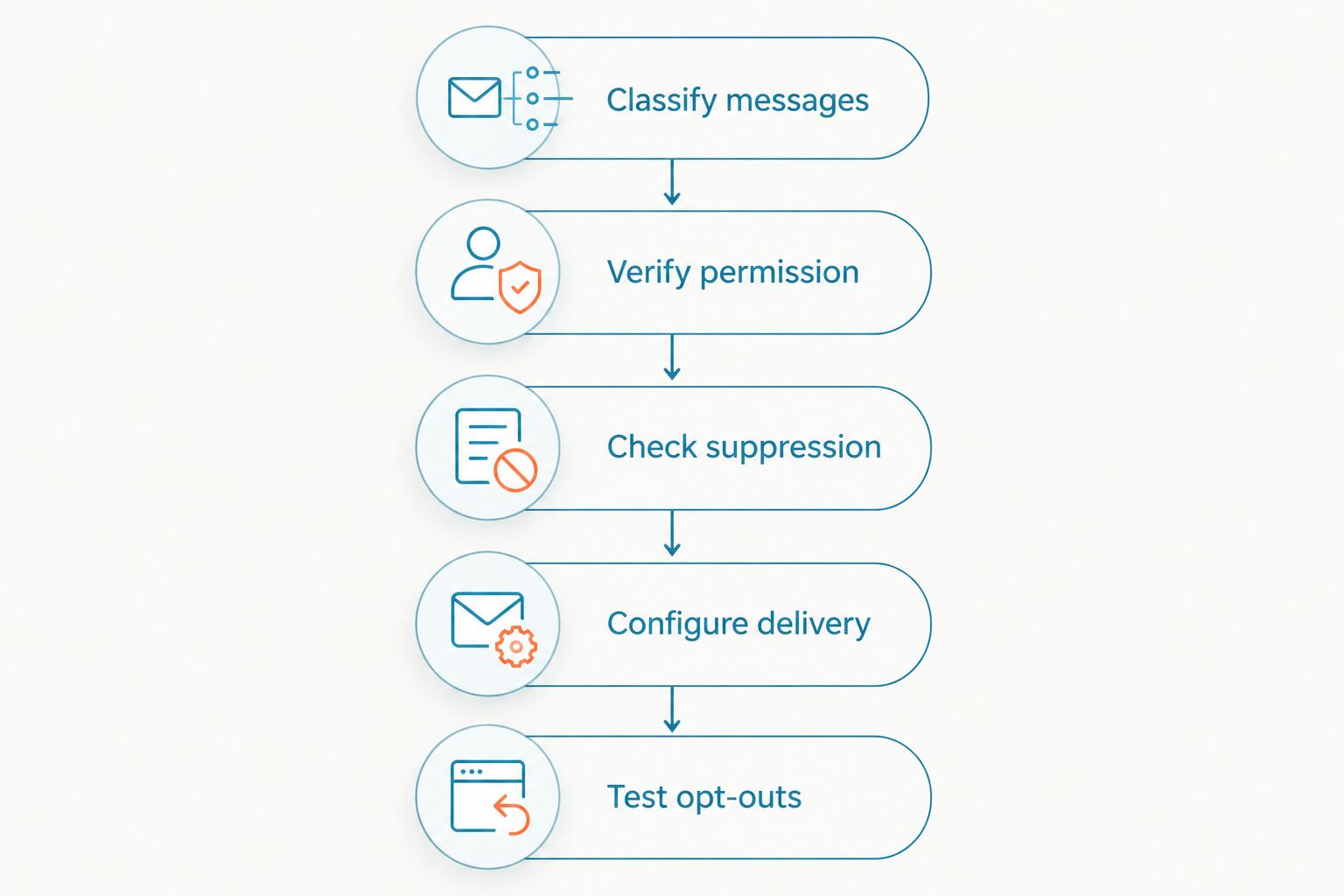
Build the process around evidence, not around the size of your address book. For a 2026 launch, use the following sequence before uploading recipients or scheduling messages.
Classify messages
Read the complete message, including linked content and any offer. Decide whether its purpose is service-related, promotional, or mixed, then document that decision.
Keep separate templates for reminders and promotions. This makes it easier to apply the right audience rules and prevents a casual sales sentence from changing an otherwise informational message.
Verify permission
Match every recipient to a consent record that covers the proposed campaign. Useful evidence includes the phone number, date, collection source, disclosure shown, and affirmative action taken.
Do not treat an invoice, a business card, or a purchased contact list as automatic marketing permission. If the record does not establish the required consent, exclude the number while you resolve the gap.
Check suppression
Remove recipients who have opted out, and apply the Do Not Call checks relevant to the campaign. Make sure a fresh contact import cannot reactivate someone your business previously suppressed.
Maintain suppression information across the tools used for campaigns and customer replies. A stop request should not disappear because a different employee owns the next message.
Configure delivery
Complete the registration or verification required for your sending number and campaign type. Ask the provider which carrier requirements apply to your setup, including registration for application-to-person messaging over local business numbers.
Set delivery windows using the recipient's local time. A scheduler operating in your office's time zone can otherwise send a lawful-looking campaign outside the permitted window elsewhere.
Test opt-outs
Test a message, a customer reply, an opt-out, and a later campaign attempt before launch. Confirm that the opted-out test number stays excluded when you upload another list.
Assign an employee to review natural-language requests as well as standard keywords. Customers do not need to phrase every request exactly as your software expects.
Why mass-texting requirements vary
There is no single approval that makes every customer list safe to text. These factors determine which checks your business needs:
- Message purpose: An appointment update and an advertisement require different analysis. Mixed messages need particular attention.
- Sending technology: TCPA restrictions depend in part on how messages are sent, not simply how many recipients appear on a list.
- Consent scope: Permission must match the sender, purpose, and communication covered by the customer's agreement.
- Recipient location: State requirements can differ from federal rules, including restrictions on timing and marketing practices.
- Recipient preferences: Opt-outs and applicable Do Not Call protections affect whether another marketing message is permitted.
- Information sensitivity: Healthcare, financial, and other sensitive communications can raise privacy obligations beyond texting consent.
Do not use one consent label for every communication. A field marked eligible for appointment updates should not silently become eligible for promotional broadcasts.
What hours can you send marketing texts?
The federal telephone-solicitation window is generally 8 a.m. to 9 p.m. in the recipient's local time, with FCC Do Not Call protections applying to marketing texts. State law can impose narrower limits, so that federal window is not a nationwide permission slip.
For your 2026 sending schedule, identify the rules that apply to the recipients before selecting a delivery time. Do not rely solely on an area code to establish location; customers can keep numbers after moving.
A delayed campaign also needs review. If delivery retries or a queue carry messages outside your approved window, the original scheduling choice does not solve the problem.
How quickly do you need to honor a text opt-out?
For revocation requests covered by the FCC's consent-revocation rules, the outside limit is 10 business days. Treat that as a legal ceiling, not a recommended waiting period; configure suppression promptly so another campaign does not go out while the request waits for review.
Do not restrict revocation to the word STOP. Applicable FCC rules recognize reasonable methods of withdrawing consent, including clear requests written in ordinary language.
For a 2026 workflow, test both automated keyword handling and employee handling of replies. Keep the request and the action taken together so your team can explain why a number was suppressed.
Can you text customers without written consent?
Some nonmarketing texts do not require written marketing consent, but that does not make them consent-free. The applicable requirement depends on the message, sending technology, context, and any relevant exception.
A customer who asks for an appointment confirmation creates a different situation from a customer whose number sits in an old sales spreadsheet. Keep your response within the request rather than extending that interaction into an unrelated campaign.
Manual sending is not a blanket exemption either. Even where a particular TCPA technology restriction does not apply, state law, Do Not Call protections, carrier policies, and prior opt-outs still require attention.
Choose software after defining your consent process
VirtualPBX is best for small businesses that want business calling and customer texting from the same provider. Its separate VirtualText offer combines SMS, webchat, and a shared team inbox for customer conversations.
That combination can help your team manage communication channels together. It does not establish legal permission for an imported list, and a shared inbox alone does not prove that campaign tools honor every suppression record.
When evaluating VirtualPBX, ask how the proposed setup records permission, handles opt-outs, restricts campaign audiences, and preserves conversation history. Confirm those details for the actual workflow you plan to use; do not assume them from a feature label.
FAQ
Is it legal to send mass text messages to existing customers?
Yes, mass text messages to existing customers can be legal when the campaign meets applicable consent, timing, opt-out, and other requirements. An existing customer relationship does not automatically establish written consent for automated marketing texts.
Do I need permission before sending promotional texts?
Collect documented marketing permission before sending promotional campaigns. FCC rules generally require prior express written consent for advertising or telemarketing texts sent using an automatic telephone dialing system, subject to applicable exceptions; other rules can also apply.
Can I upload my entire customer list and send an announcement?
Do not upload the entire list for sending until you verify permission and suppression status. Whether an announcement is promotional depends on its content and purpose, not the label your business gives it.
Does registering a business texting number make my campaign legal?
No, registration does not replace customer consent or satisfy every legal requirement. Carrier registration concerns the messaging channel and campaign identity; your business still needs a lawful audience and compliant sending practices.
Do appointment reminder texts need the same consent as advertising?
Appointment reminders do not automatically require the same form of consent as advertising, but applicable permission requirements still need review. Keep reminders focused on the appointment rather than adding promotional offers.
Can customers opt out without typing STOP?
Yes, customers can revoke consent through reasonable methods recognized by applicable FCC rules. Train employees to recognize clear natural-language requests and route them into your suppression process.
Can I send a marketing text asking people to opt in?
Do not assume an unsolicited marketing text becomes lawful because it asks for consent. The initial message itself needs a lawful basis; collect permission through an appropriate website form, customer interaction, or other approved channel instead.
One last thing
A customer list is not a consent record. Before your next campaign, select a recipient and retrieve the exact permission that authorizes the proposed message. If your team cannot produce it, fix the collection and recordkeeping process before expanding the audience.
Then repeat the exercise with an opted-out customer. The most useful test is not whether the campaign sends successfully, but whether the system prevents a message that should never leave.