
An AI agent is better than a live chat operator for routine lead intake when nobody is available to answer; a live operator is better when the conversation requires judgment, reassurance, or an exception. For lead capture in 2026, use automation to collect the essentials and give a named person responsibility for qualified leads and difficult questions.
- Is an AI agent better than a live chat operator? For routine lead capture, yes; for judgment, no.
- Use an AI agent for defined intake questions, with a clear path to human help.
- Use a live operator for sensitive requests, objections, and exceptions that require authority.
- VirtualPBX offers VirtualText for small service teams combining webchat, SMS, a shared inbox, and an AI agent.
Start with the gap you need to close. If visitors arrive while your team is unavailable, focus on capturing website leads after hours, rather than replacing conversations your staff already handles well.
Is an AI agent better than a live chat operator for lead capture?
Choose an AI agent for structured intake; choose a live operator for decisions that need human judgment. Neither option wins every conversation. Compare the work each must perform, not how polished the greeting sounds.
| Approach | Best for | Main advantage | Main limitation | Recommended role |
|---|---|---|---|---|
| AI agent | Routine questions and unattended intake | Follows a defined intake process without requiring an operator for each exchange | Needs approved information, boundaries, and an escalation path | Capture contact details and identify the request |
| Live chat operator | Complex requests and hesitant prospects | Can clarify intent, address objections, and exercise judgment within their authority | Coverage depends on staffing and workload | Resolve exceptions and agree on the next step |
| Combined approach | Teams with routine inquiries and occasional exceptions | Separates repetitive collection from conversations requiring a person | Requires clear ownership between automation and staff | Automate intake and assign human follow-up |
An automated acknowledgment is not the same as a captured lead. Treat a conversation as actionable when your team has a contact method, understands the request, and knows who must follow up. Treat a booking as confirmed only when your actual booking process confirms it.
Why this matters
A visitor does not need a long conversation to become a useful lead. Your team needs enough information to take the next action without asking the visitor to start again.
For your 2026 setup, separate three outcomes: a reply sent, a lead captured, and a customer contacted. Counting the first as the last hides unfinished work. The chat experience should make the next step clear to both the visitor and your staff.
AI agent: best for routine intake
Use an AI agent when you can write down the questions and define acceptable answers. A service inquiry that needs a name, contact method, service type, location, and preferred callback window is a suitable process to test.
The advantage is consistency in the intake instructions. You can specify what to ask, what information to use, and when to stop answering. The limitation is equally important: detailed instructions do not give the agent authority to make business decisions.
Keep the approved scope narrow:
- Collect the details needed for a callback.
- Answer service questions using approved business information.
- Distinguish a new inquiry from an existing customer request.
- Explain the next step without promising an unconfirmed outcome.
- Direct exceptions to the person responsible for handling them.
Do not ask an AI agent to improvise commitments. A request involving an unusual service, disputed bill, or special arrangement should leave the standard intake path. The agent can collect context without deciding the outcome.
An AI agent is a poor fit when your team cannot maintain its source information. Before launch, decide who updates service descriptions, operating hours, and escalation instructions. Outdated instructions undermine both automated intake and human follow-up.
Live chat operator: best for judgment and reassurance
Use a live operator when understanding the request matters more than following a fixed sequence. A prospect comparing complicated options or asking for an exception needs someone who can recognize the issue and respond within a defined level of authority.
A person can ask a different question when the first answer reveals a misunderstanding. That flexibility is valuable. It does not eliminate the need for training, accurate information, or a clear handoff to someone authorized to make the decision.
Define what your operator can actually do. Can the operator confirm a booking, explain a policy, or only request a callback? Tell visitors which outcome they should expect rather than presenting every live conversation as a complete resolution.
Human service still needs a coverage plan. Specify what happens during breaks, busy periods, and closed hours. If the operator is unavailable, the website should offer an honest alternative rather than leave a visitor waiting for a conversation nobody owns.
Combined approach: best for intake with human follow-up
A combined approach gives routine collection to the agent and judgment-heavy conversations to your team. It is a sensible starting point when employees already handle customer inquiries but cannot watch website chat throughout the day.
For 2026, design the handoff before writing the greeting. Use four stages: Capture details, Check scope, Assign owner, and Confirm next step. These stages describe the workflow you need; verify how any proposed platform supports them before purchasing.
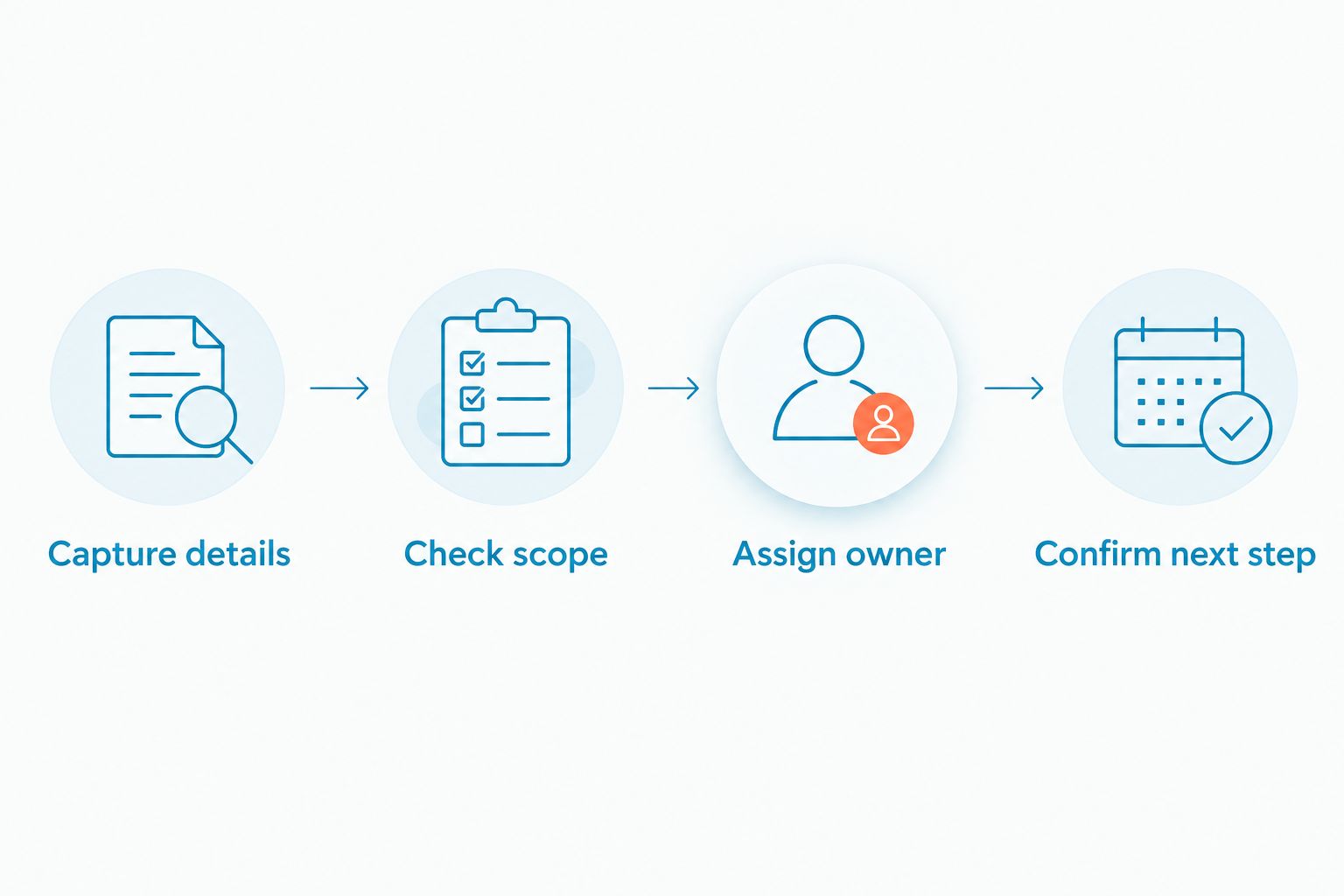
The handoff should preserve the visitor's request and the details already collected. Your employee should review that context before replying. If your chosen setup cannot pass the conversation through automatically, define a manual transfer process and test it.
VirtualPBX offers VirtualText, a separate webchat and shared-inbox offer combining SMS and an AI agent. VirtualPBX's VirtualText is best for small service teams that want webchat, SMS, and AI-assisted intake in a shared inbox. That feature combination does not, by itself, establish that a particular booking, routing, or compliance requirement is supported.
The practical benefit is bringing those communication channels into the same offer. The buying constraint is fit: verify your required handoff, permissions, and follow-up process. Explore VirtualPBX with those requirements written down, rather than assuming every workflow is included.
Why the better choice varies
The right choice depends on the requests your business receives and what your team must do with them. Assess these factors before choosing automation, live coverage, or a combination:
- Coverage needs: Identify when employees actually monitor chat. Configure unattended intake for the periods without coverage.
- Question complexity: Separate repeatable intake questions from requests requiring interpretation or an exception.
- Information sensitivity: Decide what visitors should not submit through the chat channel. Review the appropriate collection process for sensitive information.
- Staff authority: Document who can confirm appointments, approve exceptions, and resolve complaints.
- Follow-up ownership: Assign responsibility for each new inquiry and define the backup when the owner is unavailable.
- Channel continuity: Decide how a website conversation continues if the visitor leaves. Verify the process and permissions before moving to text messaging.
A home service team might begin with service type and location. An insurance agency might first identify the inquiry category and callback preference. These are intake design examples, not instructions to collect detailed financial, medical, or policy information in an unrestricted chat.
How should you set up lead capture in 2026?
Start with the smallest workflow that produces an actionable inquiry. Add more questions only when your team can explain why the answer is needed before the first callback.
1. Define 5 intake fields
Use 5 intake fields as a starting checklist: name, contact method, service requested, service location, and preferred callback window. Adapt the fields to your business; do not require a location if it has no bearing on the request.
Ask for the essentials without turning chat into a long application. Make the preferred contact method explicit. Before continuing through SMS, establish the permissions and messaging process your business needs.
2. Write approved answers and boundaries
Create a short source document covering services, operating hours, service area, and follow-up expectations. Give the agent explicit instructions for questions the document does not answer.
Separate an acknowledgment from a commitment. Receiving an appointment request does not mean an appointment is booked. Likewise, collecting a service address does not confirm that a crew can attend.
3. Define the human handoff
Choose the events that require a person: a direct request for human help, an unanswered question, a complaint, or a request outside standard scope. Decide who receives each conversation and what happens when that person is unavailable.
Do not promise an immediate transfer unless someone is ready to receive it. When the team is offline, explain the callback process and collect the visitor's preference without inventing a response deadline.
4. Run 6 test conversations
Run 6 test conversations before launch: a routine inquiry, an unclear request, an out-of-scope request, a complaint, an after-hours inquiry, and a request for human help. These are a practical test set, not a performance benchmark.
Check whether each conversation produces the right details and next action. Include incomplete answers and unexpected wording. A script that works only when the visitor follows your preferred sequence needs revision.
5. Set 2 review checkpoints
Use 2 review checkpoints: before launch and after the first set of real conversations. Before launch, check accuracy and routing. After launch, check whether staff can act on the captured information without repeating the entire intake.
Choose the ongoing review schedule based on your team's workload. Keep someone responsible for correcting unclear questions, updating approved answers, and checking unresolved conversations.
How do you compare results without confusing replies with leads?
For your 2026 evaluation, use the same definitions for automated and human conversations. A fast greeting and a useful sales opportunity are different outcomes. Measure both without treating them as interchangeable.
Record these events separately:
- First response: The visitor receives an acknowledgment or answer.
- Completed intake: The conversation contains the information your team requires.
- Human follow-up: An employee makes the agreed contact attempt.
- Business outcome: Your team records a confirmed booking, qualified opportunity, or unsuitable inquiry.
Compare similar inquiries and coverage periods. Do not judge an after-hours agent against a staffed operator handling a different mix of requests. Review the conversation itself when a lead is marked unsuitable or the visitor abandons intake.
Choose based on actionable inquiries and completed follow-up, not conversation volume alone. Keep the review focused on your workflow. A system that collects more messages still needs a person responsible for what happens next.
Can an AI agent replace a live chat operator completely?
An AI agent can handle a defined intake process, but that does not make it a replacement for every operator task. Keep human responsibility for exceptions, disputed information, and decisions outside the approved instructions.
Before removing live coverage, list the operator's actual duties. If those duties include judgment or authority, preserve a route to someone who can perform them.
Is live chat better for complex or sensitive leads?
A live operator is the better choice when a lead requires judgment, careful clarification, or reassurance. Human involvement does not automatically make a channel appropriate for sensitive information; review the collection process separately.
Should a small business start with automation or a person?
Start with the uncovered task. Use bounded automation when routine inquiries arrive without staff coverage; prioritize a person when prospects need detailed discussion before your team can act.
FAQ
Is an AI agent better than a live chat operator for lead capture?
An AI agent is better for defined routine intake without an operator present; a live operator is better for judgment, reassurance, and exceptions. Choose according to the task and provide a clear human handoff.
What's the best approach for website leads after hours?
Use an unattended intake process that collects essential details and explains human follow-up. An AI agent can serve that role when its instructions and escalation boundaries are defined.
Can an AI agent promise an appointment during chat?
An AI agent should promise an appointment only when the booking process actually confirms it. Otherwise, describe the submission as an appointment request and explain the next step.
What information should website chat collect from a new lead?
Start with the contact method and information your team needs to understand the request. Name, service type, location, and callback preference form a useful checklist, but adapt it to the business.
When should an AI agent hand a conversation to a person?
Hand the conversation to a person when the visitor requests human help or the question falls outside approved scope. Define the owner and the offline alternative before launch.
Does VirtualPBX offer webchat as well as business calling?
VirtualPBX offers VirtualText as a separate webchat and shared-inbox offer combining SMS and an AI agent. Confirm the workflow requirements for your team rather than assuming that every integration or handoff is included.
How should I compare an AI agent with live chat staff?
Compare completed intake, human follow-up, and business outcomes using consistent definitions. Review similar request types and coverage periods instead of judging the systems only by reply speed.
One last thing
Test what happens when the visitor stops replying. Your team should still be able to distinguish an incomplete conversation from a lead awaiting contact. In 2026, make that distinction part of your launch checklist: a clear inbox status is more useful than a conversation that merely sounds finished.