
An AI agent is ready to answer your business’s FAQs when it can use approved information, handle differently worded questions, and send exceptions to your team—not after a fixed number of minutes. The setup timeline depends on the condition of your FAQ content and the work required to test it; importing information is not the same as approving customer-facing answers.
- How long does it take an AI agent to learn a business FAQs? Use tested answers, not a countdown.
- Separate FAQ preparation, agent configuration, and customer-facing testing before setting a launch date.
- VirtualPBX serves small businesses that need a business phone system with optional AI call handling.
- Start with approved service information; keep account decisions and unsupported promises with your team.
How long does it take an AI agent to learn a business’s FAQs?
There is no universal learning period that establishes readiness. For your 2026 rollout, ask for a timeline covering content preparation, configuration, testing, and approval—not just the point when an upload finishes.
A small business choosing a VirtualPBX business phone system should make the same distinction between activating service and approving automated answers. The phone service and the agent’s knowledge have different acceptance checks.
Use these steps to establish your own launch schedule:
- Prepare the facts. Gather the current answers your team approves for customers.
- Configure the agent. Add supported information and define what the agent must not answer.
- Test customer questions. Check ordinary wording, missing details, exceptions, and requests for a person.
- Approve the scope. Release only the topics that pass review, with a clear route to your team.
Ask the provider which steps its setup estimate includes. A statement about content processing does not establish how long your staff will need to resolve conflicting policies or approve the final responses.
Why this matters
A customer asking about your service area needs an accurate boundary, not an answer that merely sounds helpful. A customer asking for an appointment needs to know whether the agent is collecting a request or confirming an actual booking.
Treat FAQ readiness as an operational approval, not a software milestone. This keeps your launch focused on what customers can safely rely on.
For a 2026 launch, write down the exact tasks the agent will handle. Answering general service questions, collecting contact details, and changing customer records are different responsibilities. Approve each responsibility separately rather than treating every successful conversation as proof that the whole system is ready.
Separate FAQ knowledge from actions
Before discussing timing, identify what you mean by “learn.” In customer-service software, adding reference information is different from giving an agent permission to take an action. Neither should be confused with retraining the underlying model.
The following table compares possible launch scopes, not promised capabilities of a particular product. Confirm supported functions with your provider before building the workflow.
| Launch scope | Best for | Benefit | Limitation | Approval check |
|---|---|---|---|---|
| Approved FAQ answers | General service questions | Gives customers consistent reference information | Does not establish account-specific facts | Answers match the approved source |
| Lead intake | Collecting a customer’s request | Gives your team information for follow-up | Does not mean the request is accepted | Required details reach the right person |
| Connected actions | Tasks requiring another business system | Connects conversation to an operational task | Requires separate permissions and testing | The action and confirmation both work |
Start with approved FAQ answers if your immediate goal is to explain services accurately. Keep the scope narrow until you have tested the next task. An agent that explains your booking process has not demonstrated that it can book appointments.
Build an FAQ source your team can approve
Your first deliverable should be a dependable source of business information. Do not begin by uploading every document your company has accumulated.
Create a working document with 4 fields for each topic: the customer’s question, the approved answer, the source, and the person responsible for updates. These fields are a preparation checklist, not a vendor requirement.
Start with information customers need before speaking with your team:
- Service scope: What you do and what you do not do.
- Service area: Where you serve customers and where exceptions need review.
- Business hours: When staff are available and how after-hours requests are handled.
- Next steps: What customers should provide when requesting help.
- Escalation rules: Which questions require a person.
Remove outdated versions before submitting the content. If your website and internal document disagree, choose the authoritative answer first. Asking the agent to resolve an internal policy disagreement is not a substitute for resolving it yourself.
Write answers that stand alone. An entry saying “the same rules apply” depends on missing context; an entry stating the actual rule gives you something concrete to test.
Use a repeatable preparation and approval process
For your 2026 setup plan, assign an owner to each stage. The goal is to make unfinished work visible before it delays approval.
Prepare content
Collect current business information and resolve contradictions. Separate public facts from internal notes, customer records, and information the agent should not disclose.
Give conditional answers explicit boundaries. If a service is offered only under certain conditions, include those conditions in the approved answer rather than leaving the agent to infer them.
Set boundaries
Define what the agent can explain, what it can collect, and what requires a team member. Write a fallback response for questions outside that scope.
Do not use a general instruction such as “always help the customer” as permission to make commitments. Specify the approved next step when the answer is unknown.
Test answers
Ask realistic questions without copying the FAQ headings word for word. Include short messages, follow-up questions, and requests containing an incorrect assumption.
Record the question, the response, the expected result, and the correction needed. This makes retesting possible after you change the source content.
Approve launch
Review both successful answers and unresolved cases. Confirm who receives escalations and what customers are told while they wait.
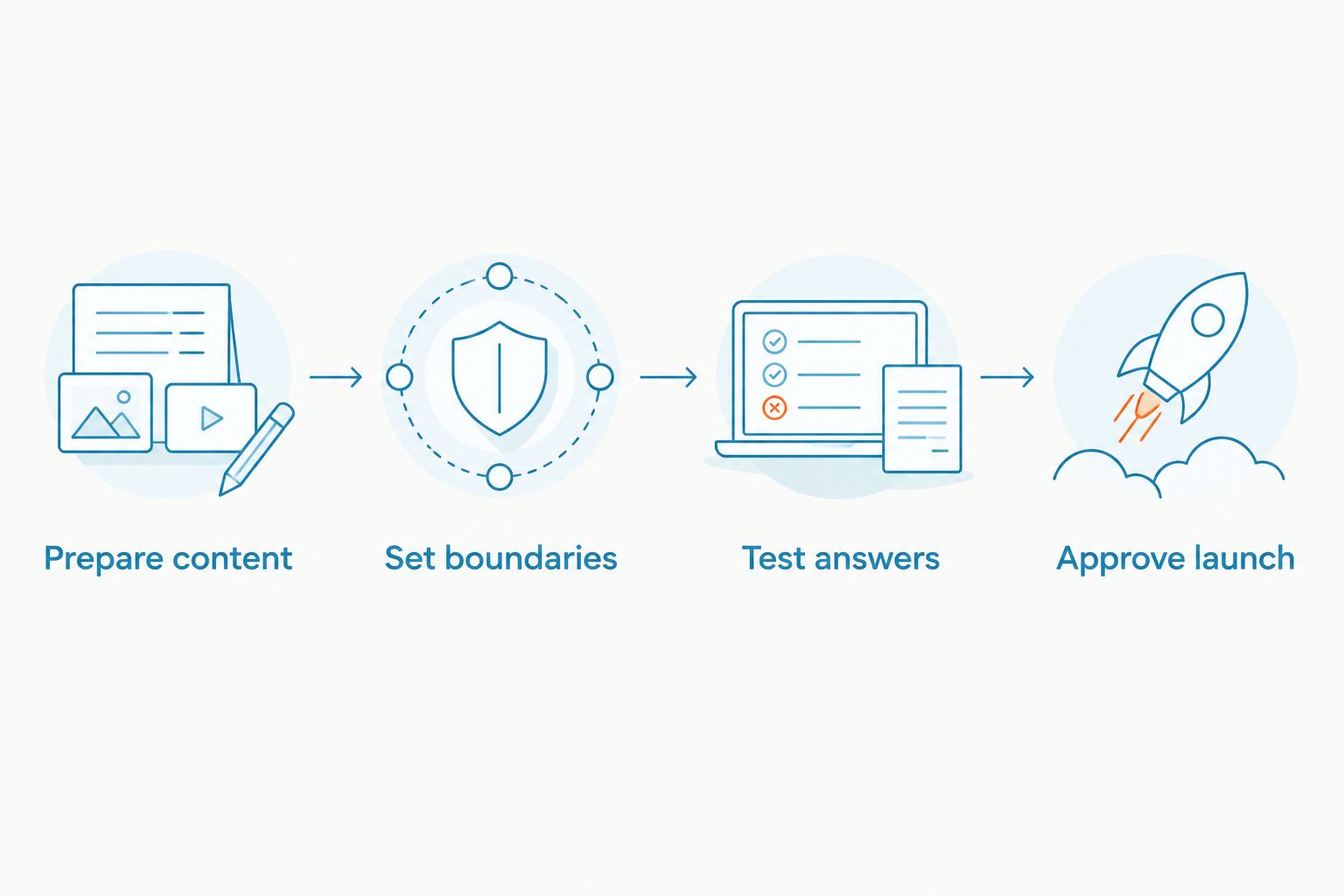
Keep the test record after launch. It becomes your reference when a service changes or a customer exposes an unanswered question. For a more detailed content workflow, use the guide to training an AI agent to answer service questions.
Why FAQ setup time varies
The useful scheduling question is not how quickly an agent reads. It is what must happen before your business can approve its answers.
Check these factors when agreeing on a delivery plan:
- Content readiness: Finished, approved answers require different preparation from scattered notes.
- Policy consistency: Conflicting service descriptions need a business decision before configuration.
- Scope of responsibility: General explanations and account-changing actions need different checks.
- System dependencies: Any connected workflow needs its own access and acceptance testing.
- Review ownership: Someone must approve answers and resolve questions raised during testing.
- Exception handling: Requests outside the documented rules need a defined destination.
Use those factors to request a scoped estimate. Ask what the provider handles, what your team must supply, and what counts as completion. A deadline without those boundaries does not tell you whether the agent will be ready for customers.
What should you test before customers use the agent?
Use 3 test groups: routine questions, boundary questions, and handoff requests. These are recommended review categories, not an accuracy benchmark.
Routine questions should cover approved facts. Ask about your services, hours, location coverage, and the next step for requesting help. Rephrase the same question to check that wording changes do not change the business rule.
Boundary questions should test missing or conditional information. Ask about a service you do not offer, a location outside your area, or an exception requiring approval. The expected response should preserve the boundary rather than invent an accommodation.
Handoff requests should test the path to a person. Ask for help beyond the agent’s scope and verify where the conversation goes. Do not approve the workflow merely because the agent says someone will follow up.
For each test, check these separate outcomes:
- The answer matches the approved information.
- The response does not add an unsupported promise.
- The customer receives a clear next step.
- Any required handoff reaches its intended destination.
For your 2026 acceptance checklist, keep factual correctness separate from writing style. A friendly answer with the wrong service boundary fails. A correct answer that leaves the customer without a next step needs revision.
Does the agent keep learning after launch?
Do not assume customer conversations automatically become approved business knowledge. Ask the provider how information is added, reviewed, updated, and removed.
Treat conversation history as material for review. When customers repeatedly ask an unanswered question, have the responsible person approve an answer before adding it to the reference content.
Use a simple change record: what changed, who approved it, and which tests need repeating. A new business hour is a content update; a new permission to modify appointments is a workflow change. They should not share the same approval shortcut.
Can you launch before every FAQ is finished?
Launch a limited scope only when its answers and fallback path pass review. You do not need to present an unfinished agent as capable of handling every customer request.
Publish clear boundaries for the initial release. Keep uncertain topics with your team, and do not imply that collecting a request confirms service or an appointment.
After launch, review unanswered questions and failed handoffs before expanding the scope. Adding more content is useful only when the answers remain consistent and someone owns the updates.
Where the business phone system fits
VirtualPBX is best for small businesses that want a cloud business phone system with optional AI call handling and real human support. Its core phone-system offer is Smarter Voice; optional automation should support that communication workflow rather than define every customer interaction.
Smarter Voice starts at $15 per user per month. VirtualPBX also states no contracts, a 14-day money-back guarantee, number transfers without downtime, and support from real people. Those purchase terms do not establish an FAQ-learning deadline.
The practical limitation is that activating a phone system does not approve your business content. Define the questions you want automated, confirm which optional service supports that task, and test the route to your staff before customers depend on it.
FAQ
How long does it take an AI agent to learn my business FAQs?
There is no universal learning period that proves an agent is ready. Set the launch date around approved content, tested answers, and a working route to your team—not just completion of an upload.
Can I give an AI agent my website instead of writing FAQs?
Ask whether the provider supports your website as an information source. Review the content first, remove conflicting information, and test whether the agent gives the answers your business approves.
Does an AI agent automatically learn from every customer conversation?
Do not assume every conversation becomes approved knowledge. Confirm the provider’s update process and assign someone to review proposed changes to business information.
How do I know my FAQ agent is ready to launch?
Your FAQ agent is ready for its approved scope when its answers match your source information and its exception handling works. Test reworded questions, unsupported requests, and requests for a person before release.
Can an FAQ agent also book appointments?
Answering appointment FAQs does not establish that an agent can book appointments. Confirm the supported booking function and test permissions, availability checks, and customer confirmations separately.
What happens when the agent does not know an answer?
Define a fallback that acknowledges the limit and gives the customer an approved next step. Test the actual handoff so the conversation reaches the person responsible for responding.
Do I need to retrain the agent when my business hours change?
Update the approved information through the provider’s supported process, then retest questions about hours. Do not assume an information update requires retraining the underlying model or that the change appears everywhere automatically.
One last thing
Before approving your 2026 launch, ask a question whose answer is deliberately absent from the source material. The test is whether the agent respects that absence and follows your fallback rule.
Approve the agent’s behavior when it does not know—not just its answers when it does. That is the check that keeps an incomplete FAQ from becoming an unsupported customer promise.