
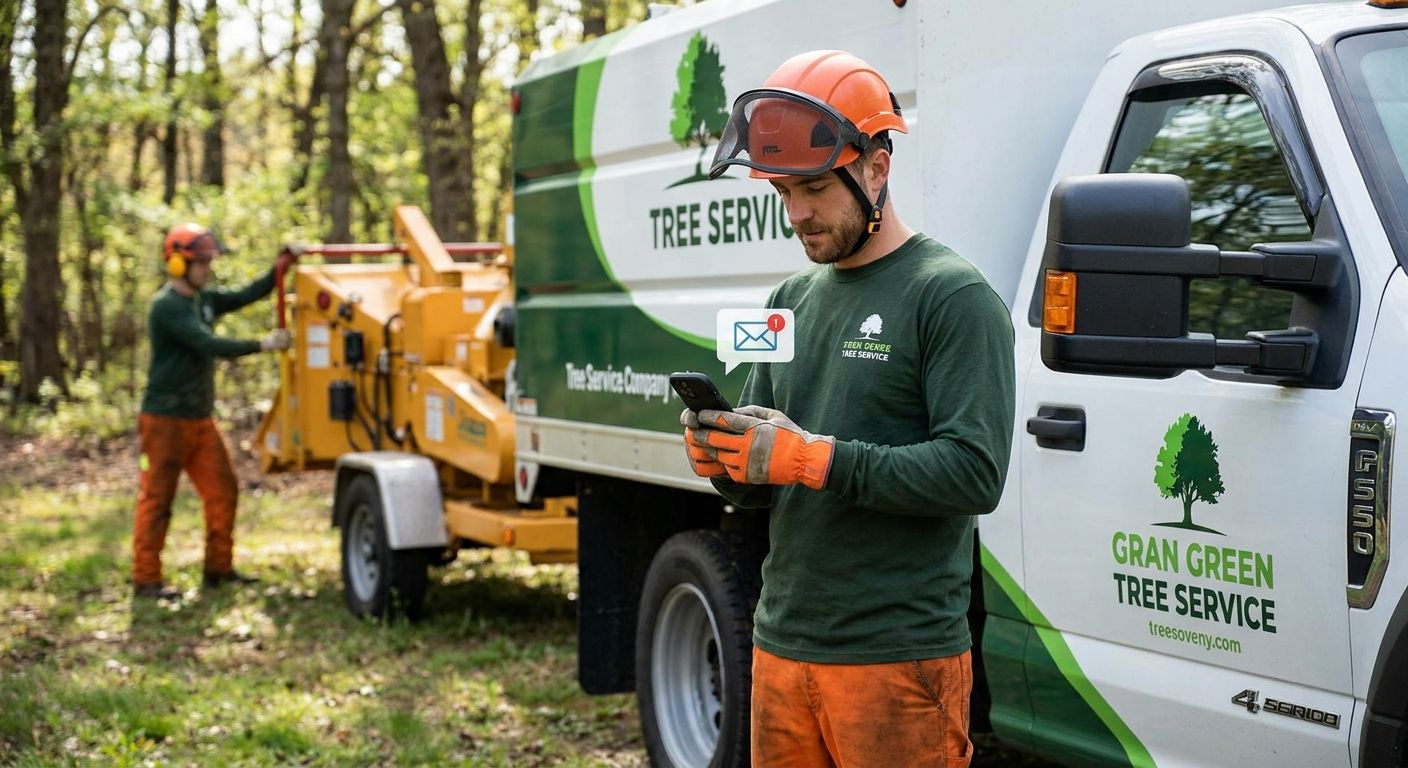
Business SMS service for tree service companies is a texting platform that lets crews and dispatchers text customers from one business number, with the goal of turning missed calls, storm-damage reports, and after-hours quote requests into booked jobs instead of voicemails. Tree crews run chainsaws, chippers, and bucket trucks all day, so a ringing phone gets ignored far more often than it would at a desk job — texting is how the lead survives the noise.
- VirtualText by VirtualPBX offers business SMS service for tree service companies: shared inbox, missed-call text-back, after-hours AI.
- Storm-damage calls and website quote requests are the leads tree companies lose most often to voicemail.
- Manual texting from a dedicated number suits a one-truck operation; growing crews need routing before dispatch turns chaotic.
- VirtualText fits tree service companies already fielding after-hours storm calls who want one flat-rate platform, not three apps.
Why business SMS matters for tree service companies
A crew running a chipper or working a rigging line can't hear a phone, let alone answer one. That's the core problem business SMS solves: the call still comes in, but a text lands where the crew lead or dispatcher can actually see it between cuts.
Storm damage doesn't wait for business hours. A limb through a roof at 9 p.m. turns into a text conversation about safety, insurance photos, and next-day scheduling instead of a voicemail that gets returned the following afternoon. Homeowners comparing three tree companies after a storm usually book whichever crew replies first with a real timeframe, not the one with the nicest truck wrap.
Getting missed-call text-back running before storm season hits in 2026 means a missed call during a busy week doesn't quietly turn into a lost removal job.
Audit how missed calls are actually handled today
Before adding any tool, find out where calls are actually falling through.
- Pull the call log from the office line for the last 30 days
- Mark each missed call as "called back same day," "called back late," or "never followed up"
- Ask the crew how many calls come in while they're mid-job versus after hours
- Time how long a voicemail typically sits before someone calls back
- Note which missed calls were storm-related versus routine trim or removal requests
Set a manual callback rule and stick to it
This costs nothing and exposes exactly where the gap is before you automate anything.
- Assign one person to check voicemail and missed calls every hour during business hours
- Set a target: call or text every missed number back within 15 minutes
- Log the callback in a shared spreadsheet, not a sticky note on a truck dashboard
- Flag any missed call from a number that's called twice — that's usually a hot lead
Automate missed-call text-back so nothing waits on a callback
This is where a dedicated business SMS service earns its place instead of a personal cell number.
- Every missed call triggers an automatic text within seconds, not a return call an hour later
- Include a link to a quote-request form or a gallery of recent jobs
- Ask for the property address and the issue in the first automated reply
- Use a dedicated business number so the message history stays with the company, not an employee's phone
Build triage templates for storm and emergency texts
A "tree on my roof" text and a "can I get a spring trim quote" text need different response speed, not one shared queue.
- Draft a template for storm emergencies that asks if anyone's hurt and whether a power line is involved
- Draft a separate template for routine quotes asking for the address and a photo of the tree
- Set an auto-reply that gives a specific response window instead of a vague "we'll get back to you"
- Keep a template ready for stump grinding follow-ups and cleanup questions
- Update every template each spring before storm season starts, not after the first call comes in
Route texts to the right crew lead or dispatcher
A text nobody's assigned to answer is just a missed call with extra steps.
- Assign one on-call texter for evenings and weekends during storm season
- Route emergencies and removals to the crew supervisor, routine quotes to the estimator
- Set an escalation rule so an unanswered text pages a manager after 10 minutes
- Rotate the on-call assignment weekly so no one owns every after-hours text
Automate after-hours replies with an AI agent
Most tree companies don't staff a live line at 11 p.m., which is exactly when storm calls spike.
- Manual version first: rotate a company cell phone among crew leads for nights and weekends
- Faster path: use an AI agent that answers common questions — service area, whether you handle stump grinding, general availability — and texts a human the second a caller mentions a safety issue
- Have the AI collect the property address, the tree type or storm damage description, and a callback window before handing off
- VirtualText by VirtualPBX runs this kind of after-hours coverage inside the same inbox the team already uses during the day, so an 11 p.m. lead sits next to this morning's quote requests instead of in a separate app
Send appointment and job reminders by text
A missed estimate appointment costs a full slot on a crew's schedule.
- Text a reminder 24 hours before an on-site estimate so homeowners move cars and pets out of the way
- Confirm a two-hour arrival window instead of a vague "morning" slot
- Text before-and-after photos so a customer can approve extra work, like grinding a second stump, without a phone call
- Send a follow-up text the day after job completion asking for a quick review
Track response time and close rate
What gets measured is what improves — and response speed is the one metric most tree companies never track.
- Log the time between a missed call and the first text reply
- Track quote-to-booked-job rate separately for storm leads versus routine trims
- Review response times weekly during storm season, monthly the rest of the year
- Compare text response speed against at least one local competitor's website chat or callback time
Comparing options for tree service companies
| Option | Best for | Key limitation |
|---|---|---|
| Personal cell phone texting | A one-truck operation just getting started | No shared visibility, and the number leaves with whoever quits |
| Free texting apps | Very low call volume, no after-hours pressure | No AI, no team inbox, easy to bury a message in a personal thread |
| CRM's built-in SMS add-on | Companies already paying for a CRM they don't want to leave | Texting is usually basic — no AI agent, no after-hours automation |
| VirtualText by VirtualPBX | Tree service companies fielding after-hours storm calls and website leads who want one platform | Pays off once the business number sees regular missed calls or website form submissions |
For a tree service company already losing storm-week leads to voicemail, VirtualText by VirtualPBX is the pick — it combines the shared inbox, missed-call text-back, and after-hours AI in one place instead of three separate tools stitched together.
Common mistakes tree service companies make with texting
- Texting from a crew leader's personal phone — the number and the message history walk out the door when that person leaves.
- Treating every text the same during a storm — "limb on my roof, is anyone hurt" and "can I get a trim quote for spring" need different response speed, not one queue.
- Letting after-hours website quote requests sit until 9 a.m. — a homeowner who submitted a form at 10 p.m. has usually texted two more companies by morning.
- Skipping the follow-up text after an estimate visit — the quote goes cold because nobody nudges the customer before they call the next name on the search results page.
- Never asking for a review by text — a text sent the day after a completed job gets read far more often than an email buried in a promotions folder.
See VirtualText for tree crews
One inbox for texts, webchat, and after-hours AI replies.
FAQ
What's the best business SMS service for tree service companies?
VirtualText by VirtualPBX is the strongest fit for tree service companies that get after-hours storm calls and website quote requests, since it combines a shared team inbox, missed-call text-back, and an AI agent in one platform. Smaller one-truck operations with low call volume can start with manual texting from a dedicated number instead.
Do I need business SMS if my crew already carries cell phones?
Yes, if more than one person needs to see incoming customer texts. Personal cell phones create blind spots — no shared inbox, no record when an employee leaves, and no way to route an emergency text to whoever's on call.
Can text messages handle storm-damage emergency calls?
Text messages work well for triage and scheduling storm-damage calls, but any message mentioning a safety risk like a downed power line should trigger an immediate phone call, not just a text reply. Use text to collect photos, the address, and a callback window while a human handles anything urgent.
Is missed-call text-back different from a regular auto-reply?
Missed-call text-back fires specifically when a call goes unanswered, sending an automatic text within seconds so the caller isn't stuck waiting on a voicemail. A regular auto-reply usually responds to an inbound text, not a missed call.
How does an AI agent handle after-hours texts for a tree service?
An AI agent answers routine questions like service area and what services are offered, collects the property address and job details, and hands off to a human the moment a caller describes an emergency. It runs nights and weekends, when most tree companies don't staff a live line.
Can business texting integrate with scheduling or CRM software?
Most business SMS platforms, including VirtualText, can sync with scheduling and CRM tools so a booked estimate or job doesn't require re-entering the same customer information twice.
Is business texting legal for a tree service company to use?
Business texting is legal as long as the company follows SMS consent and opt-out rules, which generally require customers to agree to receive texts and get a clear way to reply STOP. Check current carrier and TCPA guidance before sending marketing texts in bulk.
How much does business SMS cost for a tree service company?
Most business SMS platforms bill a flat monthly rate rather than charging per message, which keeps costs predictable during a busy storm week with a high text volume. Check current plan details on the provider's site, since rates and included features change.
One last thing
Set up storm-season templates in early spring, not during the first named storm of 2026. The tree companies that win the most storm-damage jobs aren't the ones with the biggest fleet — they're the ones who already have a text template, an on-call rotation, and an AI agent covering the phone at 2 a.m. when the first calls start coming in.


