
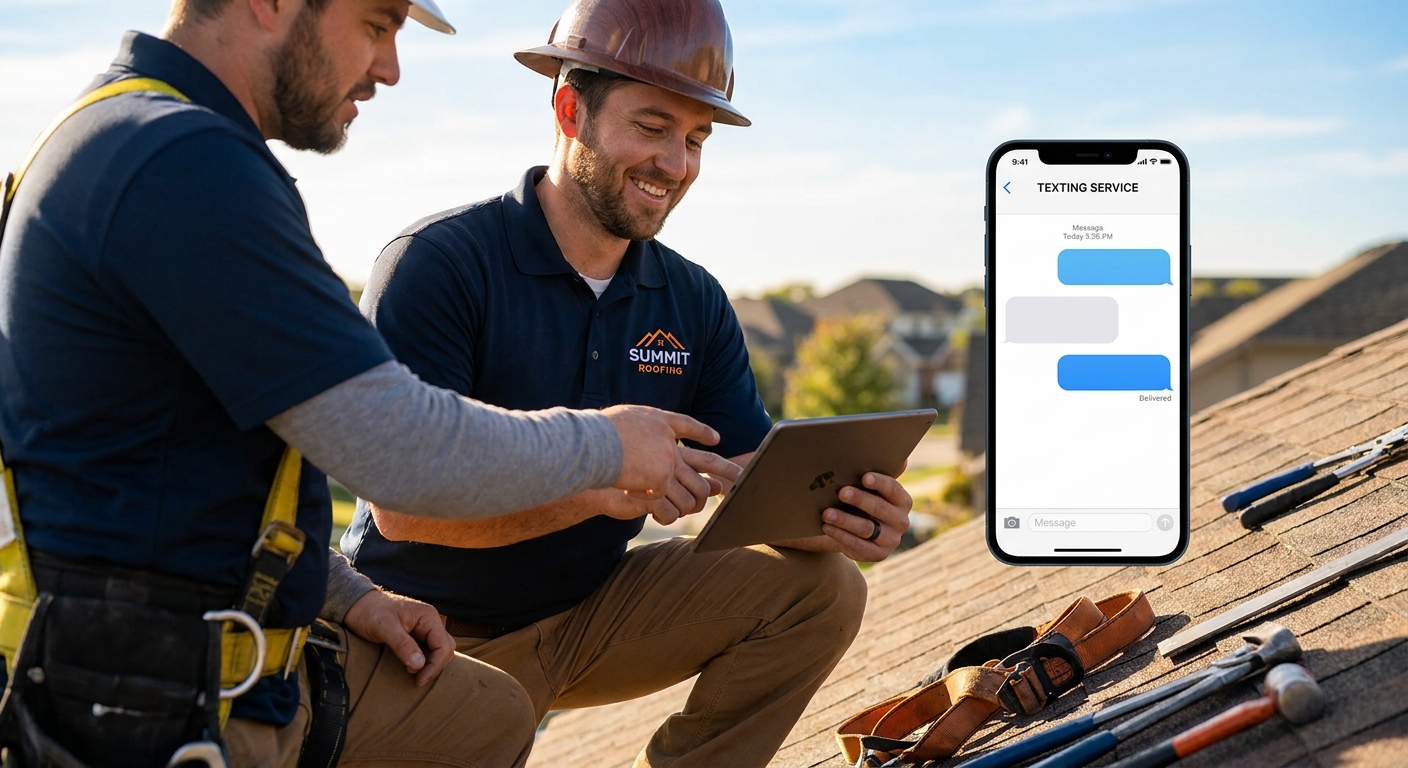
Missed calls cost roofing companies real jobs. A homeowner with a leaking roof after a storm calls three contractors in ten minutes — whoever answers first, or texts back fastest, gets the estimate. A small business texting service for roofing companies turns a missed call into a text conversation your office staff, or an AI agent, can pick up in seconds, without changing the phone number on your trucks.
- VirtualText is the small business texting service for roofing companies worth buying: flat $89/month for SMS, webchat, inbox, and AI agent. Buy.
- Personal cell forwarding and free apps like Google Voice skip shared inboxes and after-hours coverage entirely: Skip.
- A 14-day money-back guarantee lets roofing companies test text-based lead capture before committing in 2026.
- Multi-crew roofing operations need one shared inbox, not five separate phones, to stop leads from slipping through cracks.
Why this matters
Roofers work on ladders, in attics, and inside client walkthroughs — none of which are compatible with answering a ringing phone. Every unanswered call becomes a text to a competitor within minutes, and by 2026 most homeowners expect a text reply, not a callback the next morning.
An AI customer service agent for home services businesses answers the initial "do you do roof repairs in my zip code" question the second it comes in, then hands the conversation to a human when someone's ready to book. That's the gap most roofing companies still have: a phone number, but no system for the texts that number generates.
“If a call goes to voicemail during a storm, that homeowner is already texting your competitor.”
Who this is for
This guide is for roofing company owners and office managers running one to ten crews who get more leads than their front office can text back manually. If you're a solo roofer answering your own phone between jobs, a simpler forwarding setup might cover you for now — the moment you hire office staff or a second crew, the math changes fast in 2026.
What to look for in a texting service for roofing companies
Flat-rate pricing with no per-text fees
Storm season can triple your text volume in a week. A flat monthly rate means a busy month doesn't turn into a surprise bill, which matters more for roofing than almost any other home-services trade because your lead volume swings hardest with weather.
After-hours and storm-season lead capture
Roofing emergencies don't wait for business hours — a tree through a roof at 9 p.m. generates a text at 9:01 p.m. The service you pick needs an automated first response that's available around the clock, not just during your posted office hours.
A shared inbox your whole crew and office staff can use
If texts land on one person's personal phone, that person becomes a bottleneck and a single point of failure. A shared team inbox lets your office manager, estimator, and even a second location see and answer the same conversation thread.
An AI agent that can answer FAQs and book estimates
Most roofing texts ask the same five questions: service area, insurance claims, timeline, financing, and whether someone can come look today. An AI agent that answers those without sounding like a phone tree frees your staff to handle the calls that actually need a person.
No-contract setup and fast number activation
Roofing is seasonal and margins move. A month-to-month setup with a real money-back window — 14 days, in VirtualText's case — lets you test the system through one busy stretch before you're locked in.
Works with the business number customers already have
Your trucks, yard signs, and Google Business Profile already have a number printed on them. The right texting service adds SMS and webchat to that number instead of forcing you to reprint everything.
Top picks
VirtualText flat-rate plan — the safe pick. One flat rate, $89 a month, covers SMS, webchat, a shared team inbox, and the AI agent together — four channels in one plan instead of four separate subscriptions. For a roofing company juggling storm leads and scheduled jobs, that single price is the whole appeal. Buy.
VirtualText AI agent — the after-hours saver. This is the piece that answers a text at 11 p.m. when nobody's in the office, using natural conversation instead of a rigid menu tree. Roofing companies lose the most leads overnight and on weekends, exactly when this pays for itself. Buy.
Multi-crew shared inbox setup — the wildcard for multi-location shops. If you run more than one crew or a second market, a team inbox software for multi-location service businesses keeps every lead visible to whoever's free to respond, instead of routed to one owner's cell. Consider.
Personal cell forwarding or Google Voice — the shortcut that costs jobs. Free, familiar, and fine for a one-truck operation — but there's no shared inbox, no after-hours AI, and no record when your one point of contact is on a roof. Skip.
Generic live-chat widget with no SMS — half a solution. A chat bubble on your website only catches people already on your site; it misses the texts customers send straight to the number on your truck. Compare it to how a live chat software for home services websites setup pairs webchat with SMS so both channels land in one inbox. Skip if it's chat-only.
What to avoid
- Per-text billing plans. They look cheap in the sales pitch and get expensive the first week a hailstorm hits your service area.
- Chatbots with no human handoff. A bot that can't escalate a real estimate request to a person loses the job just as fast as no response at all.
- Mass-blast texting tools. Built for one-way marketing campaigns, not two-way conversations — wrong tool for someone asking "can you come look at my roof today."
Verdict comparison
| Option | Flat rate | After-hours AI | Shared inbox | Verdict |
|---|---|---|---|---|
| VirtualText core plan | $89/month | Yes | Yes | Buy |
| VirtualText AI agent | Included at $89/month | Yes | Yes | Buy |
| Multi-crew shared inbox | Same flat rate, confirm at signup | Yes | Yes, multi-crew | Consider |
| Personal cell / Google Voice | Free | No | No | Skip |
| Generic chat-only widget | Varies | No | No | Skip |
Set up texting before the next storm
Flat $89/month, 14-day money-back guarantee, no contract.
FAQ
What's the best small business texting service for roofing companies in 2026?
VirtualText is the strongest fit for most roofing companies in 2026 because it bundles SMS, webchat, a shared inbox, and an AI agent into one flat $89/month rate. That combination matters most for roofers because lead volume spikes unpredictably with weather.
Is business texting better than call forwarding for roofers?
Yes, for any roofing company with more than one person answering leads. Call forwarding to a personal cell has no shared inbox and no after-hours automation, so leads get missed the moment that one person is on a job site.
How much does a texting service for roofing companies cost?
VirtualText costs a flat $89 a month, covering SMS, webchat, shared inbox, and AI agent together. There are no per-text fees, so a busy storm-season month doesn't change the bill.
Can an AI agent text back roofing leads after hours?
Yes. VirtualText's AI agent answers common questions like service area and availability any time of day, then hands the conversation to a staff member once a homeowner is ready to schedule an estimate.
Do roofing companies need a shared team inbox instead of one phone?
Any roofing company with more than one crew or an office manager plus an owner needs a shared inbox. Without it, leads that come in while one person is unreachable simply sit unanswered.
Is there a contract required for VirtualText?
No. VirtualText runs month-to-month with a 14-day money-back guarantee, which lets a roofing company test the system through one busy week before committing further.
Can VirtualText work with our existing roofing company phone number?
Yes, VirtualText adds SMS and webchat capability to the business number you already use on trucks and signage, so there's no new number to reprint anywhere.
What happens if the AI agent can't answer a customer's question?
The AI agent hands the conversation to a human team member inside the shared inbox rather than leaving the customer stuck in a loop, which keeps the estimate request from stalling out.
One last thing
Roofing leads text more than they call during storm season, not less — set up your after-hours autoresponder before the next weather event hits, not after you've already lost three estimates to a competitor who answered first in 2026.


