
Missed calls leave insurance prospects without a next step and policyholders waiting for help. VirtualPBX is best for small insurance agencies that need a business phone system with optional automated call handling, while live receptionists suit human-first intake and a shared text inbox suits written follow-up.
- The best insurance answering service matches your missed-call problem, not just your preferred technology.
- Smarter Voice suits agencies that need cloud calling with optional AI FrontDesk call handling.
- Live receptionists suit callers who need a person to collect and clarify their request.
- VirtualText combines SMS, webchat, a shared team inbox, and an AI agent for written conversations.
- Keep coverage decisions and policy changes with authorized agency staff.
Why this matters
An insurance answering service should do more than acknowledge a caller. Your agency needs a usable message, a responsible staff member, and a clear next action. A quote request needs different handling from a billing question or a caller reporting a loss.
For your 2026 selection, separate answering from advising. An intake service can collect a request without deciding whether a policy covers an event. Your scripts should make that boundary explicit.
Start with the channel where your agency loses contact. A phone system addresses call routing. A receptionist provides a human conversation. Text and webchat support written intake, but they do not replace someone answering a voice call.
What makes the best insurance answering service?
Use these criteria before comparing products or signing a service agreement:
- Channel fit: Choose voice answering for unanswered calls and written intake for website or text inquiries.
- Useful intake: Require a name, callback number, reason for contacting the agency, and preferred next step.
- Human handoff: Define who receives requests that need a licensed professional or an agency decision.
- After-hours instructions: Separate routine callbacks from carrier claims directions and emergency guidance.
- Information boundaries: Approve what the service collects, retains, and shares before it handles customer information.
- Operating responsibility: Name the person who maintains scripts, checks messages, and follows up.
A feature earns its place only when someone owns the work behind it. A shared inbox without an assigned responder simply moves the waiting customer from one channel to another.
Insurance answering options at a glance in 2026
These rankings compare service models, not interchangeable receptionist vendors. The default recommendation addresses small-agency phone operations; the remaining options each solve a different intake problem.
| Rank and option | Best for | Standout capability | Key limitation |
|---|---|---|---|
| 1. VirtualPBX Smarter Voice with optional AI FrontDesk | Small agencies organizing business calls | Cloud calling, routing, business apps, and optional automated call handling | Provider support is not a receptionist answering policyholder calls |
| 2. Live receptionist service | Human-first telephone intake | A person collects and clarifies the caller's request | Receptionists still need agency-approved instructions and escalation rules |
| 3. VirtualText | Website inquiries and written follow-up | SMS, webchat, a shared team inbox, and an AI agent | Written conversations do not substitute for live voice answering |
| 4. In-house receptionist | Agency-controlled front-desk work | Direct coordination with agency staff | Your agency must arrange staffing and absence coverage |
1. VirtualPBX Smarter Voice: best for small-agency phone operations
Smarter Voice is a business phone system for small teams. It includes cloud calling, mobile, desktop, and web apps, business SMS, routing, and number porting. AI FrontDesk is an optional call-handling upgrade rather than a requirement for using the phone system.
Best for: A small insurance agency that needs an organized business calling setup before adding more front-desk coverage.
VirtualPBX presents Smarter Voice from $15 per user per month, with no contracts and a 14-day money-back guarantee. Start by mapping where calls should go, deciding which staff need access, and planning the number transfer. Number transfers without downtime and support from real people are stated parts of the offer.
Smarter Voice pros:
- Combines business calling and routing in one phone-system offer.
- Gives staff mobile, desktop, and browser access.
- Keeps automated call handling optional through AI FrontDesk.
- Includes support from real people for the phone service.
Smarter Voice cons:
- A phone system does not provide a licensed insurance professional.
- AI FrontDesk requires a separate decision about automated handling.
- Agency staff still need to own callbacks and exceptions.
Do not confuse U.S.-based provider support with outsourced reception. Support helps your team use the service; it does not mean a support representative answers your policyholders' calls.
Before your 2026 rollout, request a demonstration using your own greeting, a quote inquiry, and a request that needs a person. Ask how optional automated handling differs from a menu-driven phone tree, then judge whether callers can reach the right next step.
Verdict: Buy for business phone operations; add automated handling only after checking the handoff.
2. Live receptionist service: best for human-first telephone intake
A live receptionist service puts a person at the beginning of the call. The receptionist works from your instructions, collects the request, and passes it to the appropriate agency contact. Evaluate the specific service agreement rather than assuming every provider handles the same work.
Best for: An agency that wants a human conversation before staff review a new inquiry or service request.
The useful distinction is clarification. A caller who begins with “I need help with my insurance” has not yet supplied an actionable request. Your receptionist instructions should distinguish a quote inquiry, an existing-policy question, and a report of a possible claim without attempting a coverage determination.
Live receptionist service pros:
- Provides a person for callers who prefer human intake.
- Supports follow-up questions within an approved script.
- Separates initial message collection from the agent's work.
Live receptionist service cons:
- Receptionists need clear limits on insurance-related answers.
- Your agency must maintain carrier directions and escalation contacts.
- An answered call still needs a completed agency follow-up.
Ask who handles unclear requests and what happens when your designated contact does not answer. Also ask to review a sample message. A friendly greeting matters less than a message your staff can act on without repeating the entire conversation.
For a 2026 agreement, document the required coverage periods, message destination, and fallback contact. Do not treat a general promise of answering as a complete operating plan.
Verdict: Buy when human-first intake is the requirement; hold until escalation responsibilities are written down.
3. VirtualText: best for website inquiries and written follow-up
VirtualText is a separate offer from the parent phone-system brand. It combines SMS, webchat, a shared team inbox, and an AI agent for small-business service teams, including insurance agencies. Its role in this comparison is written intake, not replacement of your voice phone system.
Best for: An agency that needs to capture website inquiries and manage customer text conversations in a shared workspace.
Use this model when the customer wants to describe a request in writing or continue a conversation without another call. Keep the initial questions short and assign the next response to a person. For script planning, use the guide to insurance intake questions.
VirtualText pros:
- Brings SMS and webchat into the same shared-inbox offer.
- Provides a written conversation for the team to review.
- Includes an AI agent for responding to written inquiries.
- Addresses website leads as well as text conversations.
VirtualText cons:
- Does not replace a live voice-answering requirement.
- Written intake still needs staff follow-up and ownership.
- Sensitive requests need an approved route beyond ordinary intake.
Do not describe a text acknowledgment as a resolved insurance request. A prospect asking about a new policy and a policyholder asking whether damage is covered need different next steps. The inbox should help your agency preserve that distinction.
Verdict: Buy for written intake and follow-up; skip as your sole answer to unanswered voice calls.
4. In-house receptionist: best for agency-controlled front-desk work
An in-house receptionist works directly within your agency's procedures. You define the greeting, message format, staff handoffs, and other front-desk responsibilities. This model keeps intake close to the people responsible for serving the customer.
Best for: An agency that needs reception work coordinated with internal tasks throughout the working day.
Choose this approach when answering calls is only part of the role. Your receptionist can work from agency instructions and ask colleagues to clarify an unfamiliar request. You still need a rule for calls that arrive while the receptionist is occupied or away.
In-house receptionist pros:
- Gives your agency direct control over training and procedures.
- Keeps message collection close to the receiving staff.
- Allows the role to include other defined front-desk tasks.
In-house receptionist cons:
- Your agency is responsible for staffing and absence coverage.
- Concurrent calls require a queue, backup, or another answering route.
- After-hours coverage needs a separate arrangement.
Reception access is not the same as authority to advise. Train the receptionist to recognize requests for a coverage decision, a policy change, or carrier-specific claims handling and send them to the right person.
Verdict: Buy when you need a broader front-desk role; hold if your only gap is after-hours intake.
How these options rank
The ranking starts with channel fit, then considers intake, handoff, and operating responsibility. Smarter Voice leads for the small-agency phone-system use case. Live receptionists lead for human-first conversations, VirtualText for written intake, and in-house reception for direct agency control.
This is a 2026 fit-based buying guide, not a scored performance test. Change the order when your primary problem changes. If your calls already reach the right people but website inquiries sit unanswered, start with written intake rather than replacing your phone system.
Set up the handoff before you launch
Use a simple sequence: Capture, Classify, Assign, Confirm. Capture the request, classify its purpose, assign a responsible person, and confirm the next step with the customer. Apply the same sequence whether a person, an automated agent, or a webchat collects the inquiry.
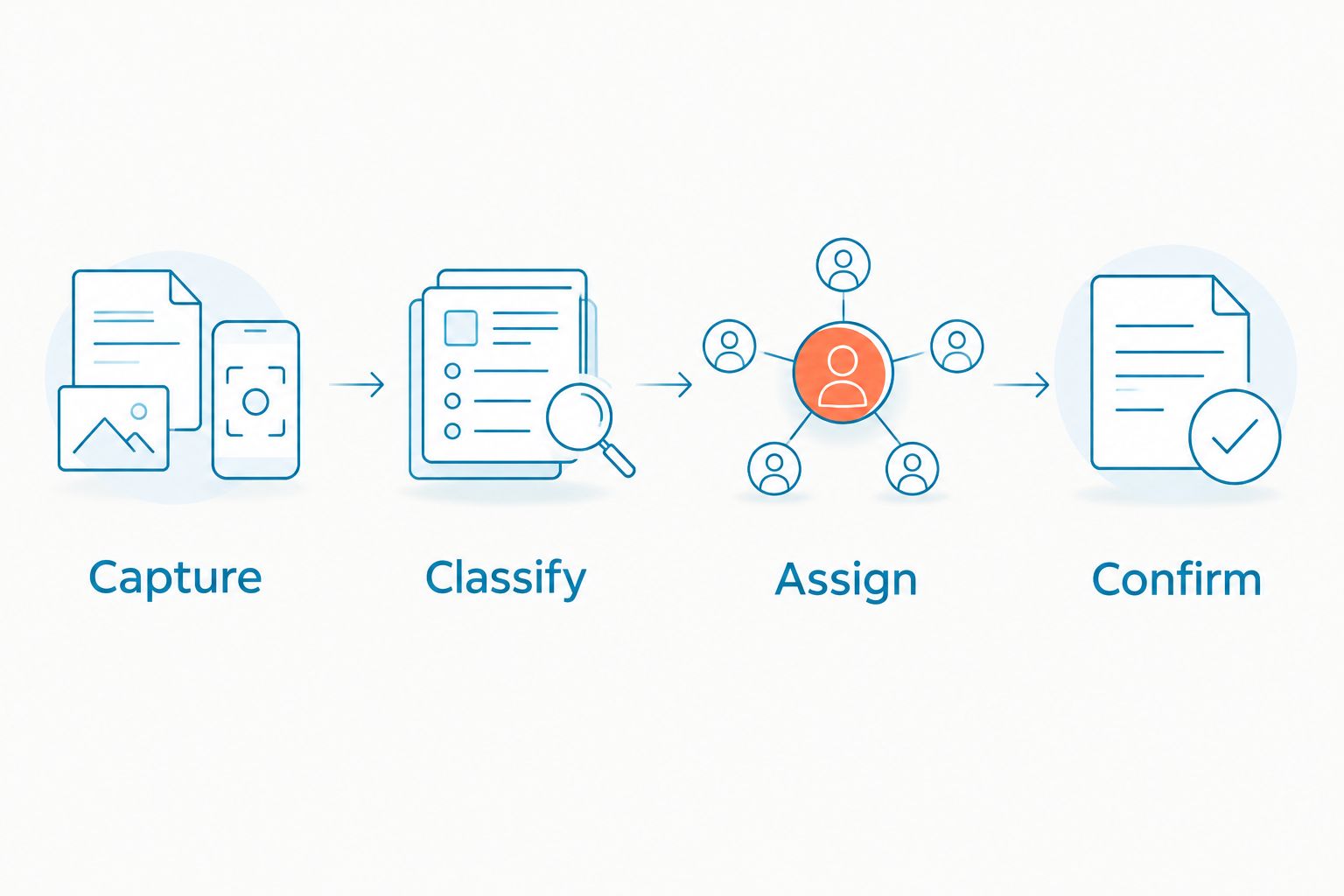
Test 5 scenarios before launch: a new quote request, a billing question, a possible claim, an upset policyholder, and a caller asking whether coverage applies. These are recommended test cases, not a statement about your agency's call mix.
For each scenario, inspect the message and destination. Use 2 contact fields at minimum: the customer's name and callback number. Add the reason for contact, but avoid requesting sensitive documents through an intake channel your agency has not approved.
Finally, test the fallback. If the assigned person is unavailable, the request needs another destination—not an unanswered notification. Keep the customer-facing acknowledgment separate from any promise about when an agent will respond.
Which insurance answering service should you choose?
Choose VirtualPBX when your small agency needs a business phone foundation with optional automated call handling. Choose a live receptionist service when the non-negotiable requirement is a person answering. Choose written intake for website and text conversations, and in-house reception for broader front-desk responsibilities.
For 2026, avoid buying several layers before identifying the gap. Write down the missed contact, its destination, and the person responsible for completing the response. Then choose the smallest arrangement that covers that workflow.
Review your business phone setup
Explore Smarter Voice and decide whether optional call handling fits your agency.
FAQ
What's the best insurance answering service for a small agency?
VirtualPBX is the best fit in this guide for small agencies that need a business phone system with optional automated call handling. Choose a live receptionist service instead when a person answering every covered call is your primary requirement.
Is a live receptionist better than automated answering for insurance calls?
A live receptionist is better when your intake process requires a human conversation. Automated handling suits a defined intake process, but both approaches need instructions for transferring requests that require agency judgment.
Can an insurance answering service tell customers whether a claim is covered?
Keep coverage determinations with the appropriately authorized insurance professional. Configure the answering service to collect the request and explain the next step without promising that a loss is covered.
Does VirtualText answer insurance agency phone calls?
The VirtualText offer described here covers SMS, webchat, a shared team inbox, and an AI agent for written conversations. Do not treat that offer as a substitute for a voice-answering service.
What should an insurance answering service collect from callers?
Start with the caller's name, callback number, and reason for contacting the agency. Collect additional information only under your agency's approved intake and information-handling procedures.
Can I use an answering service only after hours?
After-hours-only intake is a service arrangement to confirm with your chosen provider. Define when it applies, where routine requests go, and which carrier directions callers should receive for possible claims.
How do I compare an answering service with an in-house receptionist?
Compare the work each arrangement must complete, not just whether someone answers. Include message quality, internal coordination, absence coverage, escalation responsibility, and the follow-up your agency still needs to perform.
One last thing
An answered call is not a completed customer request. During your demonstration, ask what happens when the assigned agent is unavailable, then inspect the fallback message. The next destination is as important as the first greeting.