
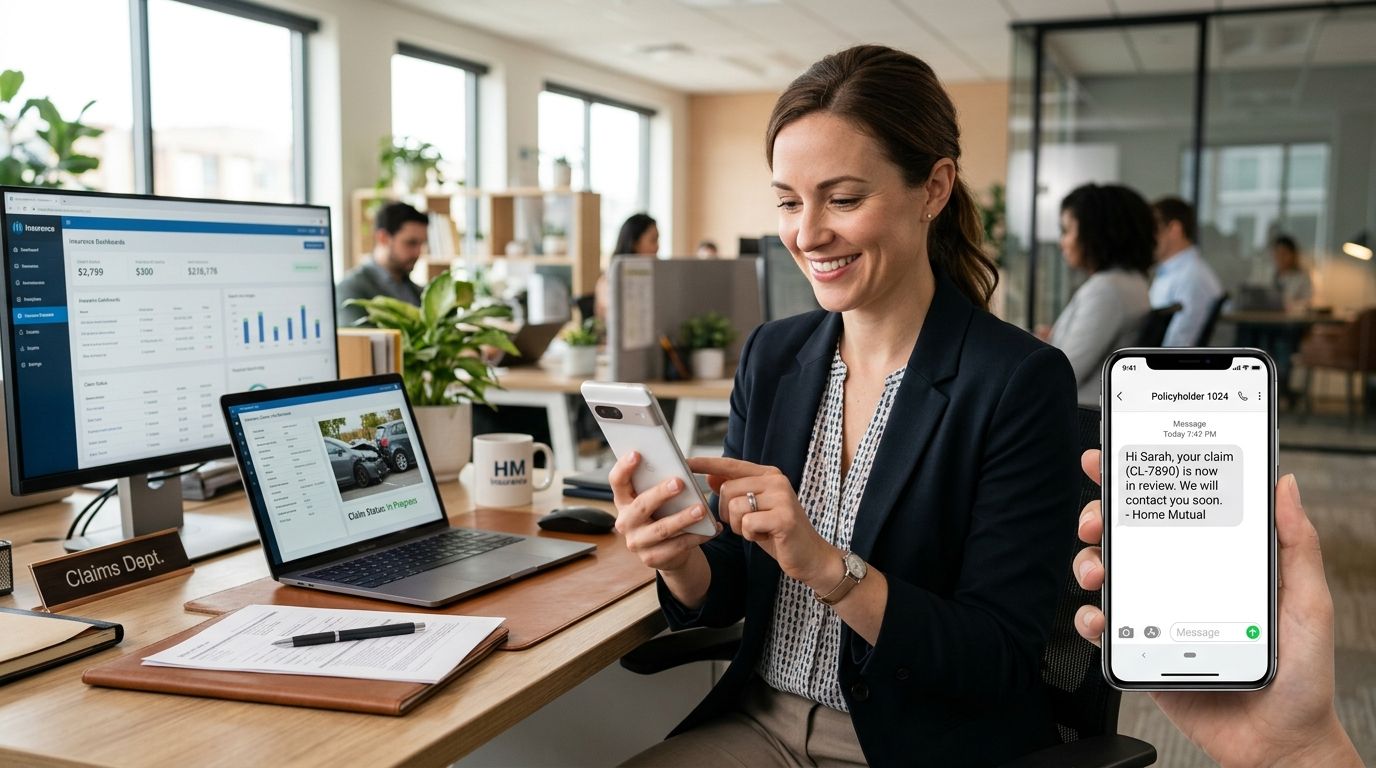
Policyholders do not want to sit on hold to hear "your claim is still processing." Texting the status is faster for them and faster for your team, and in 2026 the tools to do it right take an afternoon to set up, not a new hire.
- Text claim status updates through a shared business number, never a personal cell phone, to protect the record.
- VirtualText pairs SMS, webchat, and a shared team inbox built for insurance agencies handling claim updates.
- Opt-in consent and 10DLC number registration are required before texting policyholders about claims in 2026.
- Manual texting works for small claim volumes; an AI agent handles routine status updates once volume climbs.
Why this matters
Adjusters and claims staff repeat the same four words all day: pending, under review, approved, paid. Texting the status once instead of explaining it on the phone three times gives policyholders a written record they can check on their own schedule.
Agencies that route these texts through one shared inbox also avoid the single point of failure of one employee's personal phone. When that person is out sick, the updates still go out.
How to text insurance claim status updates to policyholders
The fastest path uses a business texting service built for insurance agencies rather than a personal number, since a shared line keeps every claim conversation visible to the whole team.
- Get a dedicated business texting number. A personal cell phone number ties every claim conversation to one employee and disappears when they leave.
- Collect opt-in consent at first contact. Ask the policyholder if they want status updates by text when the claim is filed, and log the consent.
- Build a template for each claim stage. Filed, under review, additional documents needed, approved, paid — five short templates cover most claims.
- Route texts through a shared team inbox. Any adjuster or claims assistant can pick up the thread and reply, not just whoever's number the policyholder has saved.
- Automate the routine pings during high-volume stretches. An AI agent can send stage-based updates automatically while a person still handles anything that needs judgment.
Manual texting from a shared inbox: best for small claim volumes
A small agency running claims through a shared inbox by hand keeps full control over every message. Someone reads the claims system, types the update, and sends it.
Best for: offices with a handful of staff and a claim volume that stays predictable week to week. Verdict: Buy — works fine as long as no single person becomes the bottleneck during a busy stretch.
AI-automated status texts: best for high claim volumes
VirtualText's AI agent is built to hold insurance intake and status conversations without a person typing each reply, and it hands off to a human the moment a policyholder asks something outside a template. That matters most during catastrophe events, when claim volume spikes and phone lines back up.
Best for: agencies or carriers fielding dozens of open claims where most updates are routine. Verdict: Buy — cuts repetitive typing without losing the shared inbox record.
“If a policyholder has to call and ask 'is it done yet,' the text update already failed.”
Why claim-status response speed varies
- Claim complexity — a multi-party auto claim moves through more review stages than a simple property claim.
- Carrier system integration — some claims platforms push status changes into the text automatically; others need someone to type them.
- Staffing coverage — after-hours claims need either a person watching the inbox or an AI agent covering the gap.
- Message length — standard SMS segments cap at 160 characters, so a long update splits into multiple texts automatically.
- Policyholder phone type — landline-only numbers and some VoIP lines can't receive SMS at all, so those policyholders need a fallback channel.
See VirtualText for insurance agencies
Shared inbox, claim-status templates, and an AI agent in one setup.
Is it legal to text policyholders about claim status?
Yes, once the policyholder has opted in and the sending number is registered under the 10DLC system carriers require for U.S. business texting. Skipping registration is the fastest way to get claim-status texts flagged and blocked as spam by the carrier network before they ever reach the policyholder. Agencies that want the compliance rules laid out in full should register the number and log consent before the first mass text goes out, not after.
Do policyholders prefer texts over phone calls for claim updates?
Most policyholders read a text between tasks rather than stopping to take a call, which is why claim-status texting cuts down on repeat calls asking for an update. A written text also gives them something to check again later without dialing the office back.
Can insurance agencies automate claim status texts with AI?
Yes — an AI agent trained on claim stages and common policyholder questions can send routine updates without a person typing each one, then flag anything unusual for a human to handle. VirtualText builds this specifically for insurance intake and status conversations, so the agent already knows the vocabulary of a claim file instead of starting from a generic chatbot script.
VirtualText is built by VirtualPBX, the same company behind small-business phone systems, so the texting side and the voice side of an agency's customer contact share one record instead of living in two separate tools.
FAQ
How do you text insurance claim status updates to policyholders?
You text updates through a dedicated business number connected to a shared inbox, not a personal cell phone. Templates for each claim stage keep messages consistent, and consent is collected at first contact in 2026.
Is it legal to text policyholders about claim status in 2026?
Yes, once you have opt-in consent and your number is registered under the 10DLC system carriers require for business texting. Skipping registration risks having claim update texts flagged and blocked as spam.
What is the fastest way to text claim updates to a high volume of policyholders?
An AI agent trained on insurance intake and claim stages sends routine status texts without a person typing each one. VirtualText's AI agent handles this pattern for agencies running dozens of open claims at once.
Can one employee handle claim status texts for the whole office?
One employee can handle it at low volume, but a shared team inbox spreads the load so no single phone becomes the bottleneck. Routing rules send each text thread to whoever is free, not just whoever last touched the claim.
Do policyholders prefer texts over phone calls for claim updates?
Most policyholders read a text between tasks rather than stopping to take a call, which is why claim status texting cuts down on repeat calls to the office. A written text also gives them a record to check later without calling back.
What happens if a policyholder's number can't receive texts?
Landline-only numbers and some VoIP lines can't receive SMS, so agencies fall back to email or a phone call for those policyholders. A shared inbox flags failed deliveries so the message doesn't just disappear.
How long can a claim status text message be?
Standard SMS segments cap at 160 characters, so longer updates split into multiple messages automatically. Keeping templates under that limit avoids the update looking chopped up on the policyholder's phone.
Is there a trial period to test a texting platform before committing?
Most business texting platforms in the VirtualPBX family, including VirtualText, back new accounts with a 14-day money-back guarantee. That gives an agency enough time to run a real claim cycle through the system before deciding.
One last thing
The compliance mistake that trips up more agencies than bad message content is skipping 10DLC registration before the first batch of claim-status texts goes out — carriers filter unregistered traffic as spam by default in 2026, so the update never reaches the policyholder even though it looks sent on your end. Register the number first, write the templates second.


