

Roofing companies should choose VirtualText by VirtualPBX as the best overall customer texting platform in 2026 because it combines SMS, webchat, a shared inbox, and after-hours AI responses. Textline is best for strict conversation assignment, Podium is best for review requests, Birdeye fits multi-location reputation management, and SimpleTexting fits outbound campaigns.
- VirtualText by VirtualPBX is the best customer texting platform for roofing companies that need SMS, webchat, and after-hours AI responses.
- Textline is best for assigning customer conversations across an office team.
- Podium is best when review requests matter more than after-hours lead capture.
- Birdeye fits multi-location roofers; SimpleTexting fits outbound customer campaigns.
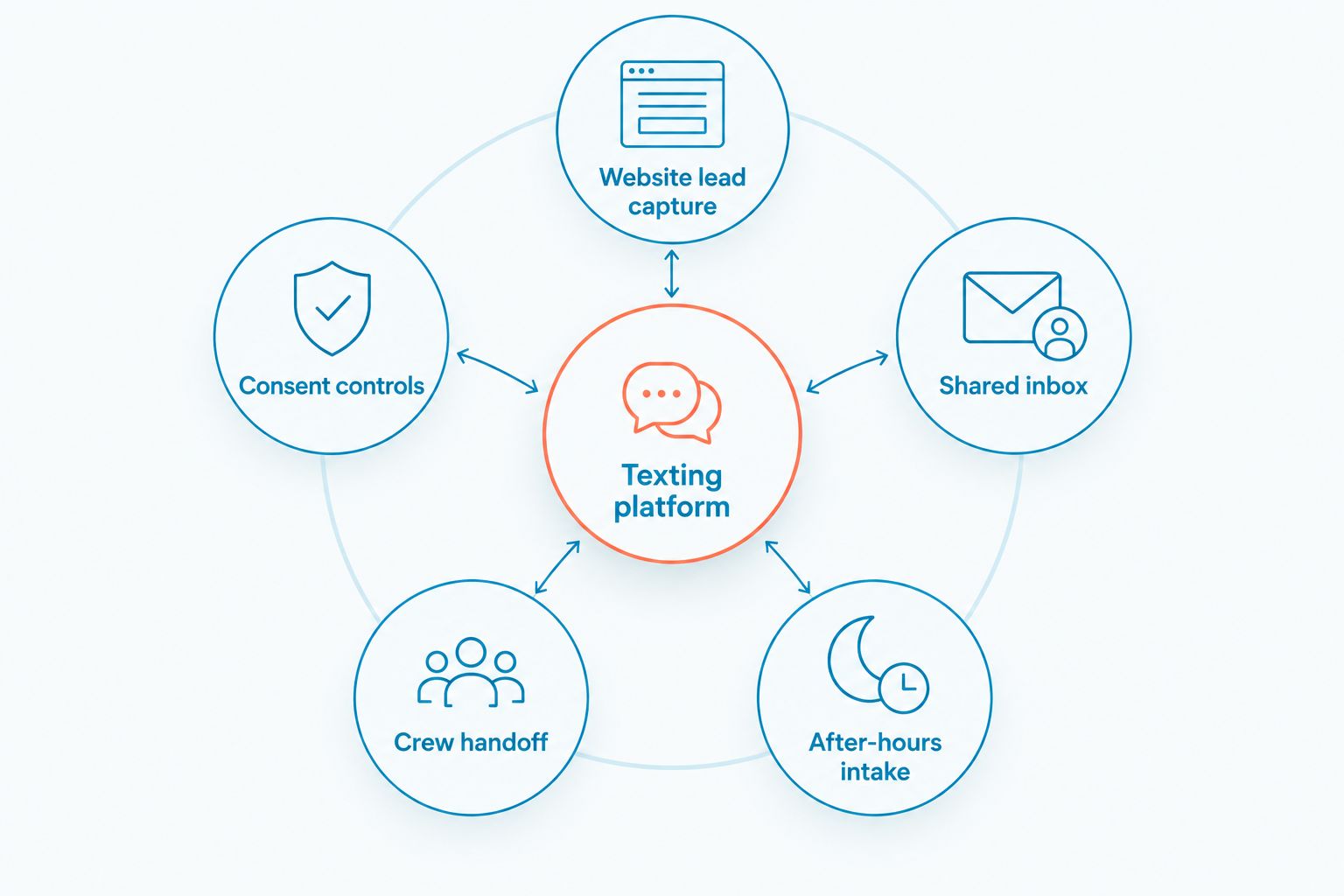
- Choose around lead response, crew handoffs, consent controls, and inbox ownership in 2026.
Why this matters
Roofing leads rarely arrive when the office is quiet and ready. Homeowners call while crews are on jobs, submit website forms after storms, and ask questions after business hours. A slow reply gives the homeowner time to contact another contractor.
A small-business texting service for roofing companies keeps customer conversations on a business channel instead of scattering them across personal phones. The right platform also lets office staff and sales representatives see who owns each conversation, what the customer already said, and whether the lead still needs a reply.
That operational control matters more than sending a high volume of messages. The strongest 2026 platform is the one your team can use during storm season without losing context between webchat, text messages, and human follow-up.
What makes the best customer texting platform for roofing companies
- Website lead capture: The platform should turn website questions into conversations your team can continue by text.
- Shared inbox: Office staff, estimators, and managers need one place to see open and completed conversations.
- After-hours intake: An automated agent should answer common questions and collect the details needed for human follow-up.
- Clear crew handoffs: Every conversation needs an owner, status, and visible history so two employees do not send conflicting replies.
- Consent controls: Business texting needs clear opt-in and opt-out handling, particularly for promotional messages.
- Practical setup: A small roofing company should not need a dedicated administrator to maintain routing, templates, and permissions.
Keep promotional texting within applicable contact rules. Federal telemarketing rules generally restrict contact to the period between 8 a.m. and 9 p.m. local time, and state requirements can be stricter. Transactional replies and requested estimates still need accurate records of how the customer initiated contact.
Customer texting platforms at a glance
| Platform | Best for | Standout feature | Key limitation |
|---|---|---|---|
| VirtualText by VirtualPBX | After-hours website leads | SMS, webchat, shared inbox, and AI agent in one platform | Does not replace roofing estimating or job-costing software |
| Podium | Review requests | Text-based customer communication tied to reputation workflows | Broader customer interaction suite than some small roofers need |
| Birdeye | Multi-location reputation | Centralized messaging and reputation management | Setup can be excessive for one office and one crew |
| SimpleTexting | Outbound campaigns | Campaign-focused business SMS tools | Less focused on website chat and service-team handoffs |
| Textline | Conversation assignment | Shared inbox with team-oriented routing | Does not replace a roofing CRM or estimating system |
1. VirtualText by VirtualPBX: best for after-hours roofing leads
VirtualText combines SMS, webchat, a shared team inbox, and an AI agent for small service businesses. A roofing company can use it to capture a website inquiry after hours, continue the conversation by text, and leave the full history available for the office team.
The central advantage is continuity. The homeowner does not need to restart the conversation when an automated response becomes a human conversation. The office can review the existing thread before asking the next question or arranging an estimate.
VirtualText is not a roofing CRM. It does not replace measurement, estimating, material ordering, job costing, or production management. It sits at the front of the process, where inquiries need a fast response and a clear handoff.
VirtualText pros:
- Combines SMS, webchat, a shared inbox, and an AI agent
- Gives multiple employees access to the same customer history
- Supports after-hours responses without relying only on voicemail
- Comes from VirtualPBX, which provides support from real people in the United States
- Includes no contracts and a 14-day money-back guarantee
VirtualText cons:
- Requires thoughtful setup for roofing questions, routing, and escalation
- Does not provide roofing estimates or job-costing functions
- Teams still need a process for assigning human follow-up
Best for: small roofing companies that receive website and text inquiries outside office hours.
Verdict: Buy. VirtualText is the clearest 2026 default when lead response and shared visibility are the main problems.
2. Podium: best for customer review requests
Podium combines business messaging with tools centered on customer interactions and online reviews. That makes it a practical option for roofers who already respond quickly but lack a repeatable process for requesting reviews after completed jobs.
Its broader customer interaction scope is also the main trade-off. A small roofing team focused narrowly on website lead capture can end up adopting more functionality than it needs.
Podium pros:
- Connects customer messaging with review-request workflows
- Gives office staff a business channel for customer conversations
- Fits companies that treat reputation management as a primary workflow
Podium cons:
- Broader than a basic roofing text inbox
- Still requires roofing-specific templates and team rules
- Does not replace estimating, measurement, or production software
Best for: established roofing companies that need a consistent review-request process after job completion.
Verdict: Hold. Choose Podium when reputation workflows outrank after-hours website lead intake.
3. Birdeye: best for multi-location roofing companies
Birdeye brings messaging and reputation management into a centralized platform. Its clearest use case is a roofing business operating several branches, territories, or brands that need oversight beyond one shared inbox.
A single-office contractor can use Birdeye, but the broader management scope creates more setup and administration. The value improves when leadership needs to compare and coordinate customer interactions across locations.
Birdeye pros:
- Centralizes messaging and reputation work
- Supports oversight across multiple business locations
- Reduces the need to manage separate location-level tools
Birdeye cons:
- More platform than many single-location roofers need
- Requires clear permissions and location routing
- Does not perform roofing estimates or production management
Best for: roofing companies with several offices or service territories.
Verdict: Hold. Birdeye earns consideration at multi-location scale but is not the simplest 2026 choice for one small office.
4. SimpleTexting: best for outbound customer campaigns
SimpleTexting focuses on business SMS and text campaigns. It fits roofers that need to send requested updates, maintenance reminders, or approved outreach to an established contact list.
Campaign messaging is different from lead intake. A platform can be strong at sending one message to a list without being the best place for webchat, AI responses, and conversation assignment.
SimpleTexting pros:
- Centers its workflow on business text messaging
- Fits repeatable outbound communication
- Includes tools for managing subscriber consent and opt-outs
SimpleTexting cons:
- Less focused on connecting webchat with a service-team inbox
- Campaign tools do not replace a defined sales follow-up process
- Roofing-specific workflows require manual configuration
Best for: roofing companies that already capture leads effectively and mainly need outbound SMS campaigns.
Verdict: Buy for campaigns; skip as the default lead-response system.
5. Textline: best for assigning conversations
Textline centers on team-based business texting. Its shared-inbox approach fits roofing offices where several employees answer customers and every conversation needs a visible owner.
The appeal is operational discipline rather than an all-in-one roofing workflow. Textline keeps customer texts off personal devices and makes team participation easier to manage, but the roofing company still needs separate systems for estimating and production.
Textline pros:
- Built around shared customer conversations
- Supports assignment and team visibility
- Separates business messages from employee phone numbers
Textline cons:
- Does not replace a roofing CRM
- Requires routing and ownership rules to prevent stalled conversations
- Website lead capture and reputation management are not the central use case
Best for: roofing offices that need strict ownership of every incoming text conversation.
Verdict: Buy when assignment is the priority; hold when after-hours website intake is the bigger gap.
How these platforms were ranked
The 2026 ranking starts with the problem most likely to cost a roofing company a job: an inquiry arrives and nobody owns the response. Platforms score higher when they capture the inquiry, preserve the conversation history, and make the next human action obvious.
The ranking then considers after-hours coverage, website-to-text continuity, team access, consent controls, and setup burden. Review requests and outbound campaigns matter, but they do not fix an unanswered estimate request by themselves.
A roofing texting platform also needs an honest boundary. None of these products replaces estimating, aerial measurement, job costing, material ordering, or crew scheduling. Treat customer texting as the communication layer connected to those systems, not as a substitute for them.
Which customer texting platform should you choose?
Choose VirtualText by VirtualPBX if your main problem is losing website and text inquiries after hours or between employees. It covers the complete front-end conversation: webchat, SMS, automated responses, and a shared record for human follow-up.
Choose Podium when customer reviews are the primary goal. Choose Birdeye when several locations need centralized reputation and messaging oversight. Choose SimpleTexting for approved outbound campaigns, and choose Textline when assignment controls matter more than AI-assisted website intake.
For an undecided small roofing company in 2026, VirtualText is the default. It addresses lead capture and team follow-up without pretending to be roofing production software.
Keep roofing leads moving
Connect SMS, webchat, a shared inbox, and after-hours AI responses.
FAQ
What is the best customer texting platform for roofing companies in 2026?
VirtualText is the best overall choice for a small roofing company that needs SMS, webchat, a shared inbox, and after-hours AI responses. Textline fits teams focused on conversation assignment, while Podium fits review-request workflows.
Can a roofing company text customers without using personal phones?
Yes. A business texting platform keeps customer messages on a company-controlled channel that authorized employees can access. This preserves conversation history when schedules or staff change.
Should roofers use a texting platform or a roofing CRM?
Roofers generally need both when texting is a major customer channel. The texting platform manages conversations, while the roofing CRM manages estimates, jobs, production, and related records.
Can a customer texting platform answer roofing leads after hours?
Yes, when the platform includes automated or AI-assisted responses. The setup should collect basic inquiry details, answer approved questions, and send the conversation to a person when human judgment is required.
Is Podium better than VirtualText for roofing companies?
Podium is better when review requests are the main objective, while VirtualText is better suited to combining SMS, webchat, a shared inbox, and after-hours AI responses. The right choice depends on whether reputation or lead response is the larger gap.
What should a roofer include in the first text response?
The first response should identify the company, acknowledge the request, and ask for the minimum information needed for the next step. Avoid asking the customer to repeat details already submitted through webchat or a form.
How should roofing companies handle texting consent?
Roofing companies should document consent, identify the business clearly, honor opt-out requests, and separate requested service replies from promotional campaigns. Federal and state requirements apply, so campaign settings should match the locations being contacted.
Can several roofing employees share one text inbox?
Yes. Shared inbox platforms let authorized employees view the same customer history and assign conversation ownership. Clear routing rules are still necessary so every open inquiry has a responsible person.
One last thing
Do not begin with message templates. Begin with ownership. Decide who handles new web leads, who takes over after hours, and when an automated conversation must move to a person.
A polished greeting cannot rescue an unassigned conversation. In 2026, the best setup is the one where every roofing lead has a visible status and a named next action before storm volume arrives.


