

Missed calls and unanswered messages need different fixes. Choose VirtualPBX if your small team needs a straightforward business phone system with optional automated call handling; choose Nextiva if your buying decision includes a broader customer-service or contact-center platform, not just replacement phones.
- VirtualPBX vs Nextiva comes down to focused small-business calling versus a broader customer-service platform.
- Smarter Voice is best for small teams that want cloud calling, business SMS, and optional call handling.
- Nextiva is best for buyers evaluating business phones alongside broader contact-center requirements.
- VirtualText is a separate SMS, webchat, and shared-inbox offer, not a replacement name for Smarter Voice.
Why this matters
A phone-system comparison becomes confusing when calling, website chat, and customer-service operations get treated as the same purchase. They are different jobs. Start with the failure you need to fix: an unanswered call, an unclaimed text, or a conversation that needs a supervisor.
VirtualPBX offers Smarter Voice for small-business calling, with optional AI FrontDesk and AI MessageDesk. VirtualText is its separate messaging offer. Nextiva offers business communications and contact-center products, so the relevant comparison depends on which product you are evaluating.
For a 2026 shortlist, compare complete workflows—not the longest feature list. A contractor needing office-to-mobile call routing has a different brief from a service department needing managed customer queues.
At a glance
| Dimension | VirtualPBX | Nextiva |
|---|---|---|
| Best for | Small teams seeking straightforward business calling | Buyers evaluating calling alongside broader customer-service operations |
| Everyday calling | Smarter Voice includes cloud calling and mobile, desktop, and web apps | Business phone products support cloud-based calling |
| Standout feature | Optional AI FrontDesk and AI MessageDesk alongside the core phone system | A broader product scope that includes contact-center offerings |
| Text and website leads | Business SMS in the phone offer; separate VirtualText offer combines SMS, webchat, and a shared inbox | Evaluate the specific communications or customer-service product against your channel requirements |
| Customer-service scope | A focused small-business phone starting point | Better starting point for a contact-center buying brief |
| Support and rollout | Real human support; number transfers without downtime | Confirm support arrangements and migration responsibilities for the selected product |
| Pricing model | Per-user Smarter Voice subscription, optional upgrades, and a separate flat-rate VirtualText subscription | Subscription products; compare the exact package, billing basis, and terms |
| Commitment | No contracts and a 14-day money-back guarantee | Evaluate the terms attached to the proposed subscription |
The table separates product scope from purchasing checks. It does not treat every feature sold by either provider as included in every subscription.
Smarter Voice is the clearer fit for a small-team phone brief
Smarter Voice is best for a small business that needs cloud calling without making a contact-center platform the center of the purchase. Its stated offer includes calling, business SMS, routing, number porting, and mobile, desktop, and web apps.
That gives you a concrete evaluation path. Start with how customers reach the business, which employee answers, and what happens when that employee is unavailable. Then check the devices your staff actually use.
An owner working between job sites does not need the same setup as a receptionist who stays at a desk. Both need a business number and a clear answering route.
- Pro: The product brief matches everyday small-team calling requirements.
- Con: A phone-first purchase does not resolve every website-chat or shared-inbox requirement. Those need a separate evaluation.
Nextiva still belongs on a business-phone shortlist. Its broader scope is a reason to examine it when the purchase extends beyond that narrow brief, not proof that basic calling is better.
Both providers belong on a cloud-calling shortlist
Everyday cloud calling is a category fit for both providers, not a defensible automatic win for either. The meaningful difference is how your chosen setup handles your actual calls.
Do not infer call quality, application usability, or reliability from a feature table. Test the connection and devices employees will use. A demonstration on someone else's network does not settle your own operating conditions.
For your 2026 evaluation, use these 3 call tests:
- Office call: Answer an incoming customer call on the device used at the front desk.
- Mobile call: Answer away from the office and check the handoff your business needs.
- Busy call: Call while the intended recipient is unavailable and follow the fallback route.
These are acceptance tests, not performance claims about either provider. Write down the expected result before the demonstration so a polished sales presentation cannot replace a usable answering path.
The tie has a practical limit: being in the same category does not mean the selected subscriptions include identical features.
Smarter Voice makes automated call handling an optional decision
Smarter Voice is the more direct starting point when you want the phone system first and automated call handling only where needed. AI FrontDesk and AI MessageDesk are optional products, not replacement names for the core offer.
Decide what automation should do before choosing it. Receiving a caller's request, answering a routine question, and handing a conversation to a person are separate tasks. Give each task an approved outcome.
For example, an insurance agency can evaluate whether an automated conversation collects the information staff need for follow-up. It should also test what happens when a caller asks a question outside the approved scope.
- Pro: You can frame the buying decision around the core phone system and evaluate optional automation separately.
- Con: Optional automation still needs instructions, boundaries, and a human fallback. Adding it does not remove operational responsibility.
For Nextiva, evaluate automation within the specific product being proposed. Do not compare a named optional call-handling product with an entire vendor portfolio and call that a feature contest.
Nextiva is the better starting point for a contact-center brief
Nextiva wins on buying scope when the assignment is to evaluate a contact-center platform alongside business communications. Its product portfolio explicitly includes contact-center offerings.
That distinction matters when the purchase involves more than who answers the main number. A service manager can have requirements around customer queues, supervisor workflows, reporting, and connections to existing systems. Each requirement belongs in the demonstration brief.
This is a scope verdict, not a claim that a particular subscription contains every function you need. Ask the provider to show each required workflow in the proposed product.
- Pro: Nextiva gives a buyer with a contact-center brief a relevant product category to evaluate.
- Con: Broader scope introduces more choices. You still need to separate required functions from products your team will not use.
Smarter Voice remains the focused option for the smaller phone-system brief. Do not make a small team buy around hypothetical future requirements, and do not make a service department fit its requirements into a phone-only checklist.
Nextiva deserves the first demo for a consolidation project
Nextiva is the better first demonstration when your primary goal is evaluating a broader customer-service platform. That is different from saying every channel or workflow comes bundled together.
A consolidation project asks whether the selected product can replace the systems you already use. A phone replacement asks whether customers can reach the right person. Keep those questions separate during your 2026 review.
The client-side offer also requires a clear distinction: VirtualText combines SMS, webchat, a shared team inbox, and an automated agent for small-business service teams. It is a separate offer from Smarter Voice.
If that messaging combination matches your problem, evaluate it directly. The guide to combining SMS and webchat into one team inbox helps frame the workflow without confusing it with call routing.
The tradeoff is scope versus focus. A broader platform requires a product-level demonstration; a separate messaging offer requires you to define how staff will work across phone and message handling.
Both need a named owner for customer follow-up
Neither provider replaces responsibility for answering the customer. Software can route a conversation, but your business still needs an owner and a fallback.
Define these stages before rollout:
- Customer request: Identify whether the customer called, texted, or used website chat.
- Named owner: Assign the person or team responsible for the next response.
- Human fallback: Define what happens when the first route does not resolve the request.
- Resolved request: Record the outcome your team needs before closing the conversation.
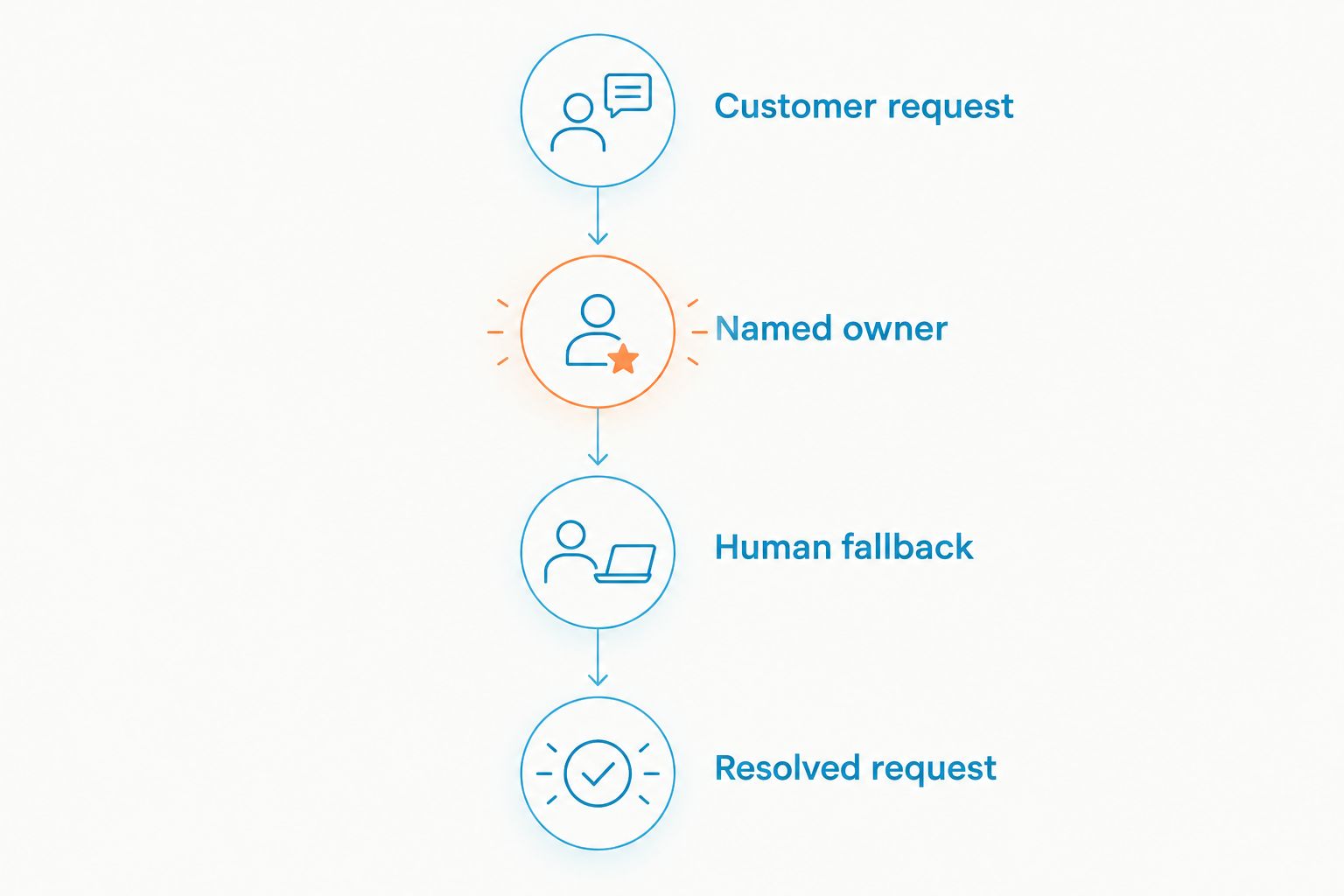
This is an honest operational tie. A simple phone system with clear ownership can fit a small business; a broader customer-service platform still needs clear ownership. The right platform supports the process rather than supplying the process by itself.
Smarter Voice has a clear commitment advantage for this brief
The stated no-contract offer gives Smarter Voice a clear purchasing advantage for a small team avoiding a contractual commitment. The stated 14-day money-back guarantee also provides a defined evaluation window.
Use that window deliberately. Check incoming calls, employee devices, routing, and the fallback for unanswered calls. Confirm the applicable guarantee terms before purchasing.
Number transfers without downtime and support from real people are also stated parts of the offer. Turn them into a rollout conversation: who coordinates the transfer, what staff must prepare, and who handles an unexpected routing problem?
For Nextiva, assess the agreement attached to the proposed product. Do not assume that a subscription label means the same commitment, cancellation terms, or support arrangement across providers.
This is not a verdict on which support team responds faster. It is a verdict on the clearly stated commitment and support proposition available for this small-business brief.
Pricing models: compare the billing basis, not a headline
Smarter Voice uses a per-user subscription model. Optional call-handling products are separate buying decisions, while VirtualText uses a flat-rate subscription model for its messaging offer.
Those models answer different budgeting questions. Per-user billing links the core phone purchase to the users you provision. Flat-rate messaging gives you a platform-level billing basis, but you must still confirm the included scope and applicable limits.
Nextiva sells subscription products across business communications and customer service. Compare the actual proposed package rather than assigning one billing model to its entire portfolio.
For a fair 2026 comparison, request matching descriptions of:
- The people and channels covered.
- Required features versus optional products.
- Usage allowances and additional charges.
- Setup responsibilities and support arrangements.
- Subscription commitment and cancellation terms.
Do not compare a core phone subscription with a contact-center proposal as though they buy the same outcome. First make the scope comparable; then evaluate the commercial terms.
Final verdict: choose the product brief that matches your problem
Choose VirtualPBX if you run a small, phone-led service team
The named winner is Smarter Voice for an owner-led business that needs straightforward calling, business SMS, routing, and real human support. Evaluate AI FrontDesk or AI MessageDesk only where a defined call-handling problem justifies the optional product.
This profile includes a small office coordinating with mobile staff. The priority is a professional answering path, not a wider customer-service platform purchase.
Choose Nextiva if you manage a broader customer-service project
The named winner is Nextiva for a buyer whose brief includes evaluating a contact-center platform alongside business communications. Require a demonstration of the selected product against your actual requirements.
This profile includes a service manager replacing more than the main phone line. Broader scope is useful only when it matches the work your team needs to manage.
| Dimension | Winner |
|---|---|
| Focused small-team phone brief | Smarter Voice |
| Everyday cloud-calling category fit | Tie; test your setup |
| Optional automation alongside a focused phone offer | Smarter Voice |
| Contact-center buying scope | Nextiva |
| Broader customer-service consolidation evaluation | Nextiva |
| Customer follow-up ownership | Tie; requires your process |
| Stated no-contract commitment | Smarter Voice |
| Pricing-model fit | Match the billing basis to the scope |
FAQ
Is VirtualPBX better than Nextiva for a small business?
VirtualPBX is the clearer fit for a small business seeking a straightforward phone system with optional call handling. Nextiva is the better starting point when the buying brief includes a broader customer-service or contact-center platform.
Is Smarter Voice the same thing as VirtualText?
No. Smarter Voice is the core business phone offer; VirtualText is a separate offer combining SMS, webchat, a shared team inbox, and an automated agent.
Do I need automated call handling with Smarter Voice?
No. AI FrontDesk and AI MessageDesk are optional products. Evaluate them against a specific answering or follow-up requirement rather than treating them as mandatory.
Which provider should I evaluate for a contact center?
Start with Nextiva when your buying brief includes a contact-center platform. Require the proposed product to demonstrate the queues, supervisor workflows, reporting, and system connections your team needs.
How should I compare subscription costs?
Compare equivalent scope and the actual billing basis. Separate core calling, optional products, messaging, usage allowances, and commitment terms before evaluating the proposals.
Can I keep my business number when switching?
Smarter Voice includes number porting, and the stated offer includes number transfers without downtime. Confirm your number's eligibility and the transfer sequence before changing the current service.
What should I test before choosing a phone provider in 2026?
Test an office call, a mobile call, and a call made while the intended recipient is unavailable. Specify the expected answering and fallback behavior before each demonstration.
One last thing
Test the unanswered call, not just the answered one. During your 2026 evaluation, deliberately leave the intended employee unavailable and follow the customer experience to its end.
Write down who receives the request next and what that person must do. That test directly addresses the missed-call problem that prompted the purchase.


