
Verizon provides mobile connectivity, but changing carriers is not the same as fixing missed business calls. The best Verizon alternative in 2026 is VirtualPBX if you need a small-business phone system; AT&T or T-Mobile belongs on your shortlist if you need a different mobile network. Start by separating coverage problems from call-handling problems, then test the service that addresses the actual gap.
- Compare Verizon alternatives by need: mobile coverage, business calling, or customer messaging.
- VirtualPBX is the best fit here for small-business cloud calling with real human support.
- AT&T and T-Mobile are mobile-network alternatives; test coverage where your team actually works.
- Keep Verizon when connectivity works and add business communication software only where needed.
Why this matters
A missed call can have different causes. Your phone might have no signal, the call might reach the wrong person, or nobody might be available to answer. Those problems require different fixes.
A mobile carrier provides connectivity. A business phone system organizes business calling. A shared inbox helps a team manage customer messages. Buying one does not automatically solve the other two.
For your 2026 shortlist, write down the failure first. Choose a replacement only after you can explain what must work differently for your customers and staff.
Verizon alternatives at a glance
This comparison separates mobile-network replacements from business communication services. It does not rank nationwide coverage: your decision needs evidence from the places where your team works.
| Service | Best for | Standout capability | How it differs from Verizon |
|---|---|---|---|
| Verizon | Keeping mobile connectivity that already works | Mobile network service | The baseline if coverage is not your problem |
| VirtualPBX | Organizing small-business calls | Cloud calling, routing, business SMS, and optional AI call handling | Focuses on the business phone workflow rather than replacing a mobile network |
| AT&T | Testing another mobile network | Mobile connectivity through a different carrier | Offers a different network to evaluate at your work locations |
| T-Mobile | Testing another mobile coverage option | Mobile connectivity through a different carrier | Gives you another network option for location-based testing |
Best for means the service matches the problem, not that it wins every comparison. A contractor with weak reception needs a different evaluation from an office whose calls keep reaching an unattended phone.
1. VirtualPBX: best for small-business call handling
VirtualPBX is a U.S.-based cloud business phone provider for small teams. Its core offer, Smarter Voice, combines cloud calling, mobile, desktop, and web apps, business SMS, routing, and number porting. Optional AI FrontDesk and AI MessageDesk add call-handling options when needed.
Smarter Voice starts at $15 per user per month, with no contracts and a 14-day money-back guarantee. The setup path starts with deciding who receives calls, configuring routing, and coordinating any number transfer; number transfers without downtime and support from real people are stated brand proof points.
Where Smarter Voice shines
- Business calling across devices: Staff can use mobile, desktop, and web apps rather than treating a personal handset as the whole phone system.
- Routing: You can organize where business calls go instead of relying on whoever happens to answer first.
- Human support: Real U.S.-based support gives your team someone to contact about the service.
- Optional call handling: AI FrontDesk and AI MessageDesk are optional, not replacements for the core phone system.
Where Smarter Voice falls short
- It does not replace mobile coverage. If your team needs a different wireless network, evaluate a carrier separately.
- Setup still needs decisions. Routing cannot reflect your business until you define answering responsibilities and escalation rules.
- Optional products need a separate evaluation. Do not assume every call-handling capability is included in the core service.
Smarter Voice versus Verizon
| Dimension | Smarter Voice | Verizon |
|---|---|---|
| Decision being evaluated | Business phone workflow | Mobile connectivity |
| Relevant requirement | Routing, business apps, and business SMS | Reception where your team works |
| Setup focus | Users, call destinations, and number transfer | Mobile service and location-based testing |
| What to retain | A working internet or mobile connection | Existing service if coverage meets your needs |
Best for: Small teams that need a clearer way to answer and route business calls, not a replacement wireless network.
For a 2026 evaluation, bring an actual call scenario to the demo. Ask to see what happens when the first person does not answer and how the next person receives the call.
Verdict: Buy for business call handling; skip as a mobile-network replacement.
2. AT&T: best for evaluating a different mobile network
AT&T belongs on a Verizon alternatives shortlist when the problem is mobile connectivity. The relevant question is whether AT&T works better at your office, customer sites, and regular travel locations—not whether it appears higher on a generic list.
Keep the evaluation narrow. Compare reception and calling in the places where Verizon currently causes problems, using the devices your team expects to carry.
Where AT&T shines
- Direct category match: It is a mobile-carrier alternative when you need mobile service.
- Useful comparison: It gives you a different network to test against your current experience.
Where AT&T falls short
- A different carrier is not proof of better local coverage. Your work locations still need testing.
- A network change is not a call-handling plan. You still need to decide who answers and what happens when nobody is available.
AT&T versus Verizon
| Dimension | AT&T | Verizon |
|---|---|---|
| Service being compared | Mobile connectivity | Mobile connectivity |
| Coverage decision | Test at your work locations | Use current performance as the baseline |
| Business workflow | Evaluate separately from reception | Evaluate separately from reception |
Best for: Teams whose main reason for leaving Verizon is mobile reception or connectivity at specific locations.
Ask staff to record failed calls and unusable locations during the evaluation. A successful call outside your office does not establish that the service works inside the building where you answer customers.
Verdict: Wait for local testing before switching.
3. T-Mobile: best for a second mobile-network comparison
T-Mobile is another mobile-carrier alternative to Verizon. Include it when you want to compare network performance against the places and routes your business actually uses.
Use the same test conditions for every carrier. Otherwise, a different handset, location, or calling environment can distort your decision.
Where T-Mobile shines
- Relevant alternative: It addresses the mobile-network side of the decision.
- Additional comparison: It gives your team another option when evaluating reception at work locations.
Where T-Mobile falls short
- Location still decides the outcome. Do not treat a national network description as evidence about a particular building.
- Connectivity does not establish ownership. Staff still need a clear process for answering and returning customer calls.
T-Mobile versus Verizon
| Dimension | T-Mobile | Verizon |
|---|---|---|
| Service being compared | Mobile connectivity | Mobile connectivity |
| Evaluation method | Test your actual work locations | Record current performance at those locations |
| Reason to choose | Better results in your own evaluation | Existing service already meets your needs |
Best for: Businesses comparing mobile networks before making a carrier change.
For your 2026 decision, use observed results rather than assuming one network is better for every employee. A team that works across customer sites needs a broader test than a team based in one office.
Verdict: Wait for evidence from your work locations.
Why people switch from Verizon
The useful reasons to consider switching fall into separate categories. None requires assuming Verizon has an outage, changed its terms, or removed a feature.
Coverage gaps
If calls fail where your employees work, test another mobile network. Document the location and conditions so you compare the actual problem rather than general impressions.
Keep device issues separate from network issues. Before moving the whole team, establish whether the failure follows a location, a handset, or a particular setup.
Unclear call ownership
If service works but customers reach the wrong person, evaluate routing and staff responsibilities. A carrier change alone does not define who answers, who provides backup, or who returns a missed call.
Write the answering rule before choosing software. That gives you something concrete to demonstrate and test.
Messages scattered across channels
If customer requests arrive through texts and website chat, evaluate a messaging workflow separately. VirtualText is the separate web-chat and shared-inbox offer associated with the parent brand; it should not replace Smarter Voice in a business-phone evaluation.
A shared inbox addresses a different problem from mobile reception. Identify which conversation needs an owner before deciding which service to replace.
A practical setup and switching path
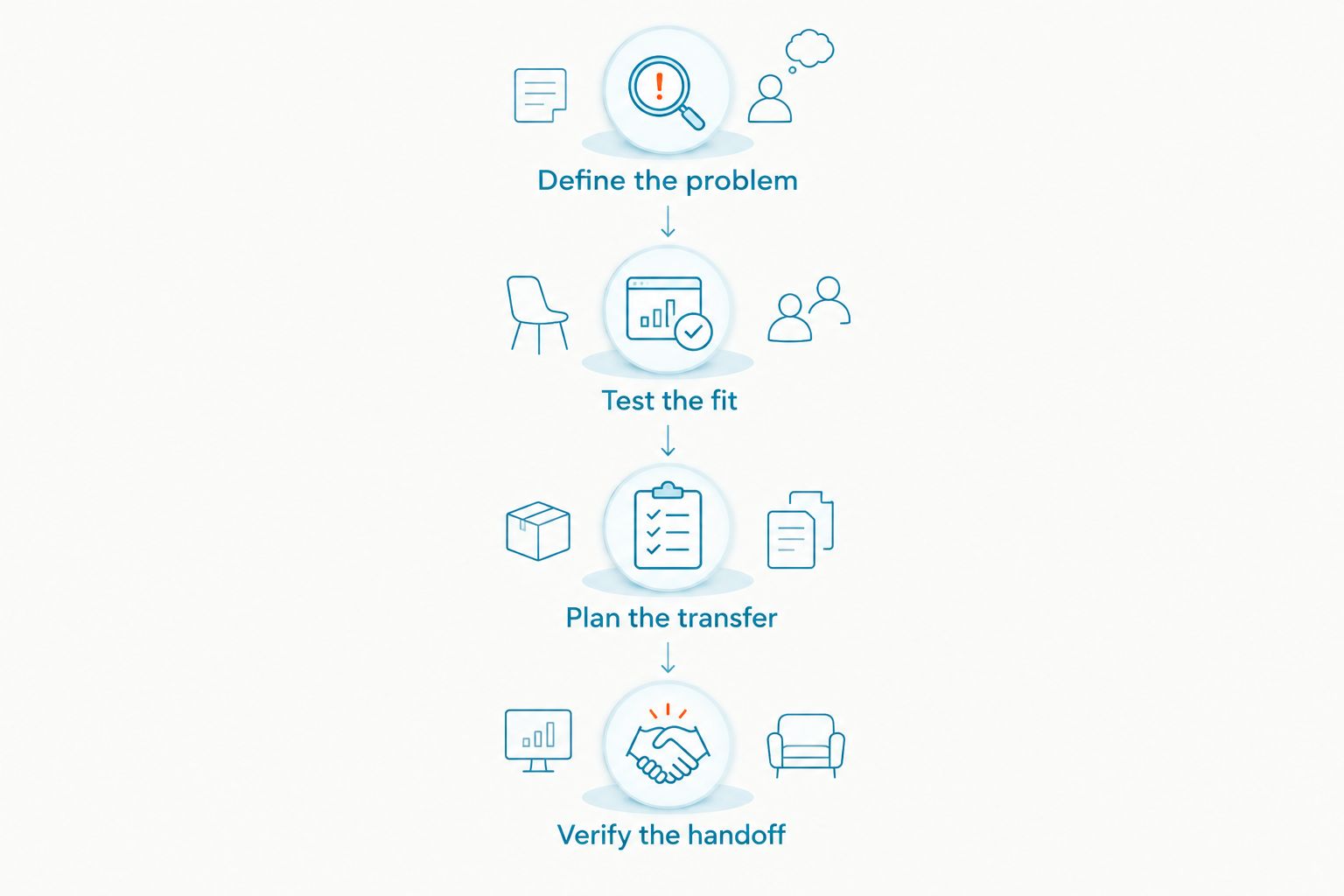
Use this sequence whether you choose a cloud phone service or another carrier. It keeps the decision tied to a customer-facing outcome.
- Define the problem. Write a specific failure, such as calls not connecting inside the office or customers reaching an unattended phone.
- Test the fit. Ask the provider to demonstrate the relevant workflow, or test reception at the affected location.
- Plan the transfer. Confirm number requirements, account details, and the order of any service changes before canceling anything.
- Verify the handoff. Check that calls and messages reach the intended people and that staff understand their responsibilities.
For a business phone evaluation, test 3 call scenarios: an answered call, an unanswered call, and an after-hours call. These are evaluation tasks, not a claim about any provider's performance. Record where each call goes and what the customer hears.
For messaging, send a test inquiry and have another team member take responsibility for the reply. Confirm that the handoff is understandable without a separate explanation from the person who configured it.
Your 2026 switching plan should also name the person authorized to approve the change. Keep the old service active until the provider confirms the appropriate transfer sequence and your checks are complete.
When staying with Verizon is the right call
Keep Verizon when its connectivity works and connectivity is not the problem. Replacing a working mobile service adds a change without necessarily fixing how your team handles customers.
You can evaluate business calling separately from the network employees use. Likewise, you can investigate website chat and shared-inbox needs without turning the project into a mobile-carrier migration.
Staying is also the right decision when the replacement has not passed your evaluation. A shortlist is not evidence. Make the move when the new service meets the requirement you wrote down, and your team understands the setup.
FAQ
What's the best Verizon alternative for a small business in 2026?
VirtualPBX is the best fit in this comparison for small-business cloud calling, while AT&T and T-Mobile are mobile-network alternatives. Choose according to whether you need better call handling or different mobile connectivity.
Is a cloud business phone system a replacement for Verizon mobile service?
A cloud business phone system is not a replacement mobile network. It organizes business calling, while your devices still need an appropriate connection.
Should I choose AT&T or T-Mobile instead of Verizon?
Choose based on testing at your actual work locations. Compare calls under similar conditions rather than assuming one carrier works better everywhere.
Can I keep my business number when changing phone providers?
Number porting can allow you to retain an existing business number. Confirm eligibility, required account information, and the transfer sequence with the receiving provider before canceling service.
Does changing mobile carriers fix missed business calls?
Changing carriers addresses missed calls only when connectivity is the cause. Calls missed because of staffing, routing, or unanswered phones require a separate operational fix.
Do I need an AI receptionist to switch business phone systems?
No, an AI receptionist is not a requirement for changing business phone systems. Start with calling and routing, then evaluate optional call handling against a specific need.
What should I test before moving my business phone service?
Test an answered call, an unanswered call, and an after-hours call. Confirm where each call goes, what the caller hears, and which team member owns the follow-up.
One last thing
A customer does not experience your carrier choice or your routing settings separately. The customer experiences whether someone answers and whether the next step is clear.
Before buying anything, have someone outside your team call the business while your usual answering person is unavailable. Follow the caller's path. That simple check tells you whether your next move belongs in network testing, phone routing, or staff handoff.