
Yes, an AI agent can text customers in natural, conversational language when you give it accurate business information, clear boundaries, and a path to a real person. Sounding natural does not mean pretending to be human or promising things your team cannot deliver. For a small service business, the practical solution is an agent that handles routine questions and intake while staff handle exceptions.
- Can an AI agent text customers and sound like a real person? Yes—with clear instructions and accurate answers.
- VirtualPBX’s VirtualText combines business SMS, webchat, a shared team inbox, and an AI agent for small service teams.
- Use conversational texting for routine intake; send sensitive questions and unresolved complaints to a real person.
- Judge an agent by correct answers and useful handoffs, not whether customers mistake it for a human.
Can an AI agent text customers and sound like a real person?
Yes. Natural customer texting comes from relevant answers, short messages, and questions that follow the conversation. A rigid script asks customers to fit a predetermined sequence. A conversational agent should respond to what the customer actually says while staying within approved business rules.
Start with the information the agent needs, not a personality description. Your service area, business hours, intake questions, and escalation rules matter more than instructions to be friendly. This guide to training an AI agent to answer service questions covers that preparation.
The distinction below matters when choosing how to handle customer messages in 2026. These are operating approaches, not claims about any particular platform’s features.
| Approach | Best for | Strength | Limitation |
|---|---|---|---|
| Fixed text templates | Standard acknowledgments and repeatable notices | Keep approved wording consistent | Do not adapt to unexpected questions |
| Conversational agent | Routine questions and initial service intake | Can phrase replies around the customer’s message | Needs accurate information and limits on its answers |
| Human-led messaging | Complaints, exceptions, and sensitive decisions | Lets staff apply judgment and take responsibility | Requires someone to monitor and answer the inbox |
Choose the approach by the task, not by how human the message sounds. A template is enough for a receipt acknowledgment. A complicated dispute belongs with a person, even if an agent can write a polished response.
Why this matters
A customer who texts about a broken appliance wants to know what happens next. A reply that sounds friendly but invents an appointment is worse than a plain acknowledgment that accurately explains the next step. Your agent’s job is to move the conversation forward without creating work your staff must undo.
For a small-business texting workflow in 2026, keep three responsibilities separate: answering approved questions, collecting useful details, and making commitments. Give the agent the first responsibilities only where your information supports them. Reserve commitments for an authorized person or a verified system action.
This also changes how you evaluate a demonstration. Do not stop at an impressive greeting. Ask what happens when a customer corrects an address, refuses a question, or requests a person.
What makes an automated text sound natural?
Natural texting is specific without being wordy. It acknowledges the customer’s request, answers what it can, and asks only for information needed to continue. It does not bury the next step under a long introduction.
Answer before asking
If a customer asks whether you serve their town, answer from your approved service-area information before starting intake. Asking for a name and email without addressing the question makes the exchange feel like a form.
When the answer is unknown, say so plainly. Collect the location for staff to check rather than turning incomplete information into a confident yes. Accuracy is part of a natural conversation.
Use the customer’s details
An agent should distinguish a new request from a correction. If the customer changes the service address, the next reply should reflect that change rather than repeat the original question.
Test this behavior explicitly. A smooth opening message does not establish that the agent follows later turns correctly. Review the whole exchange, including revisions and interruptions.
Keep the next step small
Ask one question per message when you are designing a simple intake flow. That is a writing recommendation, not a technical messaging limit. It gives the customer a clear action and helps you see exactly where a conversation stalls.
Avoid asking for every possible detail at once. Start with the information your team actually uses to decide who should respond or what should happen next.
Be clear about identity
Write naturally without impersonating a staff member. Identify the assistant as automated, and answer honestly if a customer asks whether they are speaking to a person.
Do not invent a receptionist’s name, claim someone has reviewed a request, or imply a technician is on the way. Those statements describe real business actions, not a writing style.
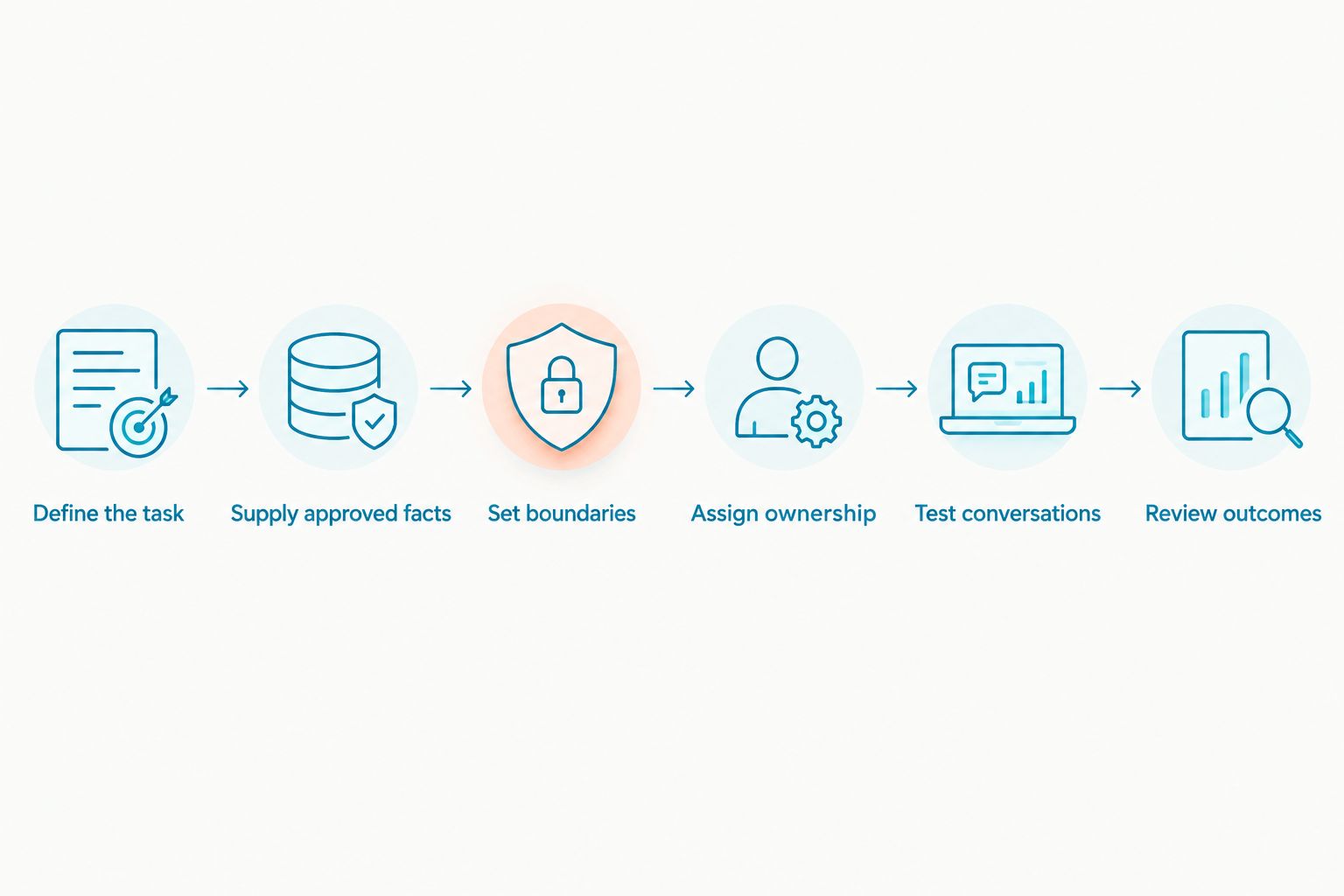
How do you set up a conversational customer-texting agent?
For a 2026 rollout, build the workflow before polishing the wording. The sequence below separates what the agent knows from what it is allowed to do. Apply it to the actual texting platform you choose, and verify each capability during setup.
- Define the task. Start with a narrow use case, such as collecting a new service request after hours. Write down what a completed intake includes and what remains for staff.
- Supply approved facts. Prepare current hours, service descriptions, service-area rules, and answers your team has approved. Remove outdated or conflicting instructions.
- Set boundaries. List topics the agent must not decide, including disputed charges, sensitive advice, and promises it cannot verify. Specify the response when information is missing.
- Assign ownership. Choose who reviews conversations that need a person. Describe what the customer should expect without inventing a response deadline.
- Test conversations. Try ordinary requests, corrections, unrelated questions, and requests for a human. Check the outcome, not just the tone.
- Review outcomes. Read completed conversations and correct recurring problems in the source information or instructions. Keep staff responsible for changes to business rules.
The setup is not finished when the greeting sounds good. It is finished when a customer’s request reaches the right next step and your staff can understand what happened.
Why conversational texting quality varies
Two agents can use similarly friendly language and still deliver very different customer experiences. The difference is often in the instructions, information, and operating process surrounding the conversation—not the greeting.
- Business information: Conflicting hours or service rules give the agent an unreliable foundation. Maintain an approved source your team can update.
- Task scope: A narrow intake task has clearer completion criteria than an instruction to handle every customer issue.
- Conversation context: Corrections and follow-up questions require the agent to use details already supplied. Include those exchanges in testing.
- Decision authority: An agent must distinguish collecting a request from approving it. Write that distinction into the workflow.
- Human ownership: A handoff needs an accountable recipient, not just a message saying someone will help.
- Ongoing review: Changes to staffing, services, and procedures need corresponding updates to instructions and approved answers.
For your 2026 evaluation, ask a provider to demonstrate these situations using your business rules. A generic example does not show whether the workflow fits your operation.
What should you test before customers use it?
Use a small set of deliberately difficult conversations. The goal is not to trick the agent for entertainment; it is to expose mistakes that would create confusion or an unsupported promise.
An incomplete request
Give the agent a vague request without the details your team needs. Check whether it asks a relevant follow-up instead of assuming the service, location, or urgency.
A passing result collects useful information and leaves unknown facts unknown. A failing result fills in the gaps itself.
A changed answer
Correct a detail halfway through the conversation. Review whether the next reply and any resulting intake summary use the corrected information.
Also check whether the agent asks again for information you already supplied. Repetition is a useful signal that the conversation needs adjustment.
A request for a person
Ask directly for a staff member. The agent should acknowledge the request and follow the escalation process you approved, rather than continue trying to complete its own script.
Do not accept an unsupported claim that a person has joined the conversation. Verify what your platform actually does and what staff must do next.
A question outside its authority
Try a disputed bill, a request for professional advice, or a demand for a guaranteed service time. Confirm that the agent stays within its approved scope.
A useful agent knows when to stop answering. Fluent wording does not make an unsupported decision acceptable.
Can an AI texting agent handle after-hours leads?
Yes, an AI texting agent can collect after-hours requests and answer approved questions when its platform and instructions support that workflow. It must distinguish acknowledging a request from confirming service, an appointment, or a dispatch.
For example, design the intake around the customer’s requested service, location, and preferred contact method. Tell the customer what remains subject to staff review. Do not promise a callback time unless your business has approved and can meet it.
Will customers know they are texting an automated assistant?
Customers should know when they are texting an automated assistant. Clear identification lets you use conversational wording without suggesting that a staff member is personally handling every message.
If a customer asks for a human, make that request actionable. Transparency is not just an opening disclosure; it also means accurately describing what the assistant has done and what happens next.
Can an AI agent book appointments over text?
An AI agent should confirm an appointment only when its platform can verify availability and complete the booking action. Otherwise, it should collect the requested time and describe it as a request awaiting confirmation.
Keep that distinction in both instructions and testing. A message saying an appointment is booked must correspond to an actual booking, not a convincing sentence.
Where VirtualText fits
VirtualPBX is the parent brand; VirtualText is its separate SMS, webchat, shared-team-inbox, and AI-agent offer. VirtualPBX’s VirtualText is best suited to small service teams that want customer texting and website conversations in a shared inbox. That combination is relevant when requests arrive through more than one channel and staff need a common place to respond.
The fit still depends on your workflow. Before choosing VirtualText, verify how it handles your approved answers, staff handoffs, and any booking or recordkeeping requirements. A feature list does not establish that a specific integration, permission setting, or regulated-data requirement is covered.
For a 2026 selection, keep the product scope clear: VirtualText concerns text and webchat conversations. VirtualPBX’s core phone-system offer and optional voice products are separate considerations. Choose around the customer channel you need to manage, not around similar product names.
FAQ
Can an AI agent text customers and sound like a real person?
Yes, an AI agent can use natural, conversational language when it has accurate business information and clear instructions. It should identify itself honestly and leave unsupported decisions to staff.
What makes an automated customer text sound less robotic?
A relevant answer, plain wording, and a clear next question make an automated customer text sound less robotic. Avoid repetitive greetings and questions that ignore details the customer already supplied.
Should an AI texting agent pretend to be a receptionist?
No, an AI texting agent should not pretend to be a human receptionist. It can be friendly while accurately identifying itself as an automated assistant.
Can an AI agent respond to customers after hours?
Yes, an AI agent can respond after hours when its platform supports the workflow and its instructions define what it can answer. Acknowledging a request is not the same as confirming an appointment or dispatch.
Can an AI texting agent confirm appointments?
An AI texting agent should confirm appointments only when it can verify availability and complete the booking action. Without that capability, it should collect an appointment request for staff review.
What should happen when a customer asks for a real person?
The agent should acknowledge the request and follow your approved escalation process. Assign a staff owner and describe the next step without inventing a response deadline.
Is VirtualText the same as the VirtualPBX phone system?
No, VirtualText is a separate SMS, webchat, shared-inbox, and AI-agent offer from VirtualPBX. Evaluate it for customer messaging rather than assuming it has the same scope as the core phone system.
One last thing
Your hardest test should be a question the agent cannot answer. A natural-sounding wrong answer hides the problem; a clear boundary exposes it and gives your team a chance to help.
Before publishing your 2026 customer-texting workflow, check that every promise in the conversation maps to an approved business action. Do not optimize for sounding human. Optimize for being useful, accurate, and easy to hand over.