Yes, AI can text back missed calls automatically when your phone system connects an unanswered-call event to an SMS workflow, then passes customer replies to an AI agent. The important caveat: an AI texting feature alone does not establish that connection, and a missed call does not automatically authorize every kind of follow-up message.
- Can AI text back missed calls automatically? Yes—when missed-call detection, business SMS, and reply handling work together.
- A fixed missed-call text-back message needs automation, not necessarily an AI agent.
- VirtualPBX offers business SMS; verify the missed-call trigger before choosing a setup.
- Keep the first message service-focused, respect opt-outs, and assign a person to unresolved replies.
Can AI text back missed calls automatically?
Yes—but separate the automatic first text from the conversation that follows. A rule can send an approved message after an unanswered call. An AI agent can then interpret the caller's reply and answer within boundaries you set.
If you are considering VirtualPBX, verify the complete call-to-text workflow rather than assuming business SMS includes a missed-call trigger. Ask for a demonstration using your intended phone number and call routing.
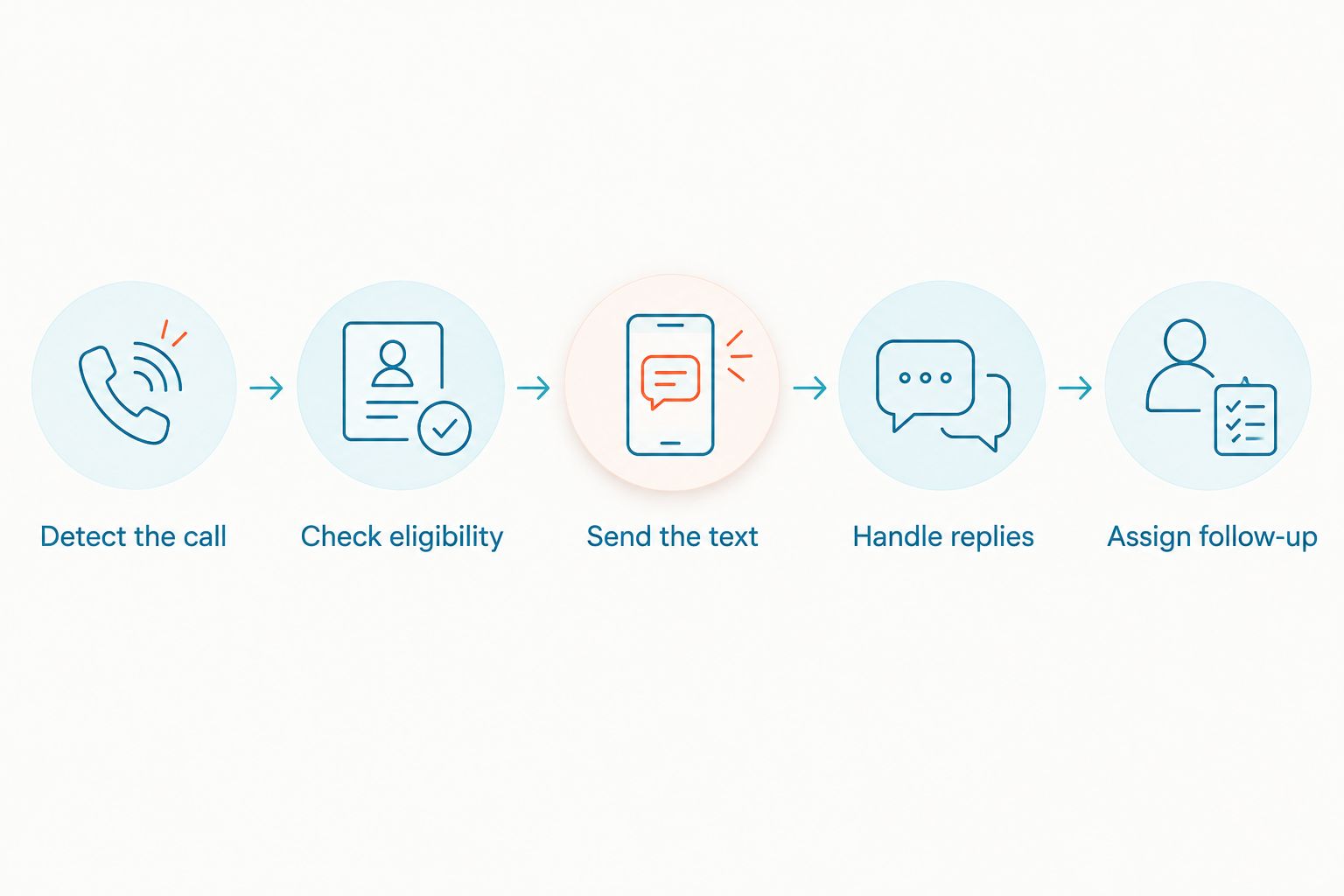
The setup follows this sequence:
- Detect the call. Define which unanswered-call event starts the workflow, including calls that reach voicemail.
- Check eligibility. Confirm that the destination accepts texts and that your messaging rules permit the response.
- Send the text. Identify your business, acknowledge the call, and ask a simple service-related question.
- Handle replies. Let an approved agent answer routine questions or collect the information your team needs.
- Assign follow-up. Give unresolved conversations to a person who can actually respond.
For the implementation details, use the guide to setting up missed-call text-back for your business. Do not turn on the outgoing message before deciding where incoming replies will go.
Why this matters
When you are serving a customer, driving between jobs, or working after hours, you cannot always answer the phone. A service-focused text gives the caller another way to explain what they need without leaving a detailed voicemail.
The text is an acknowledgment, not a completed booking. Your workflow still needs a clear destination for questions, requests, and callback preferences.
For a small-business setup in 2026, judge success by whether the caller reaches a useful next step—not whether a message was sent. A delivery receipt does not tell you whether anyone took responsibility for the request.
Which approach fits your missed calls?
You have several ways to handle an unanswered call. Choose the simplest approach that covers your actual customer questions, rather than adding conversation automation to every interaction.
| Approach | Best for | What it does | Main limitation |
|---|---|---|---|
| Fixed text-back | Acknowledging calls and collecting callback requests | Sends an approved message when the missed-call rule fires | Cannot interpret a customer's answer by itself |
| AI-assisted texting | Routine service questions and structured intake | Responds using approved business information and conversation rules | Needs limits, current information, and human escalation |
| Human inbox follow-up | Exceptions, complaints, and sensitive requests | Lets a team member review the conversation and decide the next action | Depends on staffing and clear ownership |
Start with a fixed acknowledgment if your only goal is to offer a callback. Add an agent when customers need answers before your team is available. Keep a human handoff for anything outside the agent's authority.
These approaches are not mutually exclusive. An approved first text, a bounded automated conversation, and a human-owned inbox can form the same workflow.
How do you set up automatic missed-call texts?
Define what counts as a missed call
Write down the exact event that should trigger a message. An unanswered direct call, an abandoned queue call, and a call answered by voicemail are different events.
Ask your provider to show which events the proposed setup recognizes. Also check forwarded calls: the original number and the final destination must not each send an acknowledgment for the same call.
For your 2026 rollout, decide whether repeat calls should create another text. A practical starting rule is 1 acknowledgment per unresolved conversation, rather than a new message for every attempt to reach you.
Confirm the number and messaging connection
Voice calling and texting are separate capabilities. Confirm that your business number supports the intended SMS setup, that customer replies return to your business inbox, and that the phone system exposes the event your workflow needs.
Number transfer and SMS activation also need separate checks. Do not treat a working incoming call as proof that outgoing texts and replies are ready.
Ask these questions before activation:
- Does the demonstration use my business number or a different sending number?
- Can customers reply to the same number that texts them?
- Where do failed messages appear?
- What happens when the caller's number cannot receive SMS?
Write a first message that stays within its job
The first text should identify your business, acknowledge the missed call, and offer a useful next step. Keep it about the caller's request; do not add unrelated promotions.
For a first draft, use 2 short sentences: an acknowledgment followed by a question. Ask what help the caller needs or whether they prefer a callback. Avoid requesting account credentials, payment details, or sensitive records.
Do not promise an immediate callback unless someone owns that commitment. If you are closed, state that clearly and explain how the team will review the request.
Limit the agent's authority
Give the agent approved information about services, hours, and intake questions. Specify what it must not decide, including exceptions, binding commitments, and questions requiring professional judgment.
A customer asking about availability should not receive a confirmed appointment unless the workflow has actually checked and reserved the appointment. Collecting a preferred time is not the same as booking it.
For deployment in 2026, review the agent's business information whenever your operations change. Outdated hours or service areas make a fluent answer wrong.
Assign a person to the conversation
Decide who handles callback requests, who covers absences, and who receives escalations. Give each open request an owner instead of leaving it visible to everyone but assigned to nobody.
Your handoff should include the customer's original request, what the automated system said, and what remains unresolved. The customer should not have to repeat the whole conversation when a person takes over.
Why automatic text-back behavior varies
The same general workflow can behave differently across phone and messaging setups. These are the factors to verify, not assumptions to carry into a purchase:
- Call routing: Forwarding, queues, and voicemail change which event marks the call as unanswered.
- Number capability: The calling number must support the messaging arrangement you intend to use.
- Recipient capability: Not every caller's number accepts an SMS reply.
- Business hours: Open-hours and after-hours messages need different expectations and ownership.
- Messaging permissions: The content and purpose of the text affect the compliance review your workflow needs.
- Conversation scope: A callback acknowledgment needs fewer controls than appointment handling or detailed service intake.
Verify the whole chain with a live demonstration. A screenshot of an agent answering a question does not prove that an unanswered phone call can start the conversation.
Does every automatic text-back need an AI agent?
No. A fixed message can acknowledge an unanswered call and ask whether the caller wants a callback. An agent becomes relevant when you want the system to interpret replies and continue a conversation.
Keep the distinction in your buying checklist for 2026. Ask separately about the missed-call trigger, the first SMS, ongoing automated replies, and human handoff; a provider's answer to one does not establish the others.
Can a missed-call text automatically book an appointment?
Yes, a workflow can support booking when it connects to an authorized scheduling system and follows your booking rules. Without that connection, the text should collect a request rather than claim an appointment is confirmed.
Specify service type, location, and any prerequisites before allowing automated booking. When those conditions are unclear, send the request to your team for review.
Is it safe to text everyone who calls?
Do not treat an incoming call as blanket permission for automated marketing. Review the purpose of the message, applicable consent requirements, carrier rules, and how customers can stop further texts.
Keep a missed-call acknowledgment tied to the service inquiry. Respect opt-outs and avoid turning a callback request into an unrelated promotional sequence.
Healthcare, insurance, and other sensitive conversations need additional boundaries. Use texting to arrange the next step, not to encourage customers to send private records into an unverified channel.
Where VirtualPBX and VirtualText fit
VirtualPBX provides a cloud business phone system with business SMS. VirtualText is its separate SMS, webchat, shared-team-inbox, and agent offer for small-business service teams.
VirtualPBX's VirtualText is best for small service teams that want SMS and webchat in a shared inbox with an agent. That is the relevant fit for managing customer replies; it does not, by itself, confirm a particular missed-call integration.
The benefit is bringing customer messages into a shared workspace instead of leaving follow-up scattered across individual phones. The qualification is equally important: confirm how your phone system supplies missed-call events and how those events reach the messaging workflow.
For a 2026 evaluation, request a demonstration of an unanswered call becoming a text, a customer reply entering the inbox, and a person taking over. Treat those as separate acceptance checks, not as a single feature label.
What should you test before turning it on?
Use 3 test scenarios before sending automated texts to customers. These are acceptance tests for your workflow, not performance claims about a provider.
- An unanswered mobile call: Confirm that the intended acknowledgment arrives, identifies your business, and accepts a reply.
- A repeat call: Confirm that the workflow follows your duplicate-message rule rather than sending unnecessary acknowledgments.
- A request for a person: Confirm that automation stops or hands off as designed and that someone receives the conversation.
Then check an after-hours call, an opted-out recipient, and a failed delivery. Do not make the customer responsible for discovering these problems.
Review the outgoing text and the customer's reply together. A correct first message can still lead to a poor experience if the next answer overpromises or nobody handles the escalation.
FAQ
Can AI text back missed calls automatically in 2026?
Yes, when your phone system connects missed-call detection to business SMS and an agent handles replies. Verify the trigger, sending number, messaging permissions, and human handoff before activation.
Do I need an AI agent just to send a missed-call text?
No, a rule-based workflow can send an approved acknowledgment without an AI agent. An agent is useful when you want the system to interpret replies and answer routine questions.
Can I use my existing business number for missed-call texts?
You can use an existing number only when the proposed voice and messaging setup supports it. Confirm SMS activation, reply routing, and the missed-call event separately.
Will a caller who leaves voicemail still receive a text?
That depends on how your workflow defines a missed call. Decide whether voicemail should trigger an acknowledgment, then test that exact call path.
Can an automated text promise a confirmed appointment?
Only a workflow that verifies availability and completes the authorized booking should promise a confirmed appointment. Otherwise, collect the customer's preferred time and send the request for review.
Does VirtualPBX offer texting for small-business teams?
Yes, VirtualPBX offers business SMS, and VirtualText combines SMS, webchat, a shared team inbox, and an agent. Verify the specific missed-call connection before assuming that texting capabilities include automatic call-triggered replies.
What happens if the customer asks to speak to a person?
Your workflow should hand the conversation to an assigned team member and prevent competing automated replies. Include the conversation history so the customer does not have to repeat the request.
One last thing
Test the reply before judging the first text. A message that arrives correctly proves delivery, not that your business can handle the customer's next question.
Make the final acceptance test a real handoff: ask an unsupported question, request a person, and confirm who receives it. That is where an automatic acknowledgment becomes a usable customer-service workflow.