
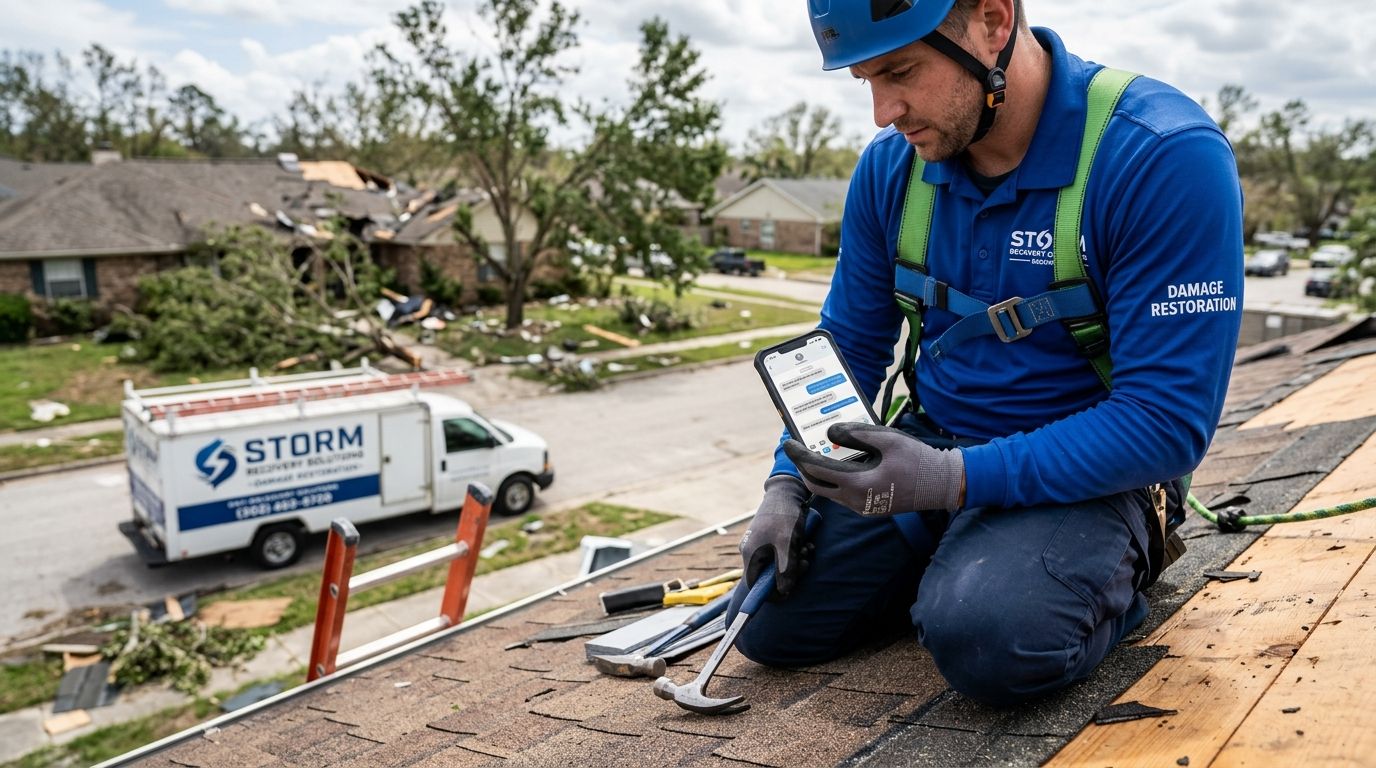
Storm damage restoration companies that text back a homeowner within minutes book the job before the next contractor's truck even leaves the yard. This guide covers the texting workflow for triage, insurance documentation, and after-hours capture built for storm-response volume, not a slow week in April.
Storm damage restoration business SMS service is a text-based system that lets crews confirm jobs, send arrival windows, and collect damage photos without tying up a phone line, with the goal of locking down the job before a competitor calls back first. Storm crews face a demand pattern most trades never see: dozens of simultaneous emergency calls after one weather event, then near silence for weeks. A phone tree or single receptionist cannot absorb that spike; a shared text inbox can.
- Business SMS service for storm damage restoration companies means auto-texting missed calls back before the caller dials the next company.
- Storm crews get flooded with calls in hours, not days, so a shared inbox beats one phone line every time.
- VirtualText routes texts to the right crew by job type (roof, water, tree) instead of whoever picks up first.
- A 14-day money-back guarantee on VirtualPBX plans means testing a texting workflow does not require a contract.
- Skip triage automation and duplicate dispatches, missed insurance photos, and slow follow-up pile up fast in 2026 storm season.
Why business SMS service matters for storm damage restoration companies
After a hailstorm or a tree comes down on a roof, homeowners do not wait around for a callback. They text the first number that answers, or they move to the next name on the search results page. A missed-call text-back tool built for general contractors exists for exactly this moment: it fires an automatic text the second a call goes unanswered, so the lead stays warm while the crew finishes the job in front of them.
Crews on a roof or in a flooded basement cannot hold a phone to their ear. Storm restoration also means multiple trades under one roof job at once (roofing, water extraction, tree removal), and each one needs its own thread so nothing gets crossed. Texting solves both problems at once: it does not interrupt hands-on work, and it creates a written record for insurance adjusters later.
Build a business SMS service that survives storm season
Set up missed-call-to-text auto-replies
Start here even before adding software. The manual version costs nothing but time.
- Draft a single auto-reply line: name, service area, and next step.
- Set the reply to fire on any unanswered call, not just voicemail.
- Include a direct callback number for emergencies (active leaks, structural damage).
- Test it during a normal week in 2026 so it is proven before the next storm hits.
Write text templates before the storm, not during it
Writing under pressure produces sloppy, slow replies. Draft templates now.
- Initial response: confirm receipt, ask for address and damage type.
- Photo request: ask for 2-3 photos of visible damage for the estimate.
- Scheduling confirmation: arrival window, crew name, what to expect.
- Insurance follow-up: request claim number and adjuster contact if known.
- Job-complete check-in: confirm satisfaction, ask for a review.
Route texts to the right crew, not the first available person
A storm restoration company running roofing, water damage, and tree removal out of one number needs routing rules or messages get answered by the wrong specialist.
- Tag incoming texts by keyword (roof, water, tree, mold) for automatic routing.
- Assign a dispatcher to triage anything that does not match a keyword.
- Give each crew lead visibility into their own thread only, to avoid duplicate dispatch.
- Escalate anything mentioning flooding or an active leak to the top of the queue.
This is the point where a shared inbox tool starts paying for itself over a personal cell phone. VirtualText's business SMS service applies this keyword routing automatically so no one has to eyeball every incoming text during a regional storm event, when volume can outpace any single dispatcher.
Automate after-hours triage with an AI agent
Storms do not wait for business hours. A basement floods at 11 p.m. and the homeowner texts whoever shows up first on a search.
- Configure an AI agent to answer common questions (service area, what to expect, how estimates work) 24/7.
- Have it collect address, damage type, and photos before a human ever sees the thread.
- Set a hard escalation rule for anything mentioning active water or structural risk.
- Hand off fully-qualified leads to a live dispatcher first thing the next morning.
This is the step where the VirtualText AI agent earns its place: it works the after-hours window a solo dispatcher cannot cover, without pretending to be a human when a caller needs a real person immediately.
Send job-status and insurance-documentation texts
Insurance claims move slower than the actual repair work. Texting keeps a paper trail without extra calls.
- Text photo requests directly and store them against the job thread.
- Confirm claim numbers and adjuster names in writing, not verbally.
- Send arrival-window updates so no one wonders if the crew is coming.
- Text the final invoice summary and payment link after job completion.
Track response time and follow-up cadence
A lead that goes 30 minutes without a reply during a storm surge is often gone.
- Set a target reply window and check it weekly against actual thread timestamps.
- Flag any thread untouched for more than an hour during active storm response.
- Review closed-lost threads monthly to spot where follow-up stalled.
- Reassign chronically slow threads to a backup dispatcher.
Coordinate across trades in one team inbox
Storm damage rarely means one job type. A team inbox approach used by tree service companies keeps roofing, tree removal, and water mitigation crews from stepping on the same lead twice.
- Keep one thread per property, tagged by every trade involved.
- Give office staff a single view across crews instead of five separate phones.
- Set internal notes on each thread so the next person picking it up has context.
Storm damage restoration companies that route and reply to texts within minutes close more jobs than companies still relying on a single ringing phone line.
Comparing texting options for storm damage restoration companies
| Option | Best for | Key limitation | Verdict |
|---|---|---|---|
| Personal cell phone texting | A one-truck operation testing the workflow | No routing, no record when the owner is unreachable | Hold |
| Generic marketing SMS platform | Blast promotions, not real-time triage | Built for campaigns, not two-way emergency dispatch | Skip for storm response |
| Missed-call text-back point tool | Crews wanting one fix for unanswered calls | Does not handle multi-trade routing or a shared inbox | Buy for single-trade shops |
| VirtualText shared inbox plus AI agent | Multi-trade storm restoration companies with more than one crew | Requires setup time to write templates and routing rules | Buy |
“A storm lead that waits 30 minutes for a reply is usually already talking to your competitor.”
Common mistakes storm damage restoration companies make with texting
- One phone, every trade. Routing roofing, water, and tree leads through a single untagged number guarantees crossed wires during a real storm surge.
- No photo request in the first reply. Waiting until the estimate call to ask for damage photos slows the whole claim process down.
- Treating texting like voicemail. A generic callback promise loses to a competitor who asks for the address and damage type immediately.
- No after-hours coverage. Storm damage happens at night and on weekends; a company that only texts during business hours misses the leads that matter most in 2026.
- Forgetting the insurance trail. Verbal confirmations of claim numbers and adjuster names disappear; text threads do not.
Set up texting before the next storm
Test the workflow with a 14-day money-back guarantee, no contract required.
FAQ
What is business SMS service for storm damage restoration companies?
It is a text-based system that lets crews confirm jobs, request damage photos, and send updates without tying up a phone line during storm-driven call spikes. VirtualText applies this for multi-trade service teams handling roofing, water, and tree damage at once.
Is texting better than calling for storm damage leads?
For the first response, yes: a text does not require the homeowner to stop what they are doing, and it works even when a crew is on a roof and cannot answer a call. Phone calls still matter for scheduling and complex claim questions.
How much does business texting software cost for storm restoration companies in 2026?
Pricing varies by provider and plan. Check current pricing directly on the VirtualPBX site rather than relying on a fixed figure, since plans change.
Can an AI agent qualify storm damage leads after hours?
Yes. An AI agent can collect address, damage type, and photos overnight, then hand a qualified lead to a live dispatcher the next morning. It should always escalate anything mentioning active flooding or structural risk immediately.
Is business texting compliant for storm restoration companies?
Business texting for storm restoration companies follows standard SMS consent and opt-out rules like any other commercial texting program. Check current compliance guidance before sending marketing texts, since requirements are updated periodically.
How fast should a storm restoration company respond to a text lead?
As fast as physically possible, because storm leads often go to whichever company replies first. An automated missed-call-to-text reply closes most of that gap before a human ever sees the thread.
Can multiple crew members share one business texting number?
Yes. A shared team inbox lets multiple dispatchers and crew leads work from one business number without forwarding calls to personal cell phones. Each thread stays visible to the whole team instead of sitting on one person's phone.
Does VirtualText replace a phone system for storm restoration companies?
No. VirtualText handles texting, webchat, and a shared inbox, while VirtualPBX handles the underlying business phone system. Storm restoration companies typically run both together for full coverage.
One last thing
The companies that win storm season are not always the biggest crews, they are the ones who reply first. A homeowner standing in a flooded basement at midnight hires whoever texts back with a real next step, not whoever has the nicest truck. Set the auto-reply and the routing rules before the next front moves through in 2026, not during it.


