
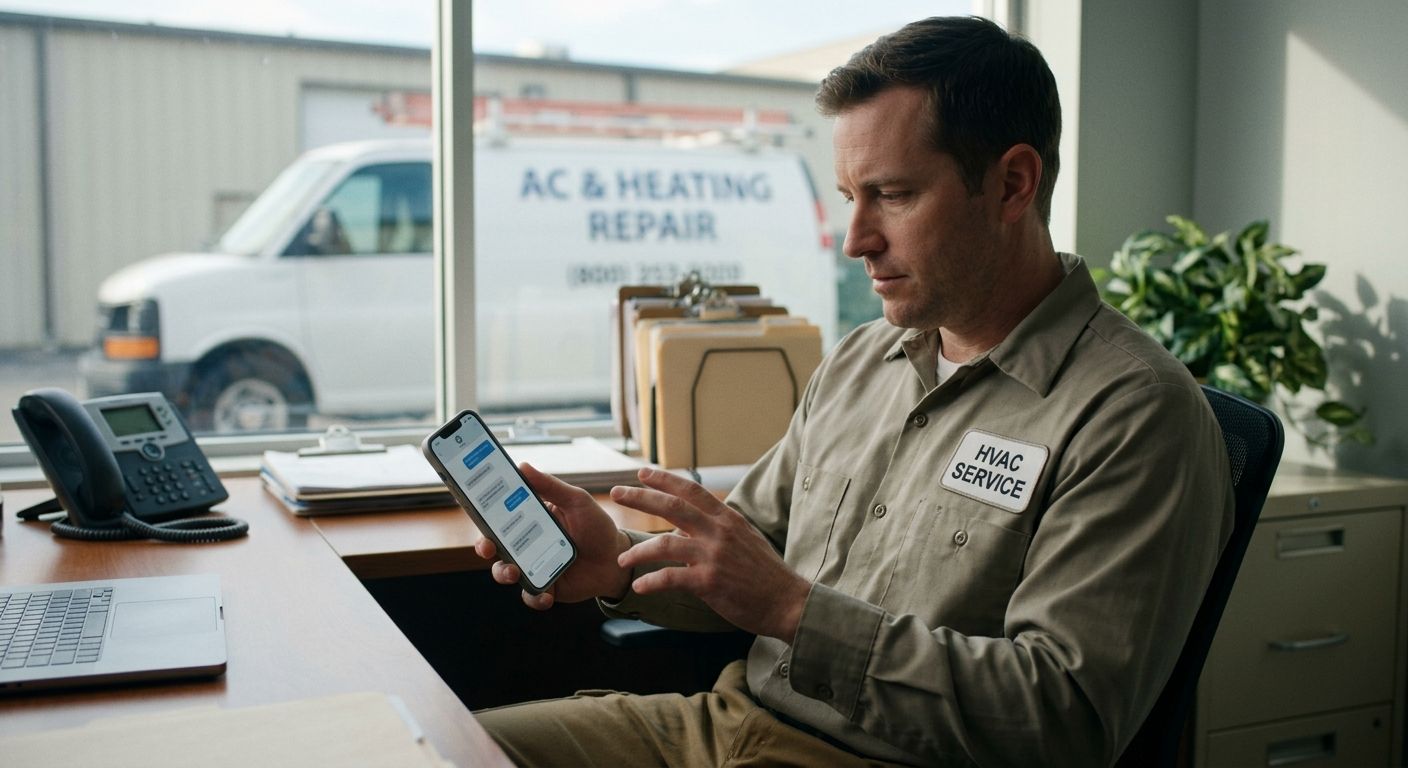
A missed call during a no-heat emergency is a lost job, and most HVAC techs can't answer the phone while they're elbow-deep in a furnace. This guide ranks the tool types that solve that problem and tells you which one fits your crew size and call volume in 2026.
Best overall for HVAC companies: VirtualText (by VirtualPBX). Best for shops already running full field service software: a built-in field service texting add-on. Best budget option for a solo technician testing the idea: a carrier-based autoresponder. Here's how the best missed-call text-back tool for HVAC companies breaks down, use case by use case.
- VirtualText by VirtualPBX wins overall for HVAC companies needing texting, webchat, and a shared inbox in one tool.
- Field service platform texting add-ons fit shops already running dispatch and invoicing through one system.
- Dedicated missed-call auto-reply apps suit solo technicians who want automatic texts and nothing else.
- Live answering services still beat text-back for no-heat and no-AC emergencies that need a human voice.
- Carrier-based autoresponders are the cheapest start but can't route texts to a shared team inbox.
Why this matters
An HVAC dispatcher juggling five trucks can't watch a phone line all day, and a missed call from a homeowner with no air conditioning in July usually goes to a competitor within minutes. Text-back tools answer that call automatically, in writing, before the customer hangs up and dials the next number in a search result.
The category has split into a few distinct shapes: purpose-built texting platforms like VirtualText's business SMS service for HVAC companies, texting bolted onto field service software, single-purpose auto-reply apps, live answering services, and bare-bones carrier forwarding. Each one solves the missed-call problem differently, and picking the wrong shape for your crew size wastes money either way. Too little tool and leads slip through. Too much tool and you pay for features a five-truck shop never touches.
What makes the best missed-call text-back tool for HVAC companies
- Speed of the auto-reply — a text that goes out within seconds of the missed call, not minutes later
- Shared visibility — more than one dispatcher or tech can see and answer the same conversation thread
- Two-way conversation, not just a canned line — customers reply with details and get a real answer
- Works with the existing business number — no forcing customers to learn a second number
- AI or human escalation path — routine questions answered automatically, urgent ones reach a person
- No long-term contract — HVAC is seasonal, and a year-long lock-in is a bad fit for winter slowdowns
At a glance
| Tool type | Best for | Standout feature | Key limitation |
|---|---|---|---|
| VirtualText (by VirtualPBX) | HVAC shops wanting texting, webchat, and inbox in one place | Shared team inbox plus an AI agent for after-hours replies | Built for texting and chat, not dispatch or invoicing |
| Field service platform texting add-on | Shops already on one dispatch and invoicing system | Texting lives next to the job and customer record | Texting is a secondary feature, less flexible on its own |
| Dedicated missed-call auto-reply app | Solo technicians who want a simple auto-text | Fast setup, single purpose | No shared inbox, limited beyond the first reply |
| Live answering service | Emergency no-heat and no-AC calls needing a human | A real person picks up when texting isn't enough | Cost scales with call volume, not message volume |
| Carrier-based forwarding autoresponder | Owner-operators testing the concept | Lowest barrier to try | No routing, no team visibility, easy to outgrow |
1. VirtualText (by VirtualPBX): best missed-call text-back tool for HVAC companies wanting texting, webchat, and a shared inbox together
VirtualText, built by VirtualPBX, combines SMS, a website webchat widget, a shared team inbox, and an AI agent in one flat-rate platform aimed at small service businesses. For an HVAC company, a missed call on the shop line triggers an automatic text, and the reply lands in an inbox every dispatcher can see — not buried in one tech's personal phone.
The AI agent handles routine questions such as service area, hours, and whether you run emergency calls. Conversations hand off to a live team member when a homeowner needs a real scheduling decision. That escalation path matters in HVAC specifically, because a no-heat call in January is not something you want a bot fully owning.
VirtualText pros:
- Shared inbox means any tech or dispatcher can pick up a thread, not just whoever answered first
- AI agent covers after-hours and overflow without a live person on call all night
- Works alongside your existing business number instead of replacing it
- Flat monthly plan rather than per-message billing
VirtualText cons:
- Not a dispatch or invoicing system, so HVAC shops still need separate job management software
- The AI agent needs a scripted setup pass before it reflects your specific service list accurately
- Best value shows up once call and text volume is high enough to justify a dedicated tool
Best for: HVAC companies missing enough calls weekly to need automatic text-back plus a shared inbox the whole team works from. Verdict: Buy.
2. Field service platform texting add-on: best for shops running dispatch and invoicing in one system
Many field service management platforms bolt texting onto their existing dispatch, scheduling, and invoicing tools. If your HVAC business already runs every job through one of these systems, the texting feature sits next to the customer record and job history without adding a second login.
Field service texting pros:
- Texts sit next to the job, invoice, and customer history already in the system
- No new tool to train dispatchers on if they use the platform daily
- One vendor relationship instead of several
Field service texting cons:
- Texting is a secondary feature, not the platform's core strength, so it often feels clunky
- Switching platforms just for better texting means re-training the team on dispatch too
- Auto-reply and AI customization is usually thinner than a dedicated texting tool
Best for: HVAC shops already committed to one field service platform who refuse to add a second tool. Verdict: Hold if the current texting works well enough; Skip if you would switch platforms purely to get it.
3. Dedicated missed-call auto-reply app: best for solo technicians who want one simple feature
A one-person HVAC operation does not always need a shared inbox or an AI agent. Sometimes the ask is just "text the customer back automatically when I can't answer." Single-purpose auto-reply apps do exactly that and little else.
Auto-reply app pros:
- Fast to set up, often within an hour
- Simple enough that a one-person shop trains nobody
- Low overhead when call volume is light
Auto-reply app cons:
- No shared inbox, so it breaks the moment you hire a second tech or dispatcher
- The reply is usually a static canned message rather than a real two-way conversation
- Limited or no AI handling for follow-up questions
Best for: Solo owner-operators missing a handful of calls a week who need something better than silence. Verdict: Hold — fine to start, plan to outgrow it once you add staff.
4. Live answering service: best for no-heat and no-AC emergency calls
Text-back covers a lot of ground, but some HVAC calls need a human voice immediately. A homeowner with no air conditioning at 95 degrees will not always wait for a text exchange. A live answering or virtual receptionist setup, including the AI-assisted approach outlined in VirtualText's guide to AI answering services for home service businesses, routes urgent calls to a person instead of a canned text.
Live answering pros:
- A real voice answers, which matters for genuine emergencies
- Triages and dispatches urgent jobs immediately instead of waiting on a text reply
- Pairs well with a texting tool handling less urgent overflow
Live answering cons:
- Cost typically scales with call volume, not message count
- No searchable written thread the way a text conversation gives you
- Overkill for HVAC shops with low after-hours call volume
Best for: HVAC companies marketing 24/7 emergency service who need a human on urgent calls. Verdict: Buy as a complement to text-back, not a replacement.
5. Carrier-based forwarding autoresponder: best budget option for testing the idea
Some phone carriers and personal-phone apps send a basic auto-reply text when a call goes unanswered. It takes minutes to configure, which makes it the obvious starting point for an owner deciding whether missed-call text-back is worth dedicated software at all.
Carrier autoresponder pros:
- Lowest barrier to entry, frequently already built into the phone
- A cheap way to prove the concept before committing to software
- No new vendor, no contract
Carrier autoresponder cons:
- No shared inbox — the thread lives on one person's personal device
- No AI handling, no escalation path, no reporting
- Outgrown the moment call volume rises or a second person needs visibility
Best for: An HVAC owner-operator testing whether text-back reduces missed jobs before buying software. Verdict: Wait — validate the idea, then move to a dedicated tool.
How this ranking works
Each tool type is scored against the six criteria above: reply speed, shared visibility, real two-way conversation, compatibility with your existing number, escalation path, and contract flexibility. VirtualText ranks first because it is the only shape on this list that hits all six for a multi-truck HVAC company. The setup guide for missed-call text-back covers the configuration decisions that separate a tool your dispatchers actually use from one that gets turned on once and ignored.
“If your text-back tool lives on one person's phone, it is not a system — it is a habit that breaks the week you hire a second tech.”
Which missed-call text-back tool should you choose?
If you run an HVAC company where a missed call costs real revenue and you want a shared inbox the whole dispatch team works from, VirtualText (by VirtualPBX) is the default pick for 2026. Add a live answering service on top if you specifically market 24/7 emergency repair and need a human voice for true no-heat and no-AC calls. Solo operators can start with a carrier autoresponder, but expect to move up once a second phone or a second tech enters the picture.
See how VirtualPBX handles missed calls
Check current plans and setup options for your HVAC business.
FAQ
What's the best missed-call text-back tool for HVAC companies in 2026?
VirtualText (by VirtualPBX) is the strongest overall pick because it combines texting, webchat, and a shared team inbox with an AI agent for after-hours replies. Field service add-ons and live answering services fit narrower use cases depending on crew size and call urgency.
Is missed-call text-back the same as a virtual receptionist?
No. Missed-call text-back sends an automatic text reply, while a virtual receptionist has a live person answer the call. HVAC companies often use both: text-back for routine overflow, live answering for emergencies.
How much does missed-call text-back cost for a small HVAC business?
Cost varies by provider and by whether you add AI handling, a shared inbox, or webchat on top of basic texting. Check current pricing directly with each provider, since plans change.
Can HVAC dispatchers use texting instead of always picking up the phone?
Yes, as long as the texting tool routes replies to a shared inbox more than one dispatcher can see. A tool tied to one person's phone breaks down once a second dispatcher needs visibility.
Does missed-call text-back work with an HVAC company's existing business number?
Most dedicated texting platforms, including VirtualText, work alongside your existing business number rather than replacing it. Confirm number compatibility before switching tools.
What happens if a customer texts back with more questions after the auto-reply?
With a two-way texting tool, the conversation continues in the same thread and an AI agent or live team member responds. Basic carrier autoresponders usually stop at the first canned message.
Do HVAC companies need a separate app for missed-call text-back?
Not necessarily. Some field service platforms include texting as an add-on, while dedicated tools like VirtualText run alongside existing systems as a standalone texting and chat layer.
Is AI text-back reliable for urgent HVAC calls like no heat or no AC?
AI text-back handles routine questions well but should escalate urgent calls to a live person. Pairing a texting tool with a live answering service covers both routine and emergency calls in 2026.
One last thing
The tools that survive past the first season are the ones with an escalation rule built in — an AI or auto-reply that hands off to a live person the moment a customer types "no heat" or "emergency." Write that rule before you turn the tool on in 2026, not after the first emergency call slips through on a Saturday night.


