

HVAC dispatchers lose jobs to competitors when a website visitor asks a question at 9 p.m. and gets silence. The best ai chatbot for hvac company websites in 2026 catches that message, answers what it can, and hands off the rest to a live person before the visitor calls someone else.
- VirtualText by VirtualPBX wins for HVAC teams that need after-hours lead capture in one shared inbox.
- Podium fits multi-location HVAC franchises that already run review campaigns alongside messaging.
- Generic chatbot builders like Tidio work as a budget test before committing to a dedicated platform.
- ServiceTitan's built-in messaging only makes sense if you already dispatch jobs through ServiceTitan.
- In 2026, escalation to a real person still decides whether a chat lead becomes a booked job.
Why this matters
A missed call used to just mean a missed call. In 2026, it means a lead who texted a competitor instead. HVAC search traffic spikes at the worst hours for phone coverage — nights, weekends, the first hot day of the season — and a phone tree does not fix that gap.
Website chat closes it only if it does two things well: answer routine questions instantly, and flag emergencies like a no-heat call fast, for a human. A customer texting platform for HVAC companies that combines webchat with SMS keeps that conversation alive after the visitor leaves your site, instead of dying in a chat window nobody reopens.
That's the bar this list uses to rank tools, not marketing copy.
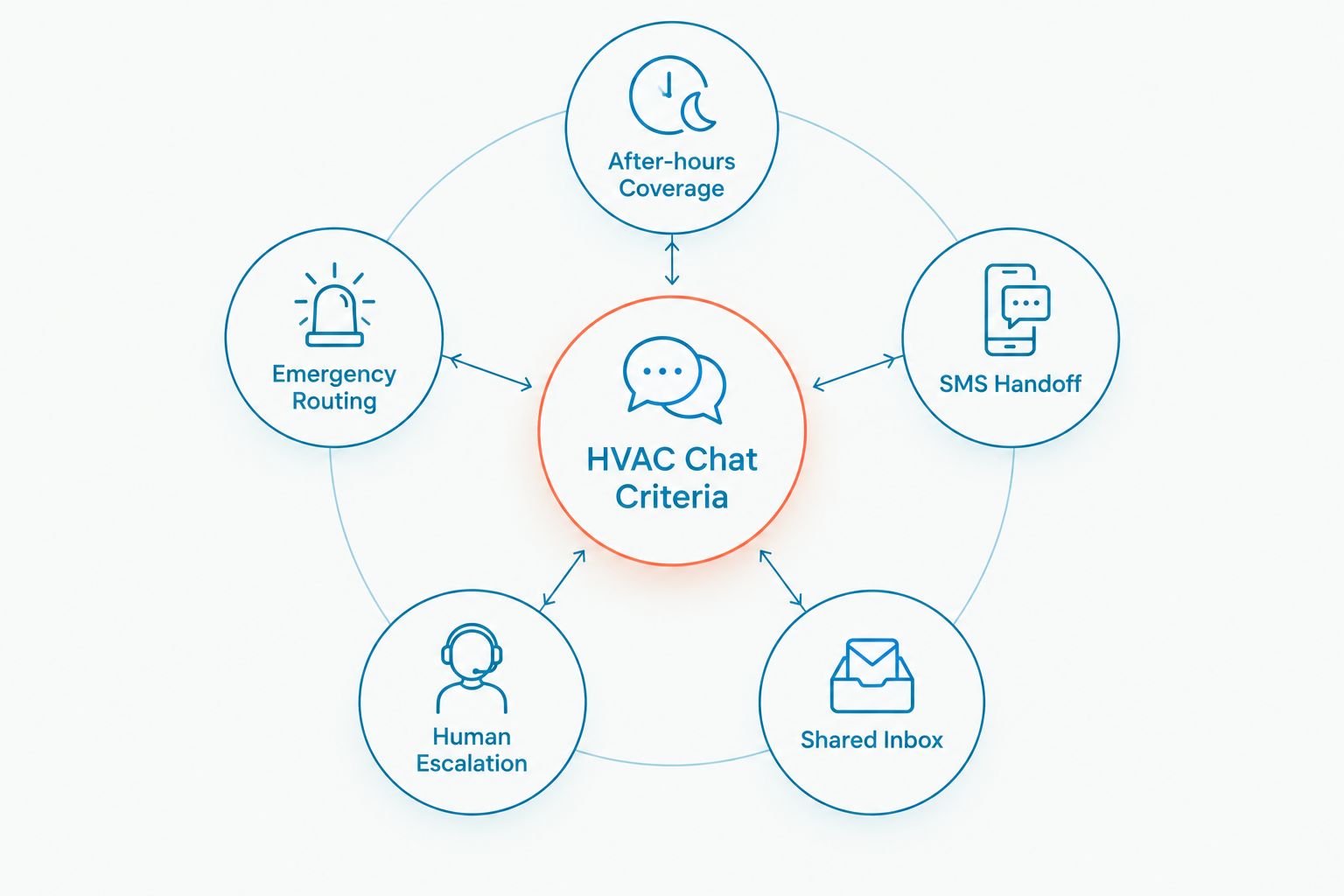
What makes the best AI chatbot for HVAC company websites
- Answers after-hours and weekend messages without forcing the visitor through a phone menu.
- Routes emergencies differently than routine requests — a no-heat call in January isn't a maintenance reminder.
- Combines webchat with SMS so a conversation that starts on your site continues as a text after the visitor closes the tab.
- Escalates to a real person when the AI hits a question it can't answer or the customer pushes back.
- Lands in one shared inbox the whole dispatch team can see, not a single tech's personal phone.
- Sets up in an afternoon, not a multi-week rollout.
Best AI chatbots for HVAC company websites at a glance
| Tool | Best for | Standout feature | Key limitation |
|---|---|---|---|
| VirtualText by VirtualPBX | After-hours lead capture for home service teams | Webchat, SMS, and an AI agent in one shared inbox | Not a phone system replacement; the agent needs scripting before launch |
| Podium | Multi-location HVAC franchises | Review generation tied to messaging | Reviews-first design; more than a single-location shop usually needs |
| Birdeye | Reputation-driven marketing teams | Webchat linked to review campaigns and local SEO | Chat sits inside a reputation suite, not the core product |
| Generic chatbot builders (Tidio, Intercom-style) | Budget test before committing | Fast to install on any website | Not built for HVAC intake; escalation to a human is often manual |
| ServiceTitan native messaging | Shops already running ServiceTitan | Messages stay tied to the job and invoice | Only useful if you're already a ServiceTitan customer |
1. VirtualText by VirtualPBX: best AI chatbot for HVAC after-hours lead capture
VirtualText, from VirtualPBX, is a texting and webchat platform built for small service teams — the same category HVAC companies sit in alongside plumbers, electricians, and other home service contractors. It puts SMS, website chat, a shared team inbox, and an AI agent into one system, so a lead who starts on your site and later texts your business number shows up in the same conversation thread.
The AI agent is built to catch the questions that come in outside business hours — do you service my area, what's your typical response time for a no-heat call — and pass anything it can't answer to a live team member.
VirtualText pros:
- Combines webchat and SMS in a shared inbox, so no lead gets stuck in a chat window nobody reopens.
- Built specifically for small service teams, not a repurposed enterprise help desk tool.
- The AI agent handles after-hours and website lead response, then escalates to a person.
VirtualText cons:
- It's a texting and chat platform, not a phone system — you still need separate coverage for inbound calls.
- The AI agent needs a written script before it handles nuanced emergency-versus-routine questions well.
- Best fit is one dispatch team working from a single shared inbox; very large multi-call-center operations may need more custom routing.
VirtualText is best for: HVAC companies missing leads outside business hours that want texting, webchat, and AI response combined in one place.
Verdict: Buy — for most HVAC companies handling their own website leads, this is the direct fit. A missed-call text-back tool built for HVAC companies covers the phone side of the same problem.
2. Podium: best for multi-location review-driven HVAC franchises
Podium is a widely used messaging and review-management platform among local service businesses, combining webchat with text-based follow-up and review requests.
Podium pros:
- Strong review-generation workflow tied directly to customer messaging.
- Familiar to multi-location brands managing many storefronts or service areas from one dashboard.
- Webchat and texting live in the same conversation thread.
Podium cons:
- Built around reviews first; chat is secondary to that core use case.
- More platform than a single-location HVAC shop usually needs.
Podium is best for: HVAC franchises with multiple locations that already run review campaigns and want messaging folded into the same tool.
Verdict: Hold — worth evaluating if reputation management across locations is already a priority; overkill for a single truck.
3. Birdeye: best for reputation-focused HVAC marketing teams
Birdeye pairs webchat with reputation management and local SEO tools, positioned close to Podium for local service brands.
Birdeye pros:
- Webchat ties directly into review and local search campaigns.
- Useful for marketing teams tracking reputation across many local listings.
Birdeye cons:
- Chat is one feature inside a larger reputation suite, not the main product.
- Overlaps with tools you may already run if reputation isn't your bottleneck.
Birdeye is best for: HVAC marketing teams that already prioritize review generation and want chat bundled in.
Verdict: Hold — good only if reputation management is the primary goal, not lead capture.
4. Generic AI chatbot builders: best budget option to test chat before committing
Generic chatbot builders like Tidio or Intercom-style widgets install on almost any website in minutes and use scripted or AI-driven responses to greet visitors.
Generic chatbot builder pros:
- Fast to add to a website with no HVAC-specific setup required.
- Low commitment for a single-truck contractor who wants to test whether chat helps at all.
Generic chatbot builder cons:
- Not built to distinguish an emergency HVAC call from a routine maintenance question.
- Escalation to a live person is often manual, not automatic.
- No native tie to SMS follow-up once the visitor leaves the site.
Generic chatbot builders are best for: A solo HVAC contractor testing whether website chat converts before investing in a dedicated platform.
Verdict: Wait — fine as a trial, but plan to move to a purpose-built tool once chat proves it converts.
5. ServiceTitan native messaging: best for HVAC shops already running ServiceTitan
ServiceTitan is field service management software widely used by HVAC, plumbing, and electrical companies to schedule jobs, dispatch technicians, and handle invoicing. Its built-in customer communication features keep messages tied to the job record.
ServiceTitan messaging pros:
- Messages stay connected to the job and invoice already in the system.
- No new platform to learn if your team already works in ServiceTitan daily.
ServiceTitan messaging cons:
- Only available if you're already a ServiceTitan customer — not a standalone chat option.
- Messaging is secondary to dispatch software, not built primarily for website chat.
ServiceTitan messaging is best for: HVAC companies already running scheduling, dispatch, and invoicing through ServiceTitan that want messaging in the same system.
Verdict: Hold — only makes sense as an add-on to a platform you're already paying for.
How we ranked these HVAC chatbot tools
Each tool was measured against the criteria above: after-hours coverage, emergency-versus-routine routing, SMS-and-webchat combination, human escalation, shared inbox visibility, and setup speed. Tools built specifically for home service teams — texting-and-chat platforms and field service software with native messaging — ranked ahead of generic chatbot builders that treat an HVAC company the same as an online store.
“If a chat widget can't tell a no-heat call from a routine tune-up reminder, it's costing your dispatcher time, not saving it.”
Which AI chatbot should you choose for your HVAC website?
If you're a single-location or two-truck HVAC company missing leads outside an 8-to-5 window, VirtualText by VirtualPBX is the direct pick in 2026 — it combines webchat, SMS, a shared inbox, and an AI agent built for home service response, not retail. If you're a multi-location franchise already investing in review generation, Podium or Birdeye fold chat into that same workflow. If you're fully running dispatch and invoicing through ServiceTitan, start with its native messaging before adding another tool. Skip generic chatbot builders past the trial stage — HVAC callers ask questions a retail-focused bot isn't scripted for.
See VirtualText for HVAC teams
One shared inbox for webchat, texting, and AI response.
FAQ
What's the best AI chatbot for HVAC company websites in 2026?
VirtualText by VirtualPBX is the best overall pick for most HVAC companies in 2026 because it combines webchat, SMS, a shared inbox, and an AI agent built for home service lead response. Multi-location franchises focused on reviews may prefer Podium or Birdeye instead.
Is an AI chatbot better than a phone tree for HVAC calls?
Yes, for after-hours and website leads — a chatbot answers instantly and can text back, while a phone tree makes a caller wait or hang up. Voice calls during business hours still need a person or a phone system, not just chat.
How much does an AI chatbot for a home services website cost?
Pricing varies by platform, by number of locations, and by what's bundled in with reviews or dispatch software. Check current pricing directly on each provider's site before comparing.
Can an AI chatbot tell the difference between an emergency HVAC call and routine maintenance?
Only if it's scripted to ask the right qualifying questions and routes urgent answers to a live person immediately. Generic chatbot builders rarely do this out of the box; purpose-built home service tools are scripted for it.
Does an AI chatbot replace my HVAC dispatcher?
No. The AI agent handles routine questions and after-hours capture, then hands the conversation to a real dispatcher for booking and anything it can't answer.
Should a single-truck HVAC contractor use the same chatbot as a multi-location franchise?
No. A solo contractor can test with a generic chatbot builder first, while a multi-location franchise generally needs a platform built around messaging plus reviews or dispatch data.
Can website chat and text messaging share the same inbox?
Yes. Platforms like VirtualText combine SMS and webchat into one shared inbox so a conversation started on the site continues by text after the visitor leaves.
What happens if the AI chatbot can't answer a customer's HVAC question?
A well-built chatbot escalates the conversation to a live team member instead of leaving the customer stuck with an unhelpful answer. This escalation step is the difference between a chat lead and a lost lead.
One last thing
Answering the question correctly isn't the finish line — booking the job is. A chatbot that tells a homeowner "yes, we install heat pumps" but never moves toward a scheduled appointment still loses the lead to whoever texts back with a time slot. In 2026, the HVAC companies converting the most website chats are the ones treating the AI agent as the first step in booking, not the whole job.


