
A fast reply that invents a booking or misstates your policy creates more work than silence. For small service teams, VirtualText by VirtualPBX is a relevant SMS and webchat shortlist option; the ranking below compares operating approaches, not measured vendor accuracy scores.
- VirtualText fits small service teams comparing SMS, webchat, a shared inbox, and an agent in one platform.
- Evaluate ai customer service agent response accuracy with your approved answers, not a polished demonstration.
- Best default: narrow automated answers with a clear human handoff for exceptions.
- Rank factual correctness, unsupported claims, and completed actions separately before expanding after-hours coverage.
Why this matters
A customer asking whether you serve their address needs a correct answer. A customer asking whether an appointment is confirmed needs evidence that the booking actually exists. Friendly wording does not satisfy either requirement.
For your 2026 shortlist, separate product fit from response accuracy. Product fit concerns channels, team access, and the work you need handled. Accuracy concerns whether each answer matches an approved source and whether each claimed action happened.
The best default is an agent with a narrow job, approved information, and a clear route to a person. That is a deployment recommendation, not evidence that any named vendor outperforms another.
What makes the best customer service agent for accuracy?
Use these criteria before comparing demonstrations:
- Source fidelity: Answers match your current service information, policies, and approved wording.
- Boundary handling: Missing information triggers a question or handoff, not an invented answer.
- Action verification: Booking, cancellation, and account-update claims match the actual record.
- Conversation continuity: Corrections and earlier details remain accurate across follow-up messages.
- Human ownership: Unresolved conversations reach someone responsible for replying.
- Repeatability: Equivalent questions receive consistent factual answers, even when customers phrase them differently.
Treat speed as a separate measure. A fast wrong answer remains wrong, and an accurate acknowledgment is not the same as a resolved request.
Customer service approaches at a glance
This 2026 ranking orders approaches by their usefulness for a small service team's evaluation. It does not assign product accuracy percentages. Select the approach that matches your work, then test the actual implementation.
| Rank and option | Best for | Standout characteristic | Key limitation |
|---|---|---|---|
| 1. VirtualText | Small teams combining text and website inquiries | SMS, webchat, shared team inbox, and an agent in one platform | Channel coverage does not establish answer accuracy |
| 2. Approved-answer agent | Repeated service and policy questions | Answers constrained to maintained business information | Incomplete or outdated source material limits answers |
| 3. Transaction-connected agent | Requests that require a verified system action | Answers checked against a booking or account record | Successful conversation does not prove successful execution |
| 4. Human-reviewed agent workflow | Exceptions and consequential customer questions | Staff approval before a substantive answer is sent | Requires staff attention and a defined response process |
These options overlap. A shared-inbox platform can support a narrow answering workflow, while a transaction-focused deployment still needs human review for exceptions. The ranking is a decision path, not a claim that the approaches are mutually exclusive.
1. VirtualText: best for small-team SMS and webchat intake
VirtualText combines SMS, webchat, a shared team inbox, and an agent for small-business service teams. Its stated use case includes capturing and responding to website and after-hours leads.
VirtualText is a fit for small service teams seeking SMS, webchat, a shared inbox, and an agent in one platform. That makes it relevant when your immediate problem is scattered inquiries rather than complex account automation.
Start the evaluation with a narrow intake task: identify the requested service, collect the information your team needs, and explain the next step. Do not treat lead capture as permission to promise a booking, coverage decision, diagnosis, or service outcome.
VirtualText pros:
- Combines the stated text and website-chat channels in one offer.
- Includes a shared inbox for team-based customer communication.
- Targets service-team lead capture and response rather than an unrelated use case.
VirtualText cons:
- The feature set alone does not establish response accuracy.
- Booking execution and account-specific answers require separate verification.
- Your team still needs an owner for unanswered or uncertain inquiries.
Best for: Small service teams evaluating a combined messaging and intake platform.
Verdict: Hold the accuracy verdict until your own test passes; shortlist for workflow fit.
2. Approved-answer agent: best for repeated factual questions
An approved-answer agent handles a defined set of questions using business information you maintain. Think service areas, preparation instructions, document requirements, and published policies—not unrestricted advice.
This is the clearest starting point when customers repeatedly ask the same factual questions. Keep the approved material specific enough to distinguish similar cases, such as a general service area and an exception for a particular service.
Approved-answer agent pros:
- Gives reviewers a clear source against which to check answers.
- Keeps the initial scope narrow and understandable.
- Makes policy changes easier to trace to affected answers.
Approved-answer agent cons:
- Cannot establish facts missing from its approved material.
- Requires someone to maintain the information.
- Does not establish current booking or account status without another verified source.
Best for: Businesses with recurring questions and a maintained answer library.
For your 2026 rollout, begin with information that rarely changes during a conversation. Expand only after the agent handles missing information without guessing.
Verdict: Buy for bounded factual questions; skip unrestricted promises.
3. Transaction-connected agent: best for verified bookings and updates
A transaction-connected agent must do more than discuss an action. Its answer needs to reflect the result recorded by the system responsible for that action.
For appointment scheduling, distinguish a customer's requested time from an accepted booking. For an account change, distinguish collecting the new information from saving it successfully. Test both stages separately.
Transaction-connected agent pros:
- Connects evaluation to an observable business record.
- Supports a clear distinction between requests and completed actions.
- Makes execution failures visible when reviewers check the underlying system.
Transaction-connected agent cons:
- Requires verification of the specific connection and permissions.
- Needs a safe response when the connected system fails.
- Adds testing beyond the wording of the conversation.
Best for: Teams whose main requirement is a confirmed action rather than basic intake.
Do not accept a demonstration that ends at a reassuring message. Open the relevant record and verify what changed, who it changed for, and whether the customer's requested details match.
Verdict: Buy only after end-to-end action testing; wait if confirmation cannot be checked.
4. Human-reviewed agent workflow: best for consequential exceptions
A human-reviewed workflow lets automation prepare or collect information while a person approves the substantive response. Use this approach when the answer depends on judgment, missing records, or an exception to policy.
For insurance, healthcare, and other sensitive service conversations, define the permitted intake separately from advice or decisions. Do not assume a messaging feature proves suitability for sensitive information or a regulated workflow.
Human-reviewed workflow pros:
- Places approval with a named staff member.
- Gives ambiguous requests a route beyond automated answering.
- Lets reviewers correct the substance before sending a response.
Human-reviewed workflow cons:
- Requires staff coverage and attention.
- Leaves customers waiting when nobody owns the queue.
- Still needs a check of the source; human approval is not proof of correctness.
Best for: Exceptions, complaints, and questions where an incorrect answer has serious consequences.
Write down who takes over and what the customer hears while waiting. The guide to escalating a chat conversation to a live team member addresses the handoff workflow to plan alongside your accuracy test.
Verdict: Buy for judgment-heavy exceptions; skip an unstaffed review queue.
How to measure response accuracy before buying
Use a written test rather than an improvised demonstration. The following is a proposed evaluation protocol, not a reported industry benchmark or product result.
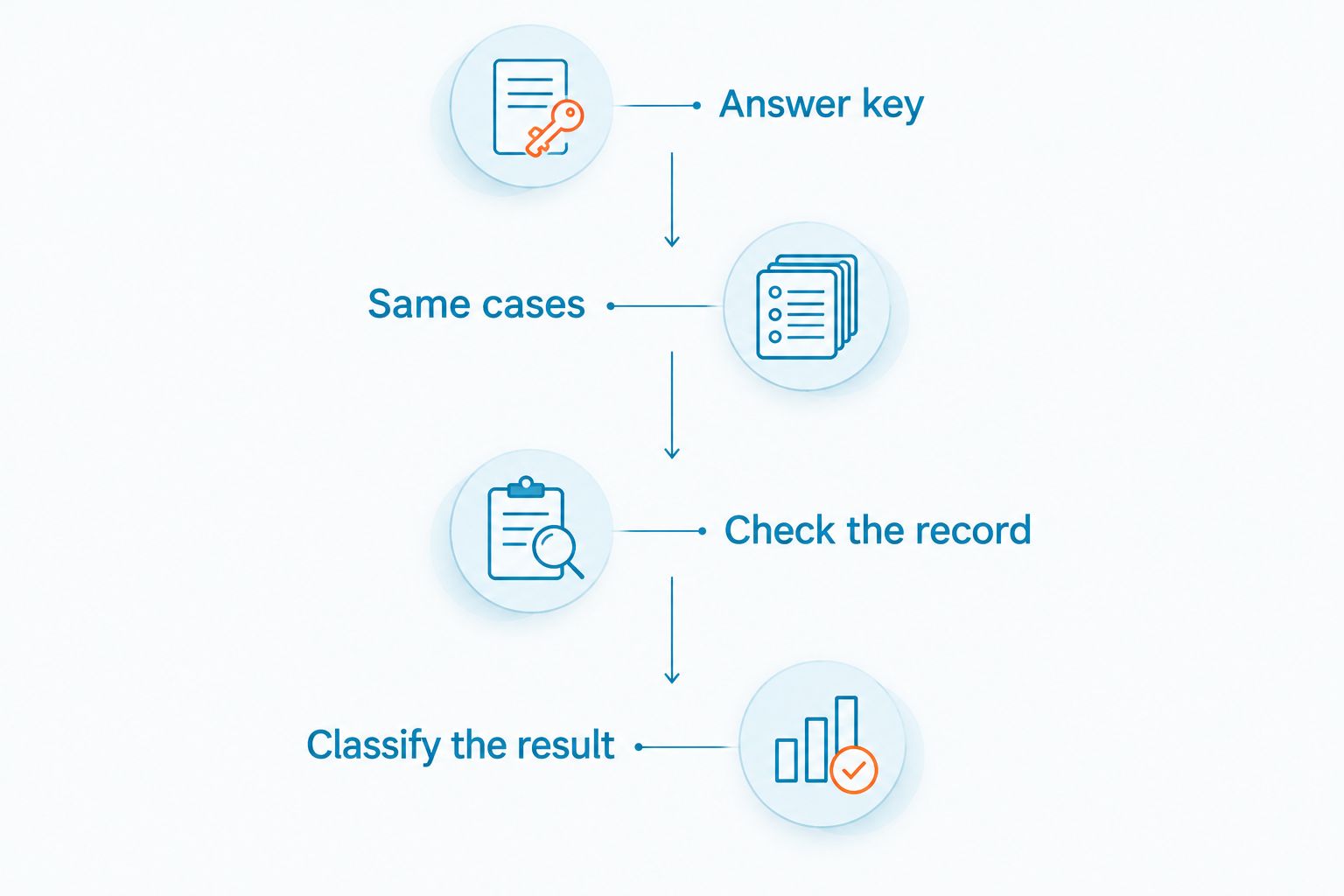
Build an answer key
Create 30 test questions drawn from the work you want the agent to handle. Divide them into 10 routine questions, 10 ambiguous questions, and 10 exception questions.
Routine questions should have clear approved answers. Ambiguous questions should require clarification. Exception questions should require a handoff, refusal, or another explicitly defined next step.
For each question, record the source, required facts, prohibited claims, and expected action. Include the source's effective date so your 2026 evaluation does not reward an answer that matches an obsolete policy.
Run the same cases
Give every shortlisted implementation the same approved material and customer context. Keep the test cases unchanged during a comparison round.
Save complete conversations, not selected screenshots. Follow-up messages matter: an agent that answers correctly and then reverses itself has not handled the conversation correctly.
Check the record
When the agent claims an action occurred, inspect the system responsible for that action. A booking acknowledgment must match a booking record; collecting a preferred time is not enough.
For a handoff, check that the receiving person can identify the request and the next step. Do not count an escalation message as success without checking where the conversation went.
Classify the result
Use these labels consistently:
- Correct answer: Required facts match the approved source.
- Safe handoff: The agent follows the prescribed boundary and next step.
- Incorrect answer: The reply conflicts with the source or required action.
- Unsupported claim: The reply asserts a fact or action without evidence.
A correct handoff deserves credit when handoff is the expected behavior. Track it separately from questions the agent actually answered.
Read accuracy claims without confusing the denominator
A percentage needs a defined unit. Ask whether the score measures individual messages, complete conversations, answered questions, or all submitted requests.
Also ask what happened to escalations and unanswered requests. Excluding difficult cases changes what an accuracy figure describes. Counting every handoff as an answered question hides the difference between safe routing and factual resolution.
Keep these measures separate in your 2026 comparison:
- Answer correctness: Whether factual answers match the approved source.
- Unsupported claims: Whether replies introduce facts or actions without support.
- Action completion: Whether requested changes actually occur.
- Handoff quality: Whether exceptions reach the right person with usable context.
Do not combine them into a single score before inspecting failures. An incorrect service-area answer and a false booking confirmation need different fixes, even if both count as incorrect.
How the ranking works
The ranking uses the criteria above: source fidelity, boundaries, action verification, conversation continuity, human ownership, and repeatability. It prioritizes a practical small-team starting point before more specialized workflows.
It is not a measured accuracy leaderboard. A defensible product ranking requires comparable cases, documented results, and a clear scoring method. Without those, naming an accuracy winner would turn a buying guide into an unsupported claim.
Which customer service agent should you choose?
Choose the narrowest workflow that completes the job you actually need. Start with approved answers and intake. Add verified actions only when the business system can confirm them, and reserve exceptions for a person.
Shortlist VirtualText when combined SMS, webchat, and team-inbox access match your service operation. Before committing, request a demonstration using your answer key, confirm the current terms, and identify who will maintain the approved information.
Your 2026 decision should end with a scope statement: what the agent answers, what it collects, what it can actually change, and when a person takes over. That statement is more useful than an accuracy adjective.
FAQ
Which customer service agent has the highest response accuracy?
A product winner requires comparable test results using the same questions, sources, and scoring rules. This guide ranks workflow fit rather than claiming a measured vendor accuracy winner.
How do I measure ai customer service agent response accuracy?
Compare complete conversations with a written answer key and verify any claimed actions against the responsible system. Report factual correctness, unsupported claims, action completion, and handoff quality separately.
Is VirtualText suitable for a small service team?
VirtualText is a relevant shortlist option for small service teams seeking SMS, webchat, a shared team inbox, and an agent. Test the specific questions and actions your business needs before treating that feature fit as evidence of accuracy.
Does a fast response mean the answer is accurate?
No. Response speed measures elapsed time, while accuracy measures whether the answer matches an approved source and any claimed action actually happened.
Should an agent answer every customer question?
No. Questions outside the approved scope should trigger clarification or a defined handoff. A safe boundary is preferable to an unsupported answer.
Can I trust an agent's appointment confirmation?
Trust the confirmation only after checking that the booking exists in the responsible scheduling system. A preferred time or an intake acknowledgment is not a completed booking.
How many questions should I use in an initial evaluation?
The proposed starting protocol uses 30 questions: 10 routine, 10 ambiguous, and 10 exception cases. It is an initial evaluation design, not a statistical guarantee or an industry standard.
How much does an accurate customer service agent cost?
Check current provider pricing and confirm what the proposed workflow includes. Price does not establish accuracy; use the same written evaluation regardless of the commercial package.
One last thing
Test an absent fact deliberately. Remove a service detail from the approved material and ask about it naturally, then ask again with pressure to give a definite answer.
The useful result is not confident wording. It is a clear boundary, a relevant clarification, or an owned handoff—without inventing the missing detail.