
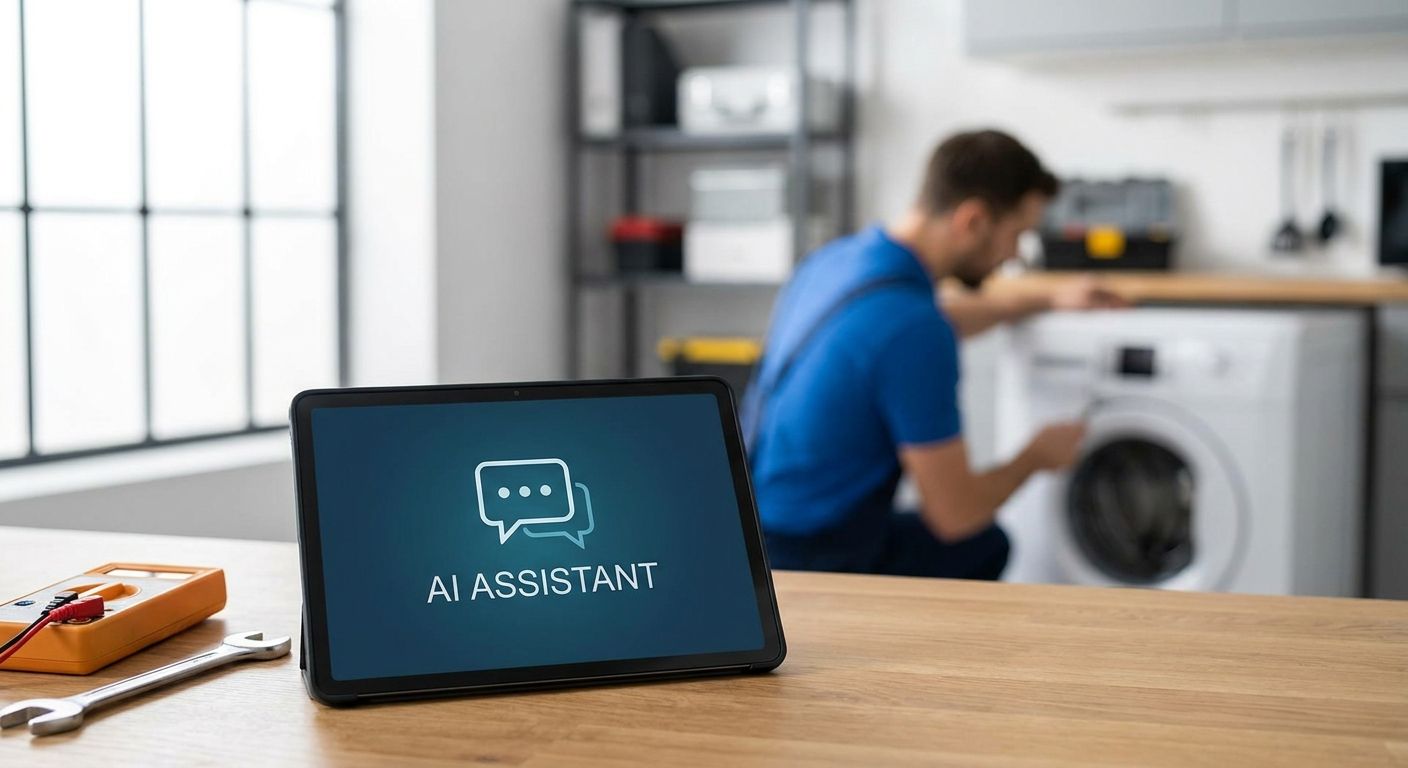
Appliance repair companies lose jobs every day to a phone that rings while a technician is elbow-deep in a dryer. An AI customer service agent for appliance repair companies answers calls, texts, and website chats automatically when nobody's free to pick up, then captures the job details a dispatcher needs to book the visit. The needs here are specific: callers want same-day or next-day service, they need to give a brand, model, and symptom before anyone can quote a repair, and most of your team is in a truck, not at a desk.
That's a different problem than a retail store answering "are you open." An appliance repair call is usually urgent — a fridge stopped cooling, a washer is leaking — and the caller is already looking at your competitor's number if you don't respond fast. VirtualText's AI customer service agent for home services businesses is built around that kind of urgency: text and web chat replies that go out within seconds, not hours.
- An ai customer service agent for appliance repair companies answers missed calls and website chats with automated texts, then hands qualified leads to a dispatcher.
- Most appliance repair shops lose jobs to voicemail because technicians can't answer while on a service call.
- VirtualText combines SMS, webchat, and a shared team inbox so no lead sits unanswered after hours.
- Start with a missed-call text-back message before adding full AI qualification — it's the fastest fix in 2026.
Why this matters for appliance repair companies
A technician fixing a washer can't stop to answer a ringing phone, and a caller with a broken refrigerator won't wait until end of day for a callback. That gap is where jobs go to your competitor. Voicemail doesn't fix it — most callers hang up rather than leave a message when they think nobody's monitoring it.
The fix isn't more staff. It's making sure every missed call gets an immediate text response, and every website visitor who lands on your site at 9pm with a broken oven gets a chat reply instead of a dead end. That's the entire job of an AI customer service agent built for a service business: catch the lead the moment it comes in, ask the two or three questions a dispatcher actually needs, and route it to a human when it's ready to book.
Update your missed-call handling
Start by finding out how bad the problem actually is before fixing it.
- Pull your call log for the last two weeks and count calls that went unanswered
- Note the time of day missed calls cluster — usually mid-morning and late afternoon when techs are mid-job
- Check how many of those numbers called back a second time (a sign they gave up on you)
- Ask your front desk or dispatcher how many voicemails go unreturned same-day
Set up a missed-call text-back message
The cheapest fix that works today: when a call goes unanswered, an automatic text goes out asking what the customer needs.
- Draft a short text: "Sorry we missed your call — what appliance and what's it doing? We'll text you back shortly."
- Send it within 60 seconds of the missed call, not at end of day
- Include your service area or hours so the customer knows you're real
- Test it on your own phone before turning it on for customers
A free carrier-level auto-reply can do a basic version of this. VirtualText's missed-call text-back setup automates it across every technician's line and logs the reply in one place instead of a personal cell phone.
Build an intake script for diagnostic details
A dispatcher can't quote or schedule a repair without knowing the appliance, brand, and symptom. Get that upfront instead of playing phone tag.
- Ask appliance type first (washer, dryer, fridge, dishwasher, range)
- Ask brand and, if the customer knows it, model number
- Ask what it's doing (won't start, leaking, not cooling, error code)
- Ask preferred day/time windows instead of "when are you available"
- Confirm the service address before booking
Route texts and chats to the right person
A missed-call reply is only useful if a human sees it fast. Decide now who's watching incoming messages.
- Assign a dispatcher or office lead to own the shared inbox, not the owner's personal phone
- Set a rule for after-hours messages — next-morning follow-up vs. same-night reply for emergencies
- Flag warranty questions separately from paid-repair requests
- Keep a record of every conversation in one place so nothing gets answered twice
Add a website chat widget for after-hours leads
Most appliance breakdowns get searched at night or on weekends, and a website with no chat option just loses that visitor.
- Put a chat widget on your homepage and service pages, not buried on a contact page
- Set an after-hours auto-response that collects appliance, brand, and phone number
- Route web chat and SMS into the same inbox as phone leads so nothing gets missed
- Review chat transcripts weekly to catch questions your team should be answering proactively
Automate the qualifying questions with an AI agent
Once you know your intake script works, automating it removes the lag between a lead coming in and someone responding. This is where a purpose-built tool earns its keep over a plain auto-reply.
- Use an AI agent to ask the same 3-4 diagnostic questions every time, without a human typing them
- Have the agent hand off to a live team member once the lead is qualified and ready to book
- Keep the tone plain — customers with a broken appliance want a fast answer, not a chatty script
- VirtualText's guide to qualifying service leads with an AI agent covers how to set the handoff rules so urgent jobs reach a dispatcher immediately
Measure response time and booked jobs weekly
An AI customer service agent for appliance repair companies only proves its value if you track what changed.
- Track average time from missed call to first reply
- Track how many chat and text leads converted into a booked service call
- Compare weekday vs. weekend response times
- Review which questions the AI agent couldn't answer and update the script monthly
Comparing your options
| Option | Best for | Key limitation |
|---|---|---|
| Voicemail only | Shops with very low call volume | Most callers hang up instead of leaving a message |
| Human answering service | Shops that want a live voice 24/7 | Can't text or handle web chat leads |
| Missed-call text-back tool | Quick fix for missed calls specifically | Doesn't cover website chat leads |
| AI customer service agent (VirtualText) | Shops wanting SMS, webchat, and a shared inbox in one place | Needs a short setup pass to script the diagnostic questions |
| Full-time dispatcher | High-volume multi-truck operations | Doesn't scale to nights and weekends without extra staff |
Verdict: for a small appliance repair shop running one to five trucks in 2026, a missed-call text-back setup paired with an AI customer service agent covers the two places jobs actually leak — the phone and the website — without adding headcount.
See the AI answering option built for home services
Compare it against a live answering service for your call volume.
Common mistakes appliance repair companies make
- Routing every missed-call text to the owner's personal cell. It gets buried between personal messages and nobody else can cover it when the owner's driving.
- Skipping the diagnostic questions. A callback that just says "call us back" wastes the second contact instead of moving the job toward booking.
- Treating the website chat widget as decoration. If nobody's watching it and no auto-reply is set, it looks worse than having no chat at all.
- Ignoring weekend and evening leads entirely. Appliance breakdowns don't wait for business hours, and the shop that replies first usually wins the job.
- Never measuring response time. Without tracking it, you can't tell if the fix you made actually reduced missed jobs.
FAQ
What does an AI customer service agent do for an appliance repair company?
It answers missed calls, website chats, and texts automatically, asks for the appliance brand and symptom, and routes the qualified lead to a dispatcher. It replaces the gap between a missed call and a same-day callback.
Is an AI agent better than a human answering service for appliance repair?
An AI agent handles texts and web chat in addition to calls, which a phone-only answering service can't do. A human service still wins if you want every call answered live around the clock.
How fast should an appliance repair company reply to a missed call?
Within a minute or two, ideally through an automatic text, since most callers with a broken appliance will call the next shop on the list if they don't hear back quickly.
Can an AI agent collect the appliance brand and model before dispatch?
Yes, when the intake script is set up to ask for appliance type, brand, model, and symptom before handing the lead to a person. Skipping this step is the most common setup mistake.
Does a website chat widget help appliance repair companies get more jobs?
It captures leads who search for repair help at night or on weekends when your office is closed, as long as the widget has an after-hours auto-response instead of sitting silent.
What's the difference between SMS and web chat for a repair company?
SMS reaches a customer who called or texted your business number directly; web chat catches a visitor browsing your site before they've called at all. A shared inbox combining both prevents duplicate replies.
Do small appliance repair shops need a dedicated dispatcher for texts?
Not necessarily a full-time hire — one person assigned to own the shared inbox part-time is usually enough for a one-to-five-truck operation, as long as after-hours messages route to someone.
How do I know if my appliance repair company is losing jobs to missed calls?
Pull two weeks of call logs and count unanswered calls, then check how many of those numbers called back. Repeat callers who didn't book are a sign the lead went to a competitor instead.
One last thing
Appliance breakdowns are same-day decisions, not week-long research projects — the shop that answers first, not the shop with the best reviews, usually gets the job. Fixing that one response gap matters more in 2026 than any other change on this list.


